
The Trump administration has held confidential meetings with representatives of a marginal separatist movement in Alberta, the Canadian province rich in oil, against the backdrop of deteriorating relations between the United States and Canada.
The discussions took place in Washington and reveal the increasingly visible tensions between the White House and the federal government in Ottawa, led by Mark Carney, notes Financial Times.
Separatists seeking massive financial support from Washington
Leaders of the Alberta Prosperity Project (APP), a far-right group advocating for Alberta's separation from Canada, have met three times since last April with officials from the U.S. State Department, according to sources familiar with the discussions cited by FT.
The APP representatives are now trying to secure a new round of meetings next month, including with officials from the U.S. Treasury.
According to the same sources, the separatists plan to request a $500 billion line of credit to finance the province if a referendum for independence - which has not yet been called - were to be approved.
"The U.S. is extremely excited about a free and independent Alberta," said Jeff Rath, legal advisor to the APP, who attended the meetings, told Financial Times. He claimed to have a "much stronger" relationship with the Trump administration than the Canadian Prime Minister.
No official commitments made: "No commitments were made"
American authorities, however, downplayed the significance of the discussions. A State Department spokesperson stated that the institution "regularly meets with representatives of civil society" and that, "as is typical for such routine meetings, no commitments were made."
A White House official conveyed a similar message, emphasizing that "administration officials meet with numerous civil society groups" and that "no support was conveyed and no other commitments were made."
U.S. Treasury denies discussion of a line of credit
A person familiar with the position of Treasury Secretary Scott Bessent stated that neither he nor other officials from the institution were aware of any proposal regarding a line of credit and had no intention of engaging in such a discussion. According to the same source, no senior Treasury official had received a meeting request.
The U.S. Treasury declined to comment officially, and a spokesperson for Carney also declined to offer a viewpoint.
Increasingly tense relations between the U.S. and Canada
The contacts with separatists from Alberta come at a time of deteriorating relations between Washington and Ottawa.
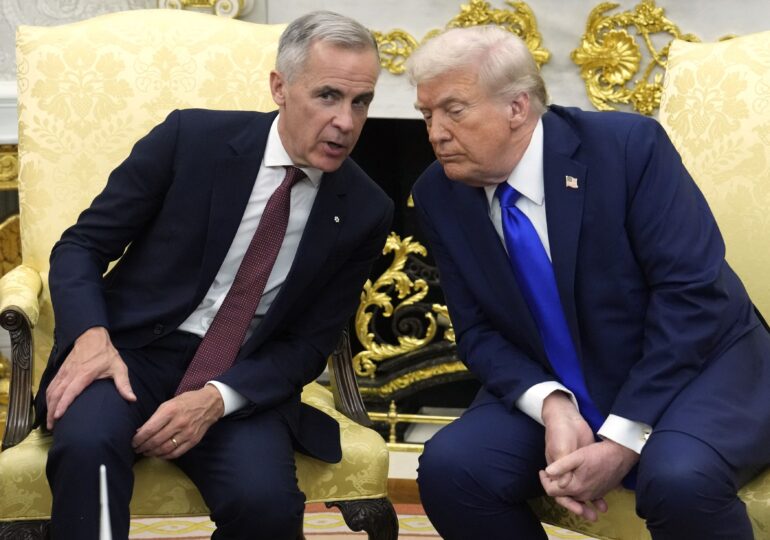
President Donald Trump and Prime Minister Mark Carney had a heated exchange of remarks last week after the Canadian Prime Minister accused the U.S. of causing a "rupture" in the global order.
Sources familiar with the American position suggest that it is unlikely for the United States to provide material support to the separatist movement.
However, the mere existence of these discussions highlights the high level of tension between the Trump administration and the Canadian federal government.
"Americans are happy to turn Canadians against each other"
Carlo Dade, an analyst at the Canada West Foundation, a conservative think tank in Calgary, described the separatist leaders as "attention seekers." "Americans are more than happy to continue to turn Canadians against each other," he said.
Recent statements by Bessent, however, have fueled enthusiasm among separatists. The Treasury Secretary described Alberta, the largest individual source of foreign oil for the U.S. market, as "a natural partner for the U.S."
"Albertans are very independent people. There is a rumor that they may have a referendum on whether to remain in Canada or not," Bessent told Jack Posobiec, host of a podcast known for right-wing views.
Alberta, between closer ties with the U.S. and remaining in Canada
According to a source close to Bessent's position, he neither supports nor opposes the separatist movement but perceives Carney as pursuing a personal agenda at the expense of Alberta. He referenced Carney's past in climate policy. At the same time, Bessent believes that Alberta could deepen its relations with the U.S. without leaving Canada.
Carney, who grew up in Edmonton, the provincial capital, hails from Alberta itself. The province, with approximately 5 million residents, has had a modest pro-independence movement for decades, with roots dating back over 150 years.
Polls and fears regarding foreign interference
A recent Ipsos poll shows that about three in ten residents of Alberta and Quebec would vote for their province to separate from Canada. However, unlike Quebec, the separatist movement in Alberta has never had widespread support.
APP is trying to gather 177,000 signatures to bring a petition for independence to the provincial legislature by May, but has refused to disclose how many signatures it has collected so far.
Discussions with American officials fuel concerns about foreign interference in Canada's domestic politics. "We see evidence of foreign interference," said Gil McGowan, president of the Alberta Federation of Labour, citing campaigns on social media, the use of online bots, and the involvement of MAGA influencers.
Federal government and provincial premier reject independence idea
The federal government in Ottawa has stated that Alberta remains "an essential partner within the Canadian federation" and that the Canada-Alberta relationship is being renewed "based on common objectives and mutual respect for each other's competencies."
Alberta's provincial premier, Danielle Smith, who last year lowered the threshold for organizing a referendum, strongly opposes independence. "The vast majority of Alberta residents are not interested in becoming an American state," her spokesperson conveyed.
Meanwhile, the Alberta Forever Canada campaign, which opposes separation, has gathered 438,568 signatures by the deadline last December.
G.P.