
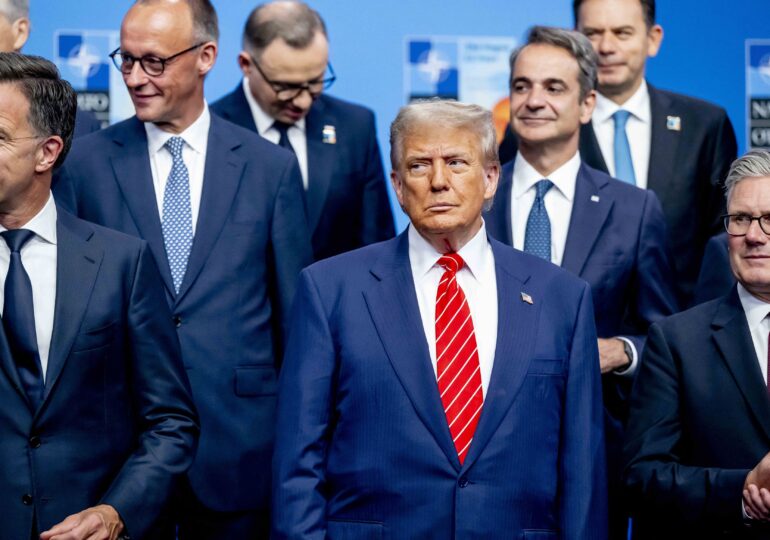
After months of cautious probing, diplomatic formulas, and visible efforts to not antagonize Donald Trump, European leaders seem to have reached a common conclusion: there comes a moment when „no” becomes inevitable.
Faced with the territorial claims of the American president and his explicit disdain for international law, Europeans have started to respond more coordinated and firmly, abandoning the reflex of flattering him or constantly seeking a compromise.
An analysis published by Associated Press shows how the threats related to Greenland acted as a catalyst for this change in attitude.
No more servile praises. No more polite solutions and old-fashioned diplomacy. And no one calls Donald Trump "daddy" anymore, writes AP.
Trump's promise to take over Greenland and punish any country opposing it seems to have been a turning point.
The "red lines" were considered crossed this year when Trump suddenly revived his demand for the United States to "absolutely" own Greenland, the semi-autonomous region that is part of Denmark, a NATO ally. This even prompted the most cautious diplomats to issue stern warnings about Trump, whom they had previously flattered with royal treatment and servile praise.
"The United Kingdom will not give up" its support for Greenland's sovereignty, said British Prime Minister Keir Starmer. Additionally, several leaders of the continent emphasized that "Europe will not be blackmailed" regarding Greenland.
"Threats have no place among allies," said Norwegian Prime Minister Jonas Gahr Støre.
The tough diplomatic discussions surrounding last week's confrontation in Davos, Switzerland, were not the only pressure factor on Trump. The U.S. Congressional elections are approaching in November, amidst a declining stock market and approval ratings.
European leaders are not the first to stand in Trump's way during his second term – there's also Federal Reserve Chairman Jerome Powell.
But the dramatic shift in attitude of the European elite, from "appeasing" Trump to defying him, provides clues about the ongoing efforts of some countries to say "no" to a president who hates to hear this word and is known for his reprisals.
"We want a piece of ice for global protection, and they won't give it to us," Trump told his audience at the World Economic Forum. "You can say yes, and we will be very grateful. Or you can say no, and we will remember," he continued.
Lesson 1: Speak with one voice
In recent days, Europe has repeatedly refused to follow Trump, from his Greenland request and joining his new Peace Council to what Mark Carney from Canada called the "fiction" that the alliance works for the benefit of any country more than the most powerful one.
The moment marked a unity among European leaders they struggled to achieve for a year.
"When Europe is not divided, when we are united and when we are clear and strong in our desire to defend ourselves, then the results will show," said Danish Prime Minister Mette Frederiksen. "I think we have learned something," she added.
Frederiksen herself is an example of this learning process. A year ago, she and other leaders were on the defensive and mainly responding to the Trump administration. She felt the need to tell reporters in February 2025, "We are not a bad ally," after Vice President JD Vance said Denmark "is not a good ally."
Trump is transactional. He doesn't place much importance on diplomacy and doesn't "need international law," as he himself stated for the New York Times this month. Here lies the discrepancy between European leaders, who are usually willing to collaborate, and the Republican president, who has come back strong to the White House, declaring he wants the U.S. to take over Greenland, Panama, and maybe even Canada.
Five months into Trump's inauguration last year, with his Greenland threat still looming, European leaders managed to understand enough of Trump's management style to organize a NATO meeting in the Netherlands. NATO members agreed to contribute more to the budget and credited Trump for forcing them to modernize.
Secretary-General Mark Rutte, known as the man who knows best how to deal with Trump, likened the president's role in calming the war between Iran and Israel to that of a "father" intervening in a schoolyard fight.
Lesson 2: Consider the possibility of saying "no" and make choices accordingly
Traditional diplomacy exists to keep collaboration options open. Often, this means avoiding a categorical "no" if possible.
But Trump's move with Greenland was such a severe threat from one NATO member to another that the Prime Minister of Greenland even uttered this word. "Enough," said Jens-Frederik Nielsen in a statement shortly after Trump's remark on January 5. "Enough with the pressures. Enough with the innuendos. Enough with the fantasies of annexation," conveyed the official from Nuuk.
This contributed to setting the tone. The Danish leader emphasized that any invasion of Greenland would mark the end of NATO and urged alliance members to take the threat seriously.
They did so, issuing statement after statement rejecting the renewed threat.
Trump initially responded from his Florida golf course with the threat of imposing a 10% import tax within a month on goods from eight European countries – Denmark, Norway, Sweden, France, Germany, the UK, the Netherlands, and Finland. The rate would rise to 25% on June 1 if no agreement was reached for the "complete and total acquisition of Greenland" by the United States.
Lesson 3: Reject Trump's big power paradigm
Trump's bellicose words ignited spirits among the leaders gathered at Davos. But they also seemed to recognize that Trump's larger-than-life persona made him vulnerable.
"Trump was in a rather weak position because he has many other imminent domestic issues, including an imminent decision by the U.S. Supreme Court on his tariffs and a negative response to raids against immigrants in Minnesota," said Duncan Snidal, emeritus professor of international relations at the University of Oxford and the University of Chicago.
Carney from Canada also responded negatively, reframing the question not as about Greenland but whether it was time for European countries to unite against an "aggressor." And his answer was yes, it is time.
Without explicitly naming the U.S. or Trump, Carney spoke bluntly: Europe should reject "coercion" and "exploitation" by great powers. It's time to accept that there has been a "break" in the alliance, not a transition.
Snidal emphasized that it wasn't stated the rupture was very recent and that, although it may be difficult to repair in the future, rebuilding it according to adjusted rules remains in the interest of the U.S. and Europe, beyond Trump's presidency. "It's too good a deal for everyone to refuse," Snidal said.
Lesson 4: Exercise caution
Before Trump left the stage at Davos, he had already started to backtrack.
He withdrew his threat to use "force" to take control of Greenland. Not long after, he completely reversed course, announcing the "framework" of an agreement that would render his tariff threat unnecessary.
Trump told Fox Business that the U.S. "will have full access to Greenland" according to the "framework" agreement, without disclosing what this might entail.
Frederiksen sounded the warning bell again. In a statement, she said, "We cannot negotiate our sovereignty." In other words: "No."