
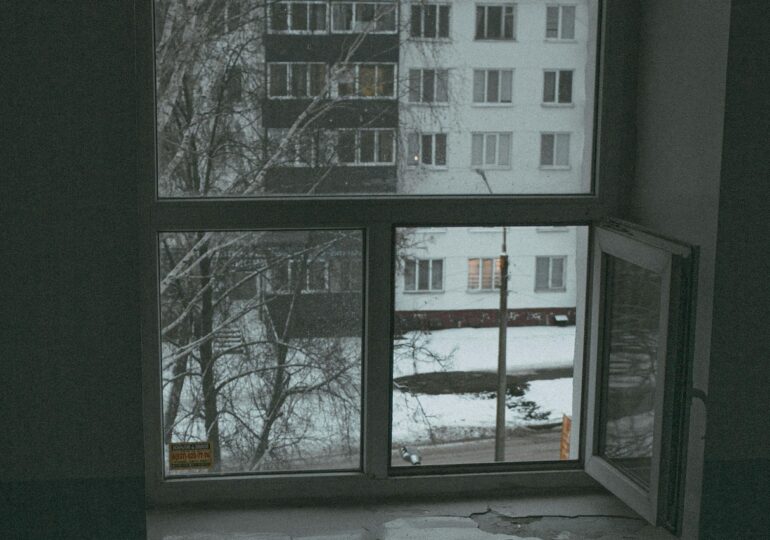
The German practice, often mandated by law, of airing out homes regardless of the season has caused tension in many relationships and even ended some. Now it sparks fascination on social media.
Lüften, which means „airing” or „ventilation,” is a dogma in German homes. Whether it’s raining, sunny, hot, or cold, windows must be opened several times a day to exchange the stale indoor air with fresh outdoor air.
Airing out is, of course, part of daily life in much of the world. Germans, however, have turned it into a unique practice.
Airing out according to the contract
Many rental contracts here contain a "lüften" clause that obliges tenants to open windows several times a day, even - or especially - in winter.
German courts have ruled that, in the absence of specific guidance from the landlord, a tenant is required to open windows twice a day, in the morning and in the evening, for 10 minutes each time.
German parents do not need to teach their children what lüften is, said 34-year-old Lukas Gesche, originally from Berlin and a dedicated practitioner of this habit. "Since we are children, we see how our parents constantly open windows. It's like learning a language: it happens automatically," he explained.
However, lüften is a concept that puzzles many foreigners. And it can be a significant source of cultural shock for those accustomed to a controlled climate environment who considered windows mostly decorative.
Now, however, Germans have their own shock related to lüften. The trend has suddenly become very popular on social media networks in the USA - and, to the horror of Germans, some Americans claim it as their own, writes The Washington Post.
In recent months, wellness influencers on TikTok have started promoting the trend of periodically opening windows. This has sparked a wave of videos with ironic responses from astonished Germans that Americans claim they have just "discovered" lüften.
The nightly terror
Sarah Armstrong, 36, moved to Berlin from California in 2022 to be with her boyfriend, half German, half Dutch. Lüften is largely to blame for why they are no longer together.
At the beginning of their relationship, Sarah came home to find all the windows in the apartment open. "I was just confused. Did something catch fire in the kitchen? And then he explained to me what lüften is," she said.
Their rental contract mandated daily lüften, he told her. But the clauses did not stop at minimum requirements - the landlord insisted that every window and door in the house be opened, even in winter. It was an extreme version of stosslüften, or shock ventilation, widely practiced, where all windows are opened for a short period of time.
A version close to this practice, querlüften, or cross ventilation, emphasizes opening windows at opposite ends of a house.
Armstrong's Boston Terrier would burrow under blankets as soon as the windows were wide open. Armstrong and her boyfriend lived in the Kreuzberg district, known for its nightlife, and the noise often kept her awake. One night, three bats flew through the apartment.
"Lüften actually became one of the biggest sources of misunderstandings in our relationship. One night, we argued in bed and thought, 'We can't do this every evening,'" she recounted.
Eventually, she moved out. To a building without mandatory lüften.
The need for "airflow" in the house
The need for ventilation has increased as homes have been modernized, and old windows have been replaced with new, more airtight ones, explained Lars Gunnarsen, an internationally recognized ventilation expert at Aalborg University in Denmark.
According to him, homes no longer have as many spaces to breathe. "And the message about this is that you need to take control and ventilate on your own," Gunnarsen said.
In the absence of ventilation, moisture buildup can lead to mold, he explained. And indoor carbon dioxide accumulation can make you feel sluggish and less productive and can cause headaches. Unlike carbon monoxide, it will not kill you unless in unrealistically high concentrations.
Gunnarsen's recommendation is a form of querlüften: open windows at opposite ends of the house to allow a strong breeze, more colloquially "a draft," for just five minutes in winter. This way, a little energy is wasted, but the indoor air is changed, and moisture is removed.
This applies only if a home does not have a built-in ventilation system. Newer multi-room buildings in Denmark are required to have ventilation systems that use fans for air exchange, Gunnarsen said.
In the United States, many homes with forced-air heating and central air conditioning have built-in ventilation systems.
A typical German apartment, however, is heated by radiators. There is no air conditioning, and the windows are tightly sealed.
How a German airs out the house
German parents encourage their children and teenagers to air out their rooms, Gesche said. "They always say, 'Oh, the air is so stuffy.' And that means there's simply no more oxygen left in the room. You've breathed it all in. You always have to open the window to get some oxygen."
Gesche aims to open the windows three times a day, though he sometimes misses the lunchtime lüften session when he's away. In winter, each lüften round lasts only five minutes, but the windows must be fully open. In summer, when the air exchange takes longer, he airs out for half an hour each time.
And this is not just a matter of personal habit; Gesche's apartment rental contract obliges him to lüften.
"Proper lüften and adequate heating," he read aloud a provision from his rental contract. "In winter, both are particularly important and are premises for a comfortable indoor climate. Proper ventilation means fully opening the window for 10 to 15 minutes, several times a day."
For more information, the rental contract recommends consulting a brochure titled "Proper Heating and Ventilation." The document provides fairly clear guidelines:
- Lüften should be practiced to achieve a relative humidity of 30 to 40% when the temperature outside is below 5 degrees Celsius and between 22 and 24 degrees inside
- a humidity of 50 to 60% is acceptable when the temperature outside is up to 15 degrees and between 19 and 21 degrees inside.
The brochure also specifies that to avoid blocking the airflow, furniture in buildings constructed before 1995 should be placed at least 10 centimeters from any exterior wall. In newer buildings, a space of five centimeters is allowed.
Even Swedes don't understand Germans
Europeans are known for their preference for fresh air, but Germans' obsession with lüften puzzles many. Even the Nordics, known for their cold resistance and desire for clean air.
Mikael Wessen, 36, rents the small guesthouse near his home on the Swedish island of Sturko and discovered a peculiar habit among his German guests.
"Every time we had Germans visiting, I noticed they would open their windows several times a day. We couldn't figure out why they all did that," he recounted.
His guests shared their fears of mold and carbon dioxide buildup in efficiently insulated homes. But Wessen's guesthouse is an "old, rustic, simple structure," he said - "if it's windy outside, it's almost windy inside." Still, his German visitors insisted on opening the windows daily, even when temperatures were below zero degrees outside, an unusual practice in Sweden.
Surprised, Wessen asked on Reddit why Germans are so obsessed with lüften. He was bombarded with harsh responses from outraged Germans: "You have to ventilate. There's this idea that if you don't, the air somehow becomes disgusting."
And Germans are wary of "drafts" too
During the coronavirus pandemic, lüften gained immense importance in Germany.
The then-Chancellor, Angela Merkel, promoted lüften as "the cheapest and most effective measure" to combat the virus.
The Federal Ministry of the Environment has issued guidelines regarding airing out rooms, recommending, among other things, opening the windows five times an hour in a room where people are exercising. Somewhat unhelpfully, the guidelines continued: "However, there should be no drafts in the room."
Which raises a surprising issue: although they avoid stagnant air, Germans are almost as afraid as Romanians of catching a cold from a draft.
So it's not uncommon at all for someone to enter an apartment or a classroom, on a train or a bus, make remarks about stale air, and dramatically open a window, only for someone else to complain a minute later about a draft and theatrically close it.
After all, there is a German saying: "Many have died of cold, but no one has died because of a bad smell" - concludes the quoted newspaper.
T.D.