
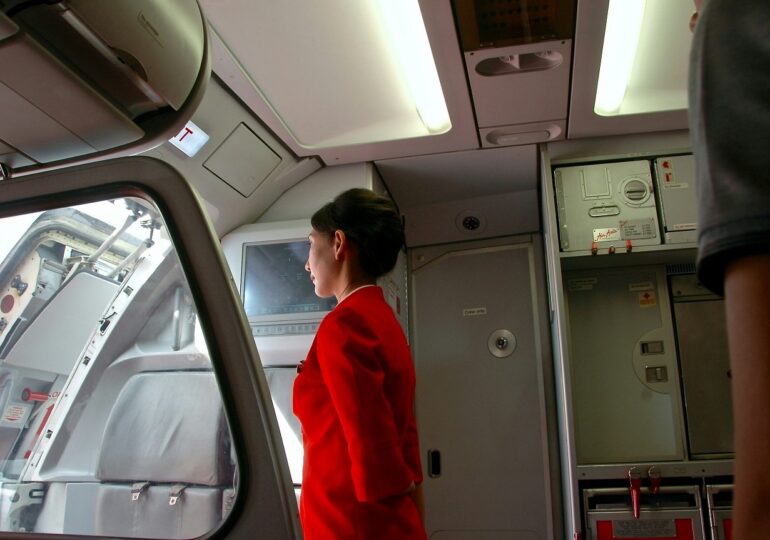
From salary and turbulence training to work schedule, a flight attendant reveals what her profession is really like. She also shares the thing she wishes passengers would stop doing, as well as what she loves most about what people do on planes.
Many people want to find out, out of simple curiosity or because they actually want to pursue a career in this field, what being a flight attendant is really like – what challenges it involves, what benefits it offers, and what both like and dislike the most about those working in this field.
Grace Hampson, a stewardess working on international flights, revealed to Sky News a few things about her profession that people may not know.
How much does a stewardess earn
"Our salary is structured in three parts… so it's hard to offer a typical salary. We are paid a base salary, a flight allowance, and also receive per diems, depending on where we travel," she said.
According to Sky News data, in the UK, the base salary starts at around £19,000 (€21,737) and can go up to £28,000 (€32,000) per year. However, the bulk comes from the other mentioned components of income.
Work schedule
"We don't have a fixed work schedule per week… Flight time limits are set by the Civil Aviation Authority. These allow us to fly 900 hours in a year and no more than 100 hours in 28 consecutive days. We get 28 days of annual leave per year."
Necessary training
Training varies for each airline, Hampson stated. "If you don't already have one, you'll need to get a certification, which is a safety qualification that all flight attendants need. That course can be completed in a week. After that, you'll need to be qualified for a specific aircraft, to learn about things like safety equipment and emergency procedures. Training durations may vary," she explained.
The biggest gain
The opportunity to explore is considered the greatest advantage of this profession, according to Hampson.
"Meeting different people and learning about different cultures is incredible. And I also love the flexible schedule that comes with long-haul flights," she explained.
What passengers do and stewardesses secretly love
One thing the British stewardess would like passengers to stop doing is asking if they can change seats while boarding.
"We are happy to receive and offer passengers as much comfort as possible during the flight, but all passengers must occupy their allocated seat for takeoff. The aircraft's weight and balance are well calculated, and this includes both passengers and cargo and other factors. Proper weight distribution is essential for the aircraft to maintain stability and control. In short, the decision is not up to the flight attendants!" she emphasized.
Hampson mentioned another thing she dislikes: "Many people call us 'waitresses in the sky,' and although part of our job is to provide excellent service, the most important thing is to keep our passengers safe. We can handle a large number of emergencies that may arise in the air, with fewer resources than you would have on the ground. It is a great responsibility, to which every flight attendant has worked hard throughout their career."
Secret language
Probably every airline has its own version of a secret language. "However, the most common secret language we use is to communicate in the cabin when we need a cup of tea or another portion of chicken," she explained.
The best time to travel
For an experienced stewardess, the ideal time to fly is early in the morning: "The journey to the airport is usually easier, and morning flights tend to be less expensive. Tuesdays and Wednesdays are usually the best days for cheaper flights."
Favorite airport
"My favorite airport is… Los Angeles International Airport. It might be an unpopular opinion, as it has a reputation for being crowded. Not only does it offer an excellent shopping and dining experience, but it also has the most flights to and from other airports, meaning you can reach amazing places."
Rules for serving alcohol
"We follow a very strict policy regarding serving alcohol on board… especially when flying such long distances. We always monitor that people do not overindulge."
Best packing trick
The best packing advice offered by Hampson is rolling clothes instead of folding them. "Somehow, this creates more space, and I can fit more. When packing for a trip, I try to keep outfits in similar color palettes, so I can wear a pair of pants or a sweater again and mix and match the things I brought with me," she explained.
Something surprising people don't know about
"We don't just turn the aircraft around and fly back home. Many passengers ask us if we will fly the aircraft directly home after a long flight. Due to the required rest, we usually stay at the destination for a night or two before working on the return flight. Another crew will be waiting for us to arrive at the destination and take over the aircraft. Then, they will work on the return flight themselves."
No accidents
Hampson has not experienced any accidents. "Aviation continues to be one of the safest modes of travel. Just before I entered the industry, my father was a pilot, and I traveled a lot with him. In total, I have had 36 years (both as a passenger and as a flight attendant) without even a close call."
The truth about sex parties on board
"Mile high club," as sex parties during flights are called in jargon, are a myth, but that doesn't mean there aren't people trying to enter this imaginary club. However, it doesn't happen as often as people imagine. "Enhanced security and regular cabin patrols make this almost impossible," she pointed out. This "almost" probably gives some hope to some.
Are stewardesses afraid of turbulence?
"Turbulence doesn't scare me at all… During turbulence, we regularly perform safety checks in the cabin. We make sure passengers continue to wear their seat belts and, of course, check their overall condition. We move through the cabin calmly and without panic, which I think helps passengers.
Also, we are happy to explain to our passengers what turbulence is and why it happens. Recently, I started a series of frequently asked questions for pilots on my TikTok channel, featuring my father, a retired pilot. We talk about turbulence, among other topics, and followers have said it really helped them," she said.
The thing passengers do that stewardesses secretly love
"I try to look calm when passengers applaud upon landing, but… deep down, I love it. We fly with some talented pilots, and they deserve the applause because they have brought us all there safely," confessed the British stewardess.
T.D.