

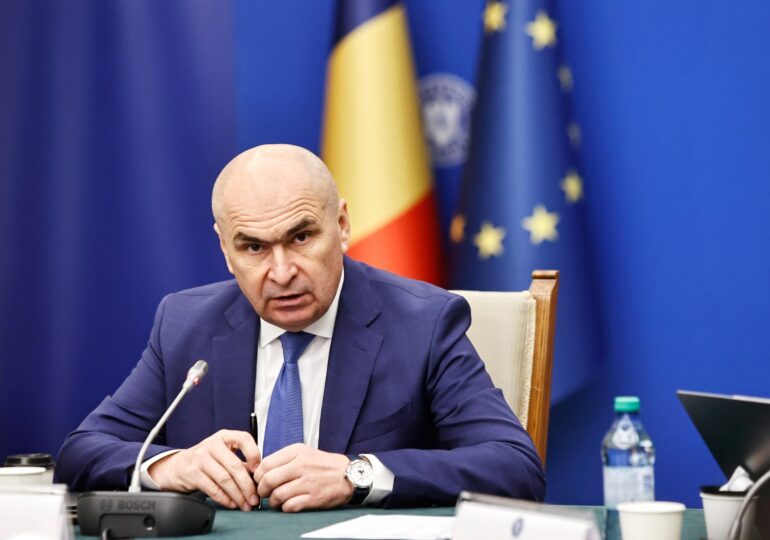
Shortly after official data confirmed that Romania has entered a technical recession, Prime Minister Ilie Bolojan explained on Facebook the economic context of the last two years. He argues that the current contraction is „temporary” and is part of a necessary correction process.
After the budget discipline measures adopted, in the second half of this year, the economic situation will reposition itself and resume growth, the prime minister is convinced, who made statements today at EuropaFM.
He also says that in 2025, we had an economic growth of 0.6%, in the conditions of a rapid change in the economic model.
"We started the transition from a model based on deficit and consumption"
"Romania's economic growth in 2025 was 0.6%, in the conditions of rapid change, in just 6 months, of the economic model that led us to a dead-end. We started the transition from a model based on deficit and consumption, apparently generating prosperity, but in fact destructive, to a model based on investments, productivity, exports, and budget discipline," Ilie Bolojan makes a direct reference to the Ciolacu government, which left the country with a huge deficit.
The Prime Minister acknowledges the existence of technical recession but qualifies it as an anticipated effect of the transition: "The temporary technical recession is part of the anticipated and inevitable cost of this transition, which will ultimately lead us to a solid economy, healthy growth, and real prosperity, based on what we produce, not through more and more expensive loans."
2024 and 2025 - "part of the same process"
The Prime Minister argues that the years 2024 and 2025 should be analyzed together. "To correctly understand Romania's current economic situation, it is important to view the years 2024 and 2025 as part of the same process," he says.
About 2024, Bolojan states that it was "an atypical year," with a budget deficit of nearly 8-9% of GDP and an external deficit of 8.2% of GDP, but with an economic growth of less than 1%. "Normally, such a fiscal stimulus should have generated a much stronger growth. This did not happen," says the Prime Minister.
He also points out that, according to INS, in the first part of 2024, there was a technical recession, "with declines of -0.4% in the first two quarters of the year."
"In 2024, we spent a lot, but grew little"
The Prime Minister explains the imbalances through the structure of expenses: "Because a significant part of the money spent in 2024 was directed towards current consumption, rigid expenses, and compensating for social and inflationary pressures, not towards the real development of the economy. And strong consumption came from more and more imports. High inflation absorbed a significant part of this strong fiscal stimulus."
"In other words, in 2024, we spent a lot, but grew little. It seemed that the situation was favorable, but the economic imbalances were accentuating," says Bolojan.
"We were backed into a corner"
According to the Prime Minister, in July 2025, the recovery began, through a correction of approximately 1% of GDP. "We made a correction of about 1% of GDP, a significant effort that generated social costs and discontent. I would have wanted there to be a way to avoid them."
In an interview on Europa FM, Ilie Bolojan explained that the correction measures were not an option but a constraint imposed by fiscal realities.
He admitted that although budgetary stimuli should have led to a faster economic growth, "the quality of some investments in terms of economic growth was lacking."
"As you all know, and all Romanians know, we were backed into a corner in the summer, and we had to take these measures, to start correcting the deficit," said Bolojan.
"The issue was not the lack of money, but how it was used"
He argues that theoretically, the adjustment should have led to a significant economic slowdown, but the data shows a growth of about 0.6% in 2025.
"In 2024, we had a large fiscal stimulus, with reduced economic impact and accumulation of internal and external imbalances. In 2025, we have fiscal discipline, but a similar growth, supported by real investments and structural factors. This shows that the fundamental issue was not the lack of money but how it was used."
The Prime Minister detailed the structure of these measures and acknowledges that budget adjustments have negative short-term effects.
He emphasized that "these measures have some inevitable economic contraction effects," but compared the adjustments to "any treatment that heals an illness": sometimes with collateral effects. Bolojan also admitted that "the order in which it was implemented may not have been the best, but it was dictated by a certain situation."
Bolojan also stressed that the adjustment does not represent a crisis: "We are not going through a crisis. We are going through a necessary period of economic correction to have a more stable and stronger economy that will bring long-term prosperity."
Repositioning and recovery in the second half of the year
The Prime Minister said that the current period is "temporary" and should not be confused with a prolonged crisis. "I am not a supporter of projecting very optimistic expectations, as the political world has done for years," the Prime Minister also said on Europa FM.
He explained that after closing the budget and completing the measures in administration and energy, the negative effects are expected to be absorbed by the economy. "In the second half of the year, these collateral effects will already be absorbed by the economy, and we will resume the economic growth zone," Bolojan emphasized.
Asked if the economic recovery could start in June, the Prime Minister confirmed. "I say that, from the second half of this year, we will see that things will reposition (...) we will create conditions for economic growth, prosperity, and economic predictability."
Grindeanu's Response
Immediately after the announcement of the INS figures indicating entry into technical recession, PSD leader Sorin Grindeanu declared that the responsibility for the current economic situation lies with the Government led by Ilie Bolojan. He said that the blame lies with "stubbornness taken to absurdity, fierce resistance to any rational argument, permanent obsession with image, and personal calculations," making an obvious allusion to Prime Minister Bolojan.
Grindeanu invoked the data regarding the economic contraction in 2025 to criticize the current fiscal strategy, while the Prime Minister insists that the adjustment was inevitable and that major imbalances had accumulated previously. What the PSD leader did not mention is that according to INS data, there was also a technical recession in 2024, precisely during the time of the government led by Marcel Ciolacu.
Romania Officially Entered Recession
Romania has officially entered a technical recession, after data published by the National Institute of Statistics (INS) shows that the economy decreased in the last two quarters of 2025. Statisticians have revised previous estimates negatively, marking the beginning of last year as a contraction quarter.
According to INS, in the fourth quarter of 2025, the Gross Domestic Product decreased in real terms by 1.9% compared to the previous quarter. As the third quarter of 2025 was also negative (-0.1%, revised from -0.2%), Romania meets the definition of technical recession - two consecutive quarters of economic decline.
Overall in 2025, the economy recorded a modest growth of +0.6% compared to 2024. However, the quarterly evolution indicates significant volatility and a downward trend in the second half of the year, confirming the pressure accumulated on economic activity.