

Yesterday I attended the most unexpected and sensational press conference of my career and there were many. In the ’90s, politicians like Ioan Gavra from Funar’s PUNR, Vadim Tudor, Romania Mare, or Senator Gheorghe Dumitrașcu (PDSR) criticized and humiliated us during press conferences, sometimes they threw us out of the room and shouted harsh words behind us when they received uncomfortable questions.
I never thought I would witness such brutal, catastrophic, and deceitful communication between a public entity and journalists, in a Romania that is part of the European Union and boasts about the independence of the Judiciary.
The conference was organized by Judge Liana Arsenie, the President of the Bucharest Court of Appeal, in a courtroom totally unsuitable for a discussion.
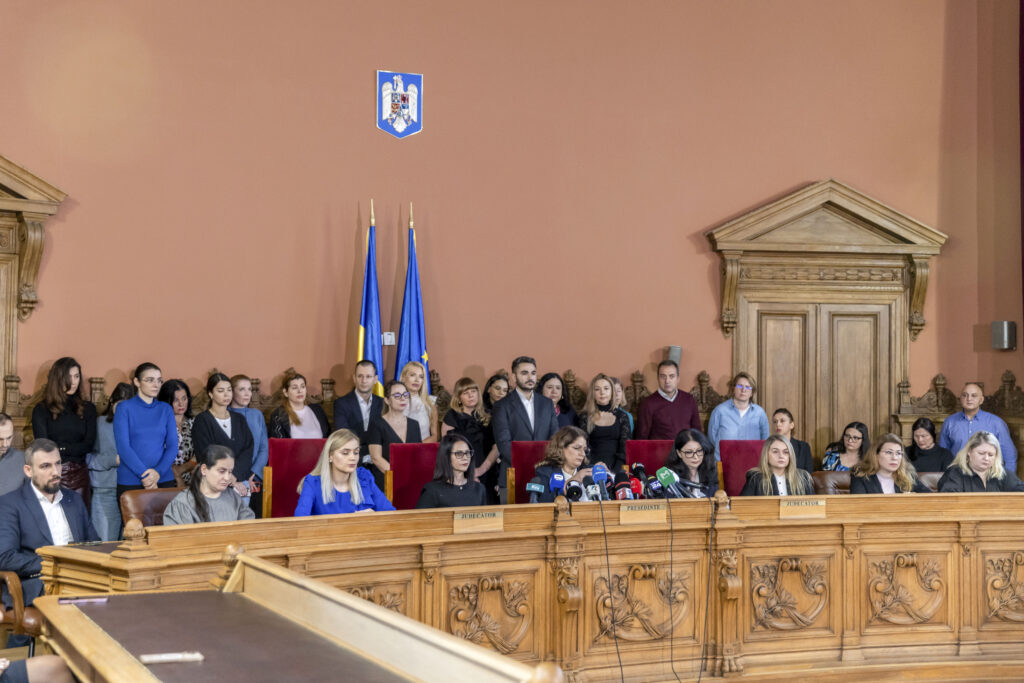
Due to the room's layout, over 50 video cameras created a barrier of tripods, lenses, and cables between reporters and an assembly resembling an extended court session, combined with a choir from a Communist-era Cântarea României edition.
Behind the court leaders, seated in chairs, around 30 people, probably magistrates, were brought in, standing, giving the impression that they were about to start singing at any moment, with the organizers' goal being to convey a message of broad support to the public for the leadership of the Court of Appeal.
Mud-Slinging
Over 150 people were present in the room, including magistrates and journalists, and the temperature rose rapidly, literally. The heat and the arrangement of the hosts projected the image of a courtroom where journalists had become part of a sort of trial, with them in the dock, as they dared to question the authority of the Bucharest Court of Appeal, probably the most corrupt court in Romania, not just recently, but for over a decade.
The entire setup aimed to provide a platform for President Liana Arsenie to dismantle the Recorder investigation, viewed over 2.5 million times on YouTube alone, and to provide journalists with "compromising evidence" about the magistrates who had the courage to reveal how the corruption laundering machine at the Bucharest Court of Appeal operates.
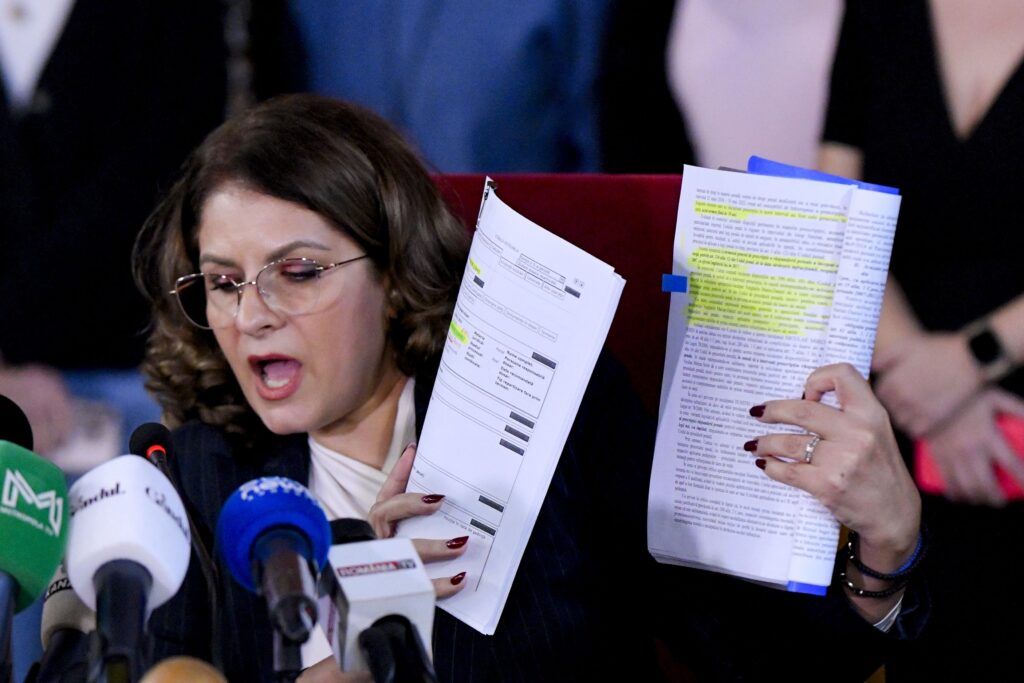
For instance, former judge Daniela Panioglu, now retired, was accused by the head of the Court of Appeal that she hit a colleague with a case file, that she asked for rent money even though she already owned an apartment, and that she yelled at lawyers during a court session, with the recording being presented in the room by the "IT guy," as President Arsenie called him, without providing any explanation about who made the recording, whether court sessions are legally recorded and by what authority, and whether they are public.
Judge Laurențiu Beșu was accused of working as an officer at the "two and a quarter" before joining the judiciary, a popular term for the intelligence service under the Ministry of the Interior.
Series of Non-Answers
At no point did Judge Liana Arsenie provide a concrete response to any accusation raised in the Recorder investigation, such as judges being sidelined in the middle of cases, silenced through disciplinary measures, and advised to fragment cases so that corrupt individuals escape through the prescription of offenses.
All responses to these questions were in fact non-answers: detachment decisions comply with internal regulations and are not public, and criticism from the public is an attack on the independence of the Judiciary, so significant that Lia Savonea, the head of the High Court of Cassation and Justice, the superior court, called the Vice President of the Court of Appeal during the press conference to instruct her on what to tell the reporters. No trace of interference.
However, the entire structure created by Judge Arsenie had no foundation at all, being shattered from the very first minutes of the only press conference organized by the important court in Bucharest, following a surprising scene for everyone.
Attention, Please!
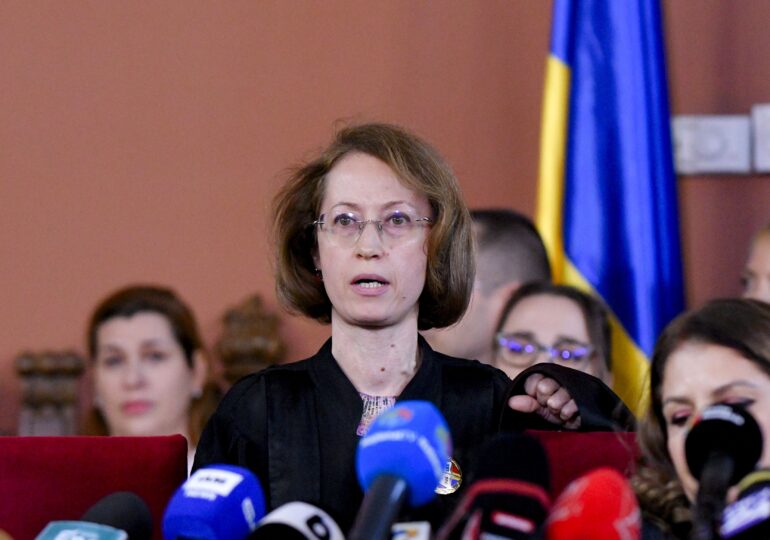
The petite woman, around 50 years old, in a judge's robe, entered through the same door as the leadership of the Court of Appeal and the summoned magistrates. Access was from the opposite side of the room compared to where the journalists were located.
With determined steps, she walked up to the video cameras, positioning herself on the left side, facing from journalists towards magistrates.
She looked at the eager reporters waiting to start the conference and shouted firmly, "Attention! Please, a little attention!" All eyes were on her, and at least in my mind, I thought she was the designated person to announce the rules for the press conference - its duration, the number of questions allowed, and the order.
I came here to support Laurențiu Beșu and to say that everything he said there is true. If contradicted, it's a lie. Here at the Bucharest Court of Appeal, we work very hard, the leadership doesn't help us in any way. We are terrorized, simply, with disciplinary actions and everything you know is happening to us. I don't want to say how toxic and tense the atmosphere is...
Raluca Moroșanu, Judge at the Bucharest Court of Appeal, speech in front of journalists, December 11, 2025
It should be noted that in the minutes before the conference began, in the absence of these rules, journalists organized themselves, creating a sort of lottery with pieces of paper containing numbers. Those who wanted to ask questions drew a slip and lined up according to the number obtained. Personally, I had number 14. I believe that after number eight, President Liana Arsenie refused to answer any more questions. She gathered her entourage and left the room.
I Support Colleague Laurențiu Beșu
The frail woman, in a black robe, with a strong voice, introduced herself. "I am Judge Raluca Moroșanu…," she said, but because she was not near a microphone, not much could be heard, and journalists shouted at her to move to the area where microphones were set up.
The rather abrupt and noisy interruption did not faze her, and with determined steps, she headed towards where Judge Liana Arsenie was seated, with all the microphones in front of her. She stood behind her and resumed her speech while everyone else fell silent.
"Alright. My name is Raluca Moroșanu. I am a judge in the Criminal Section I of the Bucharest Court of Appeal. I have 26 years of judicial experience, 19 of which in Section I. I came here to support my colleague Laurențiu Beșu and to say that everything he said there is true (interview from the Recorder investigation)…”
Word after word, the statements launched into the heated air of room E 68, "Istrate Micescu" (a profound antisemitic jurist), seemed like projectiles that bewildered those around, magistrates and reporters, all being victims of a rare courage displayed by a judge, a professional coming from the depths of Romania's most opaque power system, to confirm all the information journalists have written over the years about the massive corruption in the Judiciary, led by the revelations of Andreea Pocotilă and Mihai Voinea, authors of the Recorder investigation.
A Secondary Significance
Raluca Moroșanu concluded her brief speech to applause from journalists, an extremely rare phenomenon - cynicism and suspicion being simultaneously fundamental qualities and defects for reporters - and left the room, this time exiting through the door for conference invitees.
I couldn't resist and followed her. I asked her if she could answer a few questions, but she refused, saying she was in a hurry because she had to go into the courtroom, having a trial in progress.
However, kindly, the judge told me what prompted her to demolish her boss's carefully crafted image: "I felt the need to speak up and defend my colleague who took the risk of speaking out about what's happening here." Then, Judge Raluca Moroșanu gracefully walked away, gliding down the wide hallway, lined with white marble with shimmering shades of gray, like a figure skater elegantly finishing her artistic performance at a sports competition.
Everything that happened afterward was of secondary significance. The lies and stumbling of the leadership of the Bucharest Court of Appeal only served to deepen the major crisis in the justice system, controlled by Lia Savonea, in collusion with a number of politicians from PSD and PNL.
The small snowball had already started rolling downhill, turning into an avalanche, while honest magistrates and public opinion begin to pressure the president, government, parliament, and CSM to once again reform a justice system mutilated by Liviu Dragnea and those who followed him.