

Romanians are among Europeans who most frequently state that they are exposed to fake news and disinformation.
A Eurobarometer survey analyzed by Euronews shows that over half of the respondents in Romania believe they have encountered fake content frequently in the last week, a percentage well above the European Union average.
Romania, above the EU average in "fake news"
According to 2025 data, 55% of Romanians say they have been exposed "often" or "very often" to disinformation and fake news in the last seven days, a level surpassed in the EU only by Hungary, where the percentage reaches 57%.
At the EU level, the average is 36%. Romania is thus among the countries with the highest perceived exposure levels, alongside Hungary (57%) and Spain (52%).
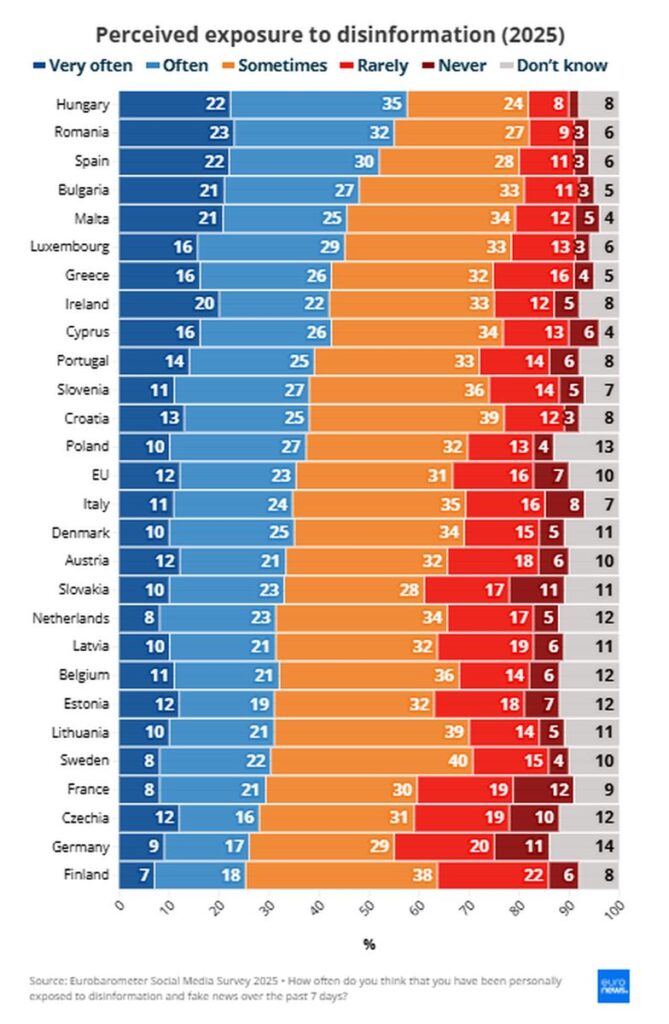
In comparison, in countries like Finland and Germany, only 26% of respondents say they frequently face ( "often" and "very often") disinformation.
At the same time, 3% of Romanians are convinced they have never been exposed to fake news.
What does the survey actually measure
The study authors point out that the data does not reflect the actual quantity of fake news, but people's perception. Respondents indicated what they considered to be disinformation without those pieces of information being verified afterwards.
In other words, the survey shows how much Europeans believe they are exposed to fake news, not how much actual disinformation exists in the public space.
Two-thirds of Europeans say they encounter disinformation
At the EU level, 31% of respondents state they are exposed "sometimes" to fake news. If these are added, approximately two-thirds of Europeans (66%) say they have encountered disinformation in the last week.
Only 7% of respondents claim they have never been exposed, and 16% say it happens rarely to them.
Romanians and trust in their ability to recognize fake news
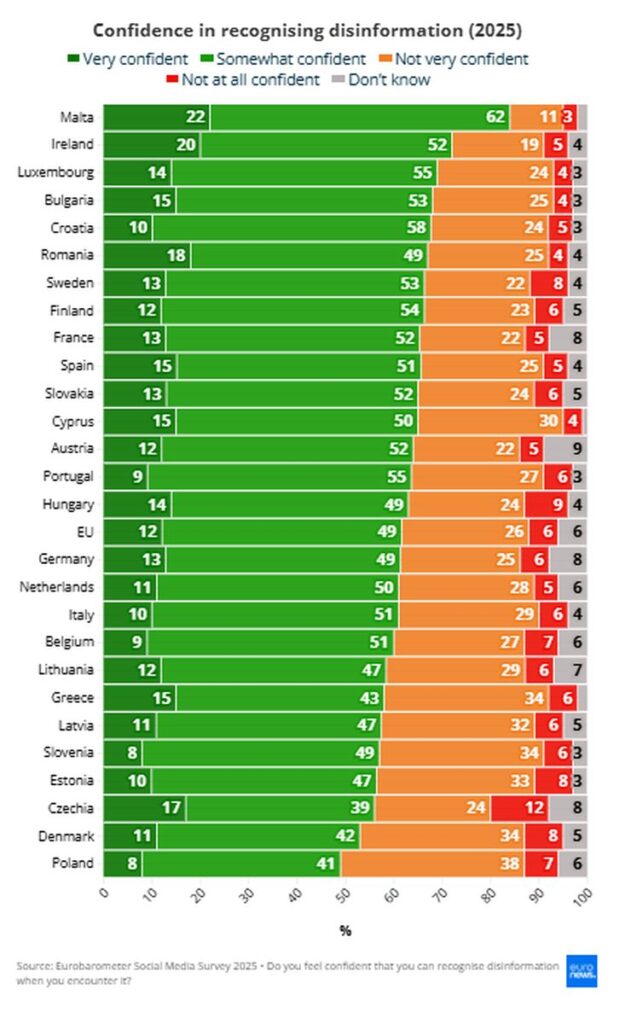
Although the perceived exposure is high, Europeans' confidence in recognizing disinformation is decreasing. At the EU level, 62% say they feel confident, but the percentage is two points lower than in 2022.
18% of Romanians are convinced they can recognize fake news, while 49% are highly confident.
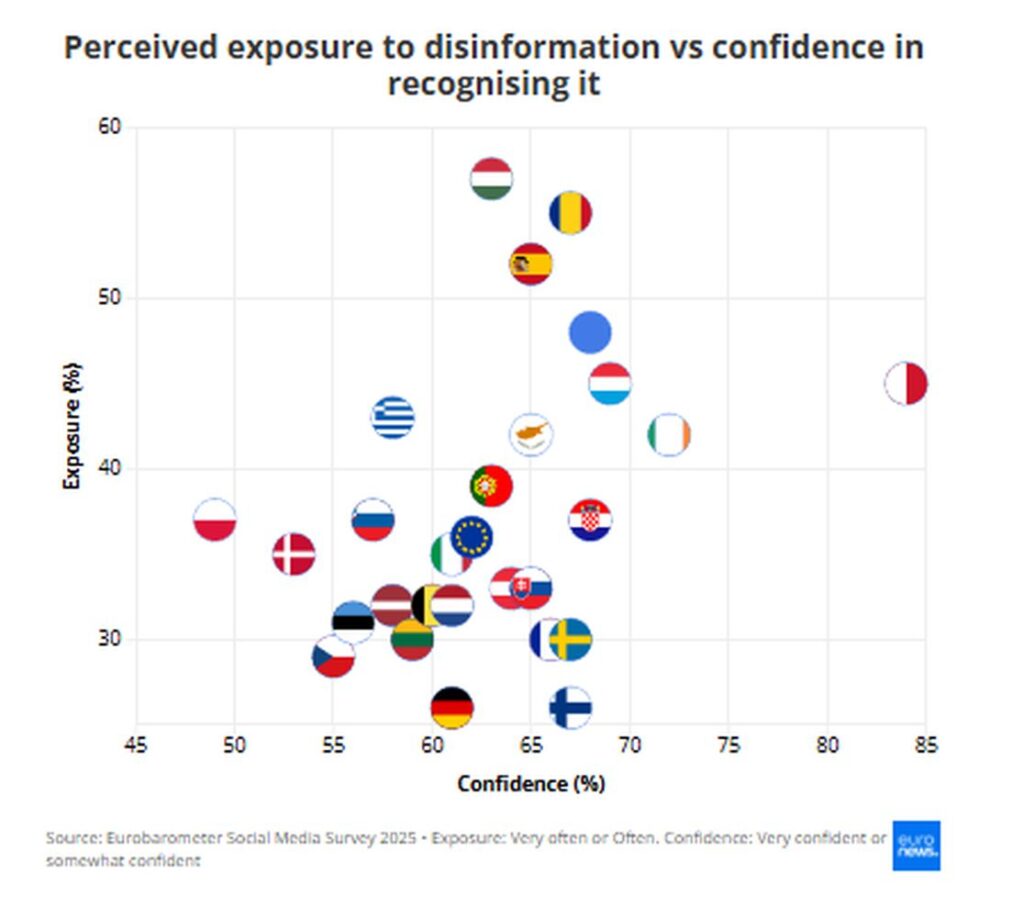
However, there is no direct link between how exposed people feel and how confident they are in identifying fake news. Countries with high exposure levels, like Malta, also have some of the highest confidence levels.
Why media education matters
Konrad Bleyer-Simon, a researcher at the Centre for Media Pluralism and Media Freedom, explains that perceptions can be influenced by several factors, not just by objective reality.
“The quality and extent of media education and fact-checking activities in a country can play a role, as well as certain psychological factors, such as the tendency to underestimate or overestimate one's own abilities and level of exposure,” he told Euronews.
The expert also points out that the impact of disinformation is stronger in societies marked by polarization, economic inequalities, poor educational system outcomes, and low trust in institutions.
In the case of Romania, the combination of high consumption of online content, low trust in institutions, and low level of media education can explain why so many respondents say they frequently encounter fake news.