
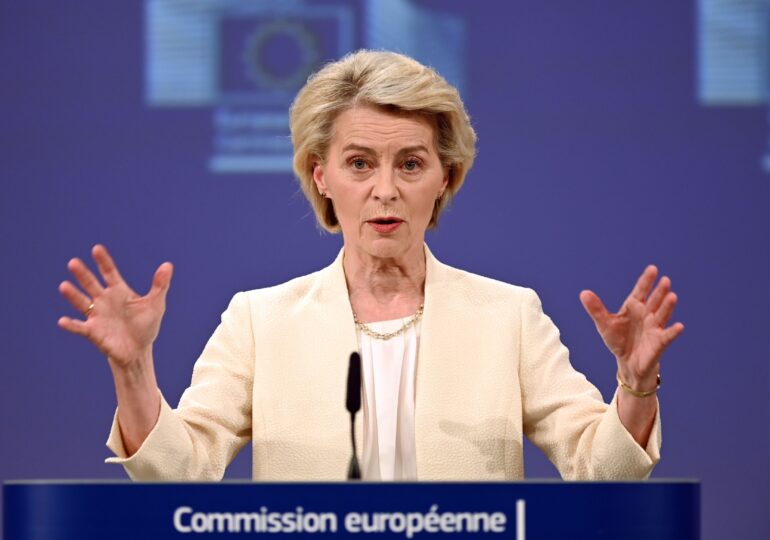
Ursula von der Leyen is facing the biggest credibility challenge for the EU in decades, with a fraud investigation hitting two of the most important officials in Brussels, risking triggering a widespread crisis.
One year after starting her second term as President of the European Commission, Ursula von der Leyen, already criticized for lack of transparency and in strained relations with the EU diplomatic service, must now avoid being caught up in a scandal that originated in the early years of her previous term.
The announcement by the European Prosecutor's Office that the former EU diplomatic chief and a high-ranking diplomat currently working in the Commission led by von der Leyen were detained on Tuesday was immediately speculated by her critics, who are calling for a fourth motion of censure.
"The credibility of our institutions is at stake," said Manon Aubry, co-chair of the Left group in the European Parliament.
If confirmed, the accusations would trigger the biggest scandal in Brussels since the mass resignation of the Jacques Santer Commission in 1999, following accusations of poor financial management.
The police detained former Vice President of the Commission Federica Mogherini, a center-left politician who led the EU diplomatic service (EEAS) from 2014 to 2019, and Stefano Sannino, a senior Italian official who served as Secretary-General of the EEAS from 2021 until he was replaced this year.
The European Prosecutor's Office, led by Laura Codruța Kovesi, stated that there are "strong suspicions" that the procurement procedure in 2021-2022 for the establishment of a diplomatic academy attached to the College of Europe, where Mogherini is the rector, was not correct and that the actions, if proven, "could constitute fraud in public procurement, corruption, conflict of interest, and breach of professional secrecy."
According to four European officials cited by Politico, the case risks worsening the already tense relations between von der Leyen and the current head of the European diplomatic service, Kaja Kallas. This year, Sannino left the position of Secretary-General of the EEAS and took on an important role in von der Leyen's Commission.
A European official defended von der Leyen and pointed fingers at the EEAS, an autonomous body within the EU treaties under the authority of Kallas - one of the 27 European commissioners.
"I know that those who do not like von der Leyen will use this against her, but they use everything against her," the official said.
"Because President von der Leyen is the most visible leader in Brussels, everything is blamed on her. And the fact that she could face a motion of censure for something that the European External Action Service could have done is not fair. She is not responsible for all the institutions," he added.
Mogherini, Sannino, and a third person have not been charged, and their detention does not imply guilt. An investigating judge has 48 hours from the start of the hearings to decide on the next steps.
The Commission declined to comment on Sannino. The College of Europe avoided answering questions about Mogherini but stated in a press release that it remains "committed to the highest standards of integrity, fairness, and compliance - both academically and administratively."
"A detective series"
The investigation comes at a time when eurosceptic, populist, and far-right parties are capitalizing on voter discontent, while the EU is pressuring states inside and outside the bloc regarding its own corruption scandals.
"It's strange how Brussels lectures everyone about 'the rule of law,' while its own institutions look more like a crime series than a functional union," quipped X Zoltan Kovacs, the Hungarian government's spokesperson.
Romanian MEP Gheorghe Piperea, a member of the European Conservatives and Reformists Group, who initiated a motion of censure against von der Leyen in July, told Politico that he is considering launching a new procedure.
Maria Zakharova, the spokesperson for the Russian Foreign Ministry, told state media that EU officials "prefer to ignore their own problems while constantly lecturing everyone else."
Corruption scandals that have shaken the EU
The EU is trying to distance itself from a series of corruption scandals that have emerged in this decade. Tuesday's raids follow the "Qatargate" scandal in 2022, where the Gulf state was accused of trying to influence MEPs through bribes and gifts, as well as after this year's investigation into the lobbying activities of the Chinese giant Huawei in Europe.
These investigations targeted members of the European Parliament, and at that time, Commission officials were quick to point fingers at the legislature and distance themselves.
But the Commission has not been immune to suspicions. In 2012, Health Commissioner John Dalli resigned following a lobbying scandal in the tobacco industry.
Von der Leyen herself was criticized by the EU Court this year for refusing to disclose text messages exchanged with the CEO of Pfizer during the Covid-19 pandemic.
However, Tuesday's revelations are more dangerous for the Commission, given the extremely high profile of the suspects and the seriousness of the accusations.
"Disastrous impact"
After serving as Vice President of the Commission and head of the EEAS, Mogherini was appointed rector of the College of Europe in 2020, despite criticisms that she was not qualified, did not meet the criteria, and entered the competition months late. In 2022, she became the director of the EU Diplomatic Academy, the project at the center of Tuesday's raids.
Sannino, an Italian diplomat, was the highest official of the EEAS and is now the Director-General for the Middle East, North Africa, and the Gulf at the Commission.
Cristiano Sebastiani, representative of the staff in one of the main EU unions, Renouveau & Démocratie, warned that if confirmed, the accusations will have "a disastrous impact on the credibility of the institutions in question and, more broadly, on citizens' perception of all European institutions." He said he received "dozens of messages" from concerned employees about their reputation.
"It's not good for the European institutions, nor for the Commission services. It's not good for Europe, it diverts attention from other issues," said a Commission official, speaking on condition of anonymity. "It induces the idea of elitism, an informal network of favors. And Mogherini was one of the most successful high representatives - it's not good for public diplomacy."
G.P.