
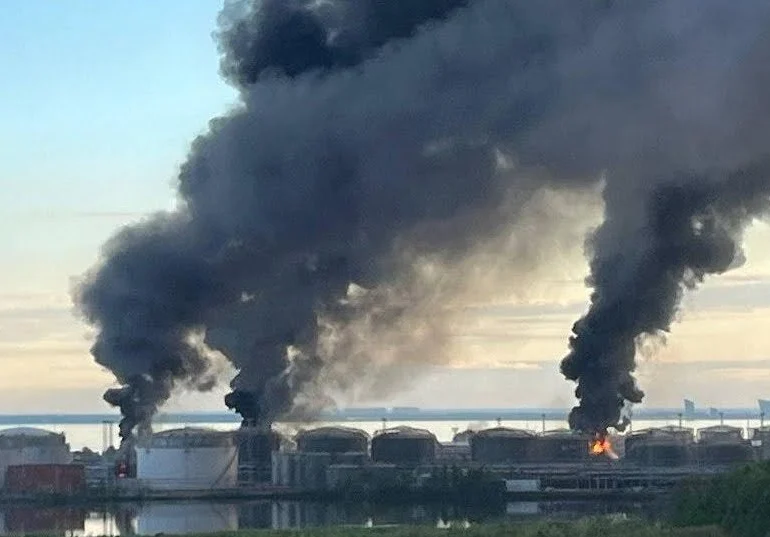
Within nine days, Ukraine hit 116 Russian ships, blocking traffic through the Kerch Strait, shattering Putin’s myth of an „inland sea,” and forcing Moscow to seek alternative, much more costly transport routes.
Ukraine’s increasingly extensive campaign with maritime drones struck another 11 Russian ships in the Sea of Azov on Tuesday night, signaling a broader effort to paralyze Moscow’s maritime logistics, limit military supplies to the occupied Crimea, and disrupt Russian oil exports, according to Kyiv Post.
Robert Brovdi, the commander of Ukraine's Unmanned Systems Forces, known by the call sign "Madyar," stated that among the recent targets were five oil tankers, five cargo ships, and a tugboat.
According to Brovdi, Ukrainian forces targeted 116 ships over nine days of operations.
The objective is not necessarily to sink each ship. Taking them out of commission, forcing them into repairs, and turning the route into one too dangerous for crews, insurance companies, and maritime operators could be enough to freeze Russia's maritime transport network.
Debunking the Myth of Russia's "Inland Sea"
The campaign directly challenges one of Vladimir Putin's main claims after the occupation of southern Ukraine: that the Sea of Azov has essentially become a Russian "inland sea" over which Moscow has full control.
Russia presented control over this waterway as a permanent geopolitical gain. Moscow has occupied Ukrainian ports, restricted international navigation, and used the sea to transport fuel, military cargo, grains, and other goods, with few concerns about potential interference.
This assumption is now starting to unravel.
"The Sea of Azov was Russia's second major trophy after Crimea," noted Ukrainian journalist and military blogger Dmytro Karpenko, known online as Apostol, asserting that Ukraine's Defense Forces are systematically destroying the Kremlin's illusion of total control over this sea.
Traffic Collapses Near the Kerch Strait
The effects are becoming increasingly visible in the navigation patterns in the region. Satellite images analyzed by Reuters showed over 40 ships waiting near the Kerch Strait at the beginning of June. After the intensification of Ukrainian attacks, only a few remained visible.
The Kerch Strait represents the only maritime outlet from the Sea of Azov to the Black Sea.
To the northeast, the Don-Azov navigable canal connects the sea to the Don River and Russia's network of inland waterways. Together, these two narrow passage points form the basic structure of the route: ships enter through the Don, cross the Sea of Azov, and exit through the Kerch Strait.
If one of these crossing points is disrupted, maritime traffic slows down. If both are affected, the entire system begins to clog up.
According to sources in the maritime and grain transportation industry, Russia has suspended traffic through the Don-Azov canal after the Ukrainian strikes. Additionally, transit through the Kerch Strait has been severely restricted.
For a state that claimed to have undisputed control over the region, closing its own waterways equates to acknowledging that it can no longer guarantee safe navigation.
Disruption of Fuel Supply Routes to Crimea
The campaign also targets one of Russia's most important military logistics networks.
Occupied Crimea remains a significant logistical center for Russian forces operating in the Zaporizhia and Kherson regions. Fuel, ammunition, and equipment are transported through the peninsula by road, rail, and sea.
The campaign aims to limit fuel deliveries to Russian forces and to occupied Crimea, while alternative land routes remain vulnerable to Ukrainian attacks.
Continued pressure on the Kerch Strait and maritime routes contributes to further isolating the peninsula.
Physical Enforcement of "Long-Range Action Sanctions"
The campaign in the Sea of Azov goes beyond immediate logistical objectives on the battlefield.
Russia relies on an extensive network of tankers, intermediaries, front companies, reflagged vessels, and opaque ownership structures to continue oil exports, circumventing Western sanctions and price caps.
Maritime tankers associated with the so-called "shadow fleet" generally cannot navigate the shallow waters of the Sea of Azov.
Therefore, smaller tankers first transport oil products from Russian inland ports and the Sea of Azov to transshipment points in the deeper waters of the Black Sea.
Ukraine is now targeting this first link in the chain. If the smaller tankers cannot deliver their cargo, the shadow fleet has nothing to export.
The strategy functions as a form of physical enforcement of sanctions. Western governments can include ships, companies, and ports on sanction lists. However, Ukrainian drones can render the transport route itself unusable.
President Volodymyr Zelensky previously described attacks on Russia's oil and transport infrastructure as "long-range action sanctions" – military pressure intended to reduce the revenues Moscow uses to finance the invasion.
The Disappearance of the Russian Front's Rear
The campaign in the Sea of Azov reflects a broader transformation of warfare.
In the past, Russia considered refineries, ports, waterways, and military infrastructure behind the front relatively safe.
Currently, Ukrainian strikes reach fuel depots, refineries, railways, ports, and military targets hundreds or even thousands of kilometers from the front line.
Moscow continues to claim to have some of the world's most advanced anti-aircraft defense systems. However, Russian authorities increasingly report damaged tankers, fuel depots in flames, affected ports, and suspended transport routes.
The contrast with Kremlin propaganda is evident.
A country that built its economy around oil revenues is now facing fuel shortages and attacks on its oil infrastructure.
A state that presented itself as a maritime power is restricting navigation on waterways it claimed to control.
And a Kremlin that insists sanctions have only strengthened Russia's economy is now desperately seeking new routes to maintain its oil revenues and support its military logistics lines.