
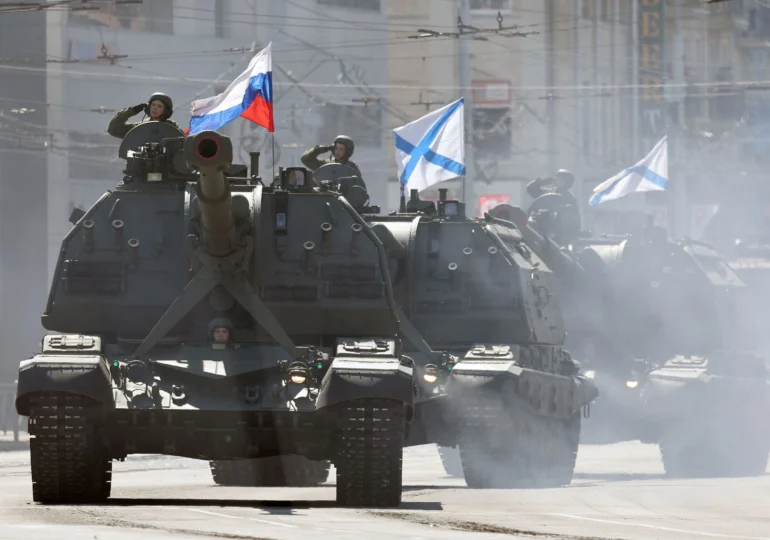
A revolt erupts in Kaliningrad, the Russian territory located between Lithuania and Poland. A group of rebels takes the governor hostage and prepares to send tanks and soldiers across the border into Lithuania, a NATO member state. The goal is to provoke a conflict that would force Moscow to intervene and ultimately lead to a war between Russia and the West.
It is not a real conflict, but one of the scenarios tested last week during an exercise organized at a university in Lithuania.
Journalists Sky News had access to the simulation in which security experts, university professors, and former diplomats from the UK and other European countries played the roles of Russian authorities, rebels, and NATO states.
The exercise was organized by the International Centre for Baltic Security, a security analysis institute, in collaboration with the ISM University of Management and Economics in Lithuania. Participants analyzed three crisis scenarios.
Why did the experts choose Kaliningrad
Edward Lucas, a British journalist and Russia specialist who founded the analysis center and contributed to organizing the exercise, said he wanted to change the usual perspective.
Most military simulations start from the assumption that Russia attacks a NATO country, and the allies must decide how to respond. This time, experts imagined a crisis that would put Moscow in difficulty and could spiral out of control.
Lucas considers scenarios where the Russian army invades the Baltic states, and NATO remains passive as unrealistic. "These countries see things we don't see. They hear things we don't hear. They understand things we don't understand," he explained, referring to Lithuania, Latvia, and Estonia.
According to the expert, the Baltic states are extremely vigilant, prepared to fight, and already have allies on their territory who would intervene from the first minutes of an attack. "Putin knows this," Lucas emphasized.
Therefore, the organizers wanted to analyze not so much the military threat Russia poses to NATO, but the vulnerability of its own territory in Kaliningrad.
An increasingly vulnerable Russian territory
Kaliningrad has nearly a million inhabitants and is geographically separated from the rest of Russia. It borders Lithuania and Poland, both NATO members, and has access to the Baltic Sea.
The region has long been one of the most militarized areas of Russia. However, according to Edward Lucas, a significant part of the troops and armaments there have been sent to the front in Ukraine. Consequently, the territory is now much less defended than in the past.
However, Moscow is extremely sensitive to any threat to Kaliningrad. In recent weeks, the Kremlin has warned that it could even resort to nuclear weapons if NATO forces attempt to attack or threaten the region.
Lithuania and Poland closely monitor the situation of the population in Kaliningrad. The authorities of the two countries fear that some residents may try to cross the border to avoid a possible new mobilization of Russian civilians for the war in Ukraine.
The Lithuanian government is already sending additional troops to strengthen the border with Kaliningrad in the event of such a situation.
The lesson of the exercise: decisions must be made very quickly
Oana Lungescu, former NATO spokesperson, also participated in the simulations. She contributed to evaluating the decisions made by participants and played various roles, including that of the supreme military commander of the Alliance.
For her, the most important lesson of the exercise was the speed at which NATO countries must react in a crisis. "The most important conclusion for me is how much time matters, how important it is to act very quickly and coordinated," said Oana Lungescu.
Oana Lungescu explained that in a real situation, threats can emerge almost simultaneously from different directions, while the available information is incomplete.
In these conditions, allies must make difficult decisions in a very short time frame. "Things happen in the blink of an eye. They come from different directions. Information is insufficient, and complex decisions must be made," Lungescu explained.
She emphasized that NATO countries must be able to quickly reach a common decision, mobilize their forces, and increase their level of military readiness to deter aggression and prevent a crisis from escalating.
G.P.