
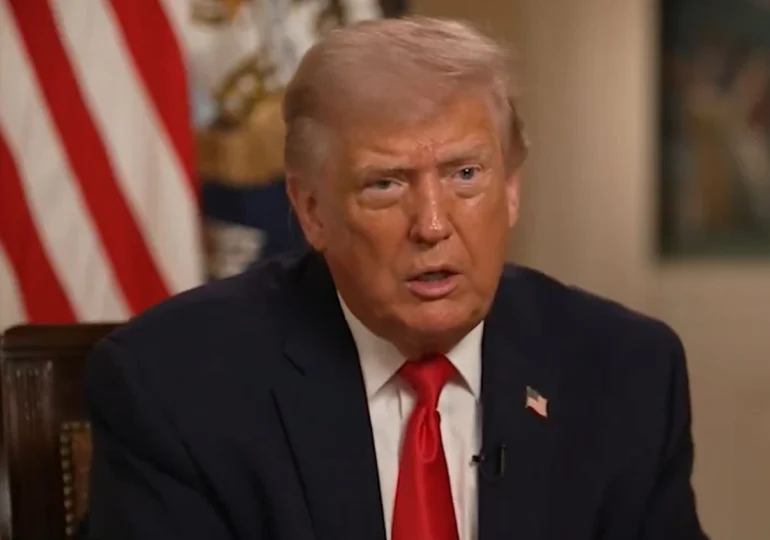
Since President Donald Trump returned to the White House last year, he has oscillated between appeasing the Russian president and reluctantly aiding Ukraine in defending itself against the invasion launched by Vladimir Putin.
In the past two weeks, Trump has made a sudden shift towards concessions to Russia. Desperate to lower gasoline prices ahead of the midterm elections, he is now helping Putin further the war, writes the New York Times in an extensive piece signed by the editorial board of the renowned American publication.
On October 9, Trump announced that he would lift sanctions on Russian diesel exports to the United States, a measure that will support the Russian economy and its "war machine." On Friday, he went even further, signing an executive order to suspend additional sanctions.
He has also taken actions that do not have clear economic justification and instead seem simply aimed at pleasing Putin. These include the new restrictions on Starshield services, the satellite network run by Elon Musk that Ukrainian forces use to defend against Russian aerial attacks. Although the White House denies involvement, Elon Musk stated that only the U.S. military and ultimately the president can order service restrictions.
Trump's Cynicism
Let's be clear about Trump's cynicism, the publication mentioned writes. He is assisting an autocratic leader and a dangerous adversary of the United States, who is waging a brutal war against a democratic neighbor. Trump does this, in part, in the faint hope that gasoline prices, which have risen due to the foolish war he initiated in Iran, will drop in the next two weeks and help Republicans avoid major electoral losses in the midterm elections (November 3).
He is prejudicing America's national interests and most likely sacrificing Ukrainian lives for his own political gain.
The stakes of the war in Ukraine are much higher than the fate of a single country. This war tests the ability of authoritarian expansionism to succeed through military force in the 21st century—or, conversely, the ability of the West to mobilize to defend democracy and innocent lives.
Even some Republicans in Congress are dismayed. Senator Thom Tillis of North Carolina called the lifting of sanctions "more than irresponsible" and "morally unacceptable." Senator Ted Cruz of Texas said it was a mistake.
Two other Republicans—Senator Kevin Cramer of North Dakota and Representative Mike Turner of Ohio—have called for an investigation into the Starshield service disruptions. Senator John Cornyn of Texas stated, "Lindsey would have been horrified," referring to the late Lindsey Graham, a Trump ally who frequently urged him to take a tougher stance against Russia and sometimes succeeded. (The sanctions Trump suspended last week came from a law signed by Graham himself last month.)
Putin Encouraged to Become More Aggressive
Trump's most recent policies are all the more disappointing as Ukraine has made progress this year. Its forces have recaptured approximately 1,036 square kilometers of territory between January and mid-October, and Ukrainian drones have inflicted damage deep inside Russian territory. With the help of the United States and Western Europe, Ukraine has the chance to turn Putin's war into a humiliating stalemate or even a defeat for the Russian leader.
Trump's excessively conciliatory attitude towards Putin only encourages him to become more aggressive, both in Ukraine and in other regions. Seeing the West as weak and divided, Putin has begun a campaign of thinly veiled attacks and provocations against other parts of Europe.
Russian drones, missiles, and fighter jets have penetrated NATO airspace, in Poland, Romania, and the Baltic states. Last week, drone attacks in the Black Sea, just outside Bulgaria's territorial waters, damaged a commercial cargo ship and sank another.
This summer, Germany announced the discovery of armed Russian drones near Leipzig airport, appearing to await remote instructions to attack. "We are already in conflict with Russia," said German Chancellor Friedrich Merz.
Meanwhile, on Monday, Trump offered the following misleading assessment: "Russia, frankly, has behaved well towards Ukraine." He presented his policy of concessions to Moscow as a strategy to achieve peace.
On Sunday, he wrote on social media that he suspended sanctions because he did not want to "do anything foolishly to push Russia away from the negotiating table." If Trump truly believes this, it means he misunderstands Putin, who responds to timid calls for peace by escalating the war.
What the US Should Do
Both the Biden administration and Ukraine's supporters in Congress have rightly set limits on American support for Ukraine. Ukraine is not a NATO member, and the United States should not send troops to fight in this war.
A significant portion of the financial support given to Kyiv should come from Western Europe, which has for far too long left the responsibility for defending the continent to the American military. However, Washington can and must play a crucial role in defending Ukrainian democracy against Russian aggression.
The most urgent measure would be for the White House to lift the restrictions on Starshield services. Ukraine relies on this satellite network to defend against Russian missile attacks. "This slowdown in services will cost many of us our lives," a Ukrainian officer told Politico.
The United States and Europe should also collaborate to help Ukraine replenish its stocks of missile interceptors and long-range missiles. Additionally, Washington should continue to sanction Putin, the oligarchs who support him, and the Russian economy fueling the war effort.
The way to do this is simple: enforce the law named after Graham. It targeted Russia's energy sector, which contributes to funding the war in Ukraine, through sanctions and other restrictive measures. These sanctions were set to take effect on Sunday until Trump signed the executive order suspending them.
The Ukrainian people have shown extraordinary courage over the past four and a half years. The Ukrainians have defied experts' predictions and repelled Russia's invasion. Over 125,000 of them have been killed, and half a million more have been injured. Many live in daily fear and prepare for a harsh winter. They are fighting a battle that benefits the entire free world. Trump fights only for himself.