
The European Union has entered a major deadlock just as the war in Ukraine approaches a crossroads.
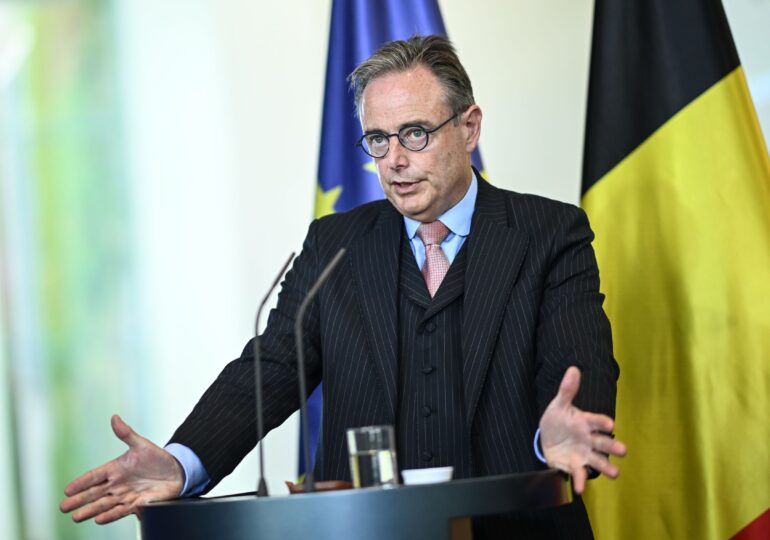
An extensive analysis by Politico shows how Belgium’s Prime Minister, Bart De Wever, managed to halt the EU’s initiative for a loan of around 140 billion euros guaranteed by Russian assets frozen in Brussels, a plan meant to stabilize Ukraine’s budget over the next two years.
Tensions erupted on October 23 at the EU leaders' summit in Brussels, where Volodymyr Zelensky was expected with this funding promise. Member states were already discussing the destination of the funds, from European arms acquisitions to Kiev's freedom to buy equipment from anywhere it wishes. But it quickly became clear that the "reparations loan" would not pass: Belgium firmly said "no."
De Wever blocked everything: "It's completely crazy"
According to Politico's report, the Belgian Prime Minister categorically rejected any solution that would involve expropriating Russian sovereign assets held at Euroclear (the central securities depository through which many of the frozen Russian assets in the EU pass, most of them in Belgium). He informed his colleagues that the risk of Russia winning in court and Belgium having to repay the entire loan alone was unacceptable. "This is completely crazy," De Wever reportedly said.
Throughout the afternoon and evening of October 23, the Belgian Prime Minister repeatedly requested the rewriting of the summit's conclusions to eliminate any reference to the use of Russian assets in support of Kiev. The result: an EU failure at a critical moment and a signal of weakness, coinciding with renewed pressures from Donald Trump for peace negotiations with close associates of Vladimir Putin.
Tensions with Berlin and a missed communication
Politico's analysis shows that Belgium's opposition overlapped with the impetuous statements of the new German Chancellor, Friedrich Merz. In September, Merz publicly called for the use of frozen Russian assets, a move that, according to quoted diplomats, frightened the Belgians engaged in sensitive negotiations.
Furthermore, Belgium's ambassador to the EU reportedly sent misleading signals, as he did not directly engage with the Prime Minister, and Brussels had not realized the severity of De Wever's position until the day of the summit.
The Belgian Prime Minister was also embroiled in internal negotiations for the national budget: "I've been negotiating for weeks to find 10 billion," he told European leaders. He deemed it impossible to accept an obligation to repay Russia an amount over ten times larger.
American pressures and "Trump's plan" regarding Russian assets
The issue of frozen Russian funds is not only a concern for Europeans. Politico notes that American officials informed EU representatives in the summer that Washington intends to return the assets to Moscow after a potential peace agreement. Additionally, the 28-point plan of the Trump administration for ending the war included unlocking the assets and using them in a joint reconstruction effort, with the U.S. taking 50% of the profits.
The idea sparked outrage in Brussels and accelerated internal discussions but failed to pave the way for a compromise with Belgium.
Von der Leyen criticized for delaying legal texts
In recent weeks, pressure has also shifted towards the head of the European Commission. Several states have criticized Ursula von der Leyen for not timely publishing the legal texts necessary for implementing the loan guaranteed with Russian assets. The documents, only recently made public, are essential to clarify responsibilities and risks.
"We have lost a lot of time," said the Estonian Foreign Ministry's Secretary-General to Politico. Even Belgium reportedly urged the Commission to urgently present the plan.
Concerns about euro stability and a possible hybrid attack
Some of Prime Minister De Wever's arguments relate to systemic risks: he fears that a legal attack on Euroclear could affect the credibility of the entire eurozone and discourage investors.
There are also concerns in Brussels about the country's security: suspicious drones recently flew over Belgian airports and military bases in a possible espionage operation. Some officials fear that Belgium would become even more vulnerable if it were to approve the use of Russian assets.
Orban, "the unpredictable factor"
Another major obstacle is Hungary. Russian assets are frozen only by the consensus of the 27 member states, which renew sanctions every six months. If Hungarian Prime Minister Viktor Orban - a political ally of Putin - were to suddenly change his position, Russia could immediately claim the assets. Belgium would then be the primary target.
European diplomats say there is no sure legal solution to bypass Hungary's veto, appease Belgium, and avoid using taxpayers' money.
What's next before the December 18 summit
The EU is trying to finalize a plan to ensure funding for Ukraine until 2025. Options being considered include direct grants from state budgets - unlikely given fiscal constraints - or a new joint European loan, rejected by the "frugal" countries known for very strict fiscal policies.
If the agreement on Russian assets is not adopted in time, leaders are considering a Plan B: an emergency bridge loan.
However, De Wever remains inflexible. In a letter to Ursula von der Leyen on November 27, the Belgian Prime Minister called the proposal "fundamentally wrong" and reiterated that if Europe wants to help Ukraine, the "skin in the game" must come from Europeans, not from Russian assets.
As the December 18 summit approaches, tension is rising in European capitals. "This is not an accounting exercise. We are preparing one of the most important European Councils. We are trying to ensure that Europe has a seat at the table where history is being written," warns Estonian diplomacy.
The fundamental question posed by Politico remains: can the European Union, with its 27 member states - diverse, tense, and affected by internal conflicts - unite when the stakes are crucial?
G.P.