
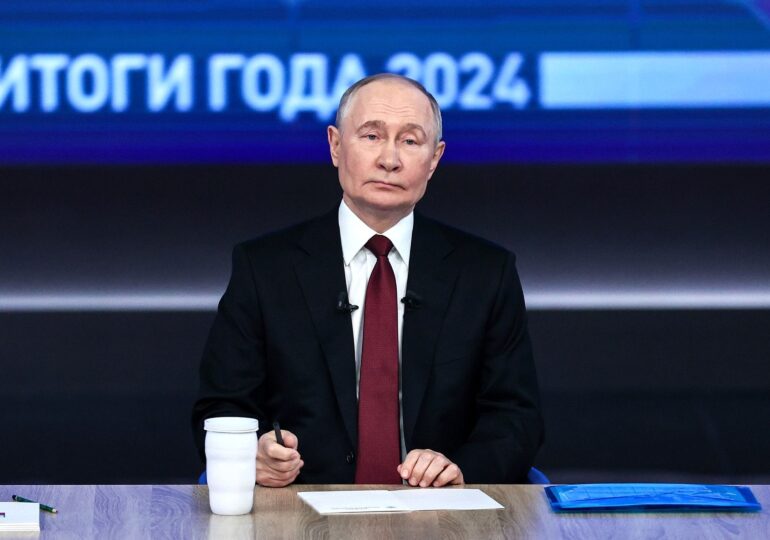
Due to the constant financial and military support that Europe provides to Kiev, Russia is facing losses not seen since World War II. Meanwhile, the U.S. is abandoning its historic transatlantic commitment. Only bad news for Putin.
A change is underway for Europe, shaking the doors on Pennsylvania Avenue in Washington and Downing Street in London.
For various reasons, Donald Trump and Keir Starmer are facing deep political troubles. It is not the first time an American president has been humiliated by his actions in Iran. Donald Trump could have listened to Jimmy Carter's advice about his ill-fated military incursion to rescue American hostages in Tehran in 1980. American optimism about a military action against Iran is nothing new, although it is misguided.
Meanwhile, in the UK, Starmer's premiership has come to an end, and Andy Burnham is preparing to take office at 10 Downing Street.
Such a situation should bring satisfaction to Moscow, but among the emotions felt in the Russian capital, joy is not among them. A gray cloud has recently lingered over Moscow after a drone attack from Ukraine. The Russian leader appears incompetent, a hostage to the situation he himself has triggered, writes Irish journalist Tom Clifford in an analysis published by Kyiv Post.
On the other hand, President Volodymyr Zelensky could gain momentum. Ukraine, with sophisticated drones and missiles, has thwarted the Russian invasion.
China Watches as Russia Sinks
Russia is currently recording approximately 30,000 casualties per month. A level of around 1,000 casualties per day will not be sustainable, even in a country where news about the war is heavily censored. Drone attacks launched from inside Ukraine have penetrated deep into Russia.
An important milestone has been reached. Putin's "special military operation" in 2022, intended to bring a quick victory, has lasted longer than the First World War. The bloodshed that began in August 1914 was supposed to end by Christmas. You don't have to be a history student to realize that it lasted much longer and led to the downfall of a Russian leader, writes Clifford.
In Beijing, Chinese leaders watch in horror at what is happening. Putin, a key ally, has ended up in a quagmire, and now the Chinese plans to attack Taiwan are being reconsidered in light of Russia's stumbling invasion failures.
The journalist highlights the role of geography. Ukraine and Russia share a land border that is easily violated. Taiwan is about 100 kilometers off the coast of China. Landing Chinese troops on the island would involve either parachuting or coastal landings. Both would come with huge losses, as Taiwan would become a "Ukraine" and deploy drones to break through an invading force. If Ukraine were to capitulate, China might feel encouraged. As it stands, military plans had to be revised in Beijing.
With Putin, You Never Know, But He's Running Out of Cards
But any sense of optimism in Kiev must be tempered. Putin is facing a strategic and personal defeat. He rejected Zelensky's offer of peace talks with an arrogance that is not justified by the situation on the ground.
It is not excluded that Putin may decide to widen the conflict. In poker, this is called doubling down: with a weak hand, he raises the stakes. It's a way to get out of a predicament through a bluff.
Ultimately, Putin has threatened to use nuclear weapons against the West. He may try to rally the Russian people behind him by provoking a NATO military response. Then, he would repeat the discredited mantra that NATO had planned from the start to attack Russia and that only he is capable of protecting the Motherland.
In a similar vein, this is already happening before our eyes. Security, intelligence, and military chiefs in Europe openly discuss the increasingly numerous acts of sabotage directed by Moscow as the fighting intensifies in Ukraine. Russia is already embracing aggressive belligerence.
NATO airspace is constantly violated by Russian drones and fighter jets. GPS interference, disrupting civilian aviation and maritime navigation, is a feature of Russia's reckless behavior.
Poland's railway network, a crucial component of the supply chain to Ukraine, has been sabotaged. Submarine pipelines and internet cables in the Baltic Sea have been cut. Norway's land border with Russia, the North Sea, and the North Atlantic are being tested by Russian military activities.
Europe's Debt to Ukraine
The words of outgoing British Prime Minister Keir Starmer should not be ignored. Western intelligence services, he said, warn that Russia could attack a NATO country before the 2030 World Cup.
In this context, the European Union has just opened official accession talks with Ukraine. This comes as Washington openly abandons its commitment to defending Europe.
American Secretary of Defense, Pete Hegseth, has launched a six-month review of U.S. military presence in Europe. He said some allies have "taken advantage."
This petty sentiment shows the debt that Europe owes to Ukraine. Kiev's success against Russia, though at huge costs, has shown that Europe does not depend on Washington for its survival, concludes Clifford.
T.D.