
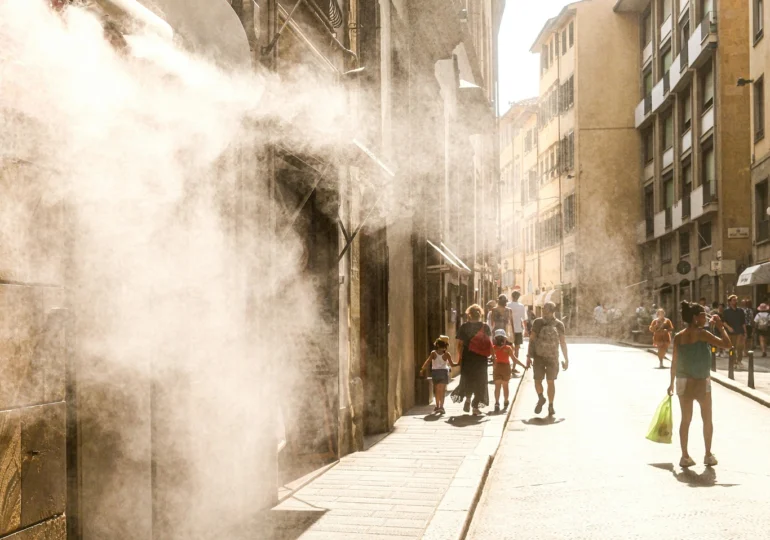
Western Europe is gripped by yet another brutal heatwave this week, a sign of what global warming can do to this continent, even as climate change slips further down the political priorities list.
Meteorologists say that temperatures in the coming days will break records for June in several countries. France is bracing for temperatures up to 43 degrees Celsius. Spain could reach up to 45 degrees Celsius.
Temperatures in some parts of the United Kingdom, Germany, and Italy could reach 40 degrees Celsius.
And we're not even in the middle of summer yet.
In Belgium, where temperatures could reach 37 degrees Celsius, the head of the forecasting service at the national meteorological office said this could become "the hottest week ever recorded" in the country.
Nights will also be exceptionally warm, and nighttime temperatures will not drop below 25 degrees Celsius in many parts of Western Europe by the end of this week.
The lack of respite exacerbates heat stress - the heat accumulating in the body - leading to illnesses and even deaths, especially among vulnerable populations such as the elderly. Approximately 200,000 people in the European Union have died from heat-related causes in the past four years.
Politico analyzes the reasons why Europeans are sweating in their homes and workplaces this week.
Fossil Fuels
Indeed, heatwaves are not a recent phenomenon - they have appeared in the northern hemisphere during the summer since time immemorial. But global temperatures have risen by 1.4°C since humans began burning fossil fuels to power factories, cars, and buildings, releasing greenhouse gases that warm the planet.
As a result, humanity has raised the baseline for summer weather. Scientists agree that each heatwave occurring now is hotter and more likely to occur as a result of climate change.
It is possible that climate change did not cause the heat dome - a meteorological phenomenon that traps warm air for extended periods - that settled over Western Europe this week, said Mireia Ginesta, an associate researcher in climate damage analysis at the University of Oxford.
"But it raises the background temperature on which meteorological systems operate. In a cooler climate, this heatwave would have been less intense," she explained.
Europe is also the continent with the fastest warming rate in the world due to a combination of factors, including its relative proximity to the Arctic and changes in regional meteorological patterns.
And with every fraction of a degree that the planet warms, the heat will be more intense. Scientists say that if global warming reaches around 3 degrees Celsius above pre-industrial levels, the number of heat-related deaths in Europe will double or triple compared to the 1.5 degrees Celsius level.
Weak Infrastructure
Outdoor temperatures are only part of the problem. Europeans spend about 90% of their time indoors - in homes, shops, trains, schools, and workplaces.
In much of Europe, and especially in northern regions, buildings are designed to retain heat indoors, not to release it outdoors. Even now, many new homes are built to withstand winter temperatures, not the increasingly hot summer weather. In the UK, 92% of homes are projected to be exposed to overheating by 2050, according to the country's Climate Change Committee.
Additionally, although an increasing number of European homes have air conditioning, it is still a rarity: only about a fifth of households on the continent have installed air conditioning. Even if they have it, they may not be able to use it: more than a third of Europeans say they cannot afford to keep their homes adequately cool, with the percentage rising to two-thirds among those struggling to meet expenses.
Offices, schools, trains, and public transport in many cities also lack sufficient air conditioning. In France, the heat — and the lack of cooling technology — forced the closure of over 800 schools this week. In Belgium, a fifth of all trains have no air conditioning at all, leading the national railway company to cancel services during peak hours.
Although some cities have started to provide cooling spaces during heatwaves — offering air-conditioned rooms to the public — such initiatives are rare and available only during the day, not during the sweltering nights.
Disinterested Politicians
Governments can take numerous measures to both reduce emissions that warm the planet and protect citizens, infrastructure, and economies from extreme weather events. However, as increasingly intense heat affects Europe year after year, climate change is descending down the political priority list across the continent, notes the cited publication.
While the European Union's emissions reduction plans are among the most ambitious in the world, governments have placed greater emphasis on industrial revival in recent years and have scaled back climate policies seen to affect the economic ambitions of the bloc. EU emissions actually increased slightly last year, indicating a stagnation in pollution reduction.
Both in the EU and the UK, preparations for the inevitable consequences of climate change - such as heatwaves - lag far behind efforts to reduce emissions.
According to the European Environment Agency, the bloc of 27 countries is not protecting its citizens from extreme temperatures. The agency assesses the threat of heat stress to the general population as critical in this decade and "catastrophic" from the mid-century onwards.
The UK Committee on Climate Change also described the UK's efforts as inadequate, and on Tuesday, the think tank Green Alliance warned that Britons are "paying the price" for their government's failure to adapt the country to rising summer temperatures.
"Right now, children are trying to finish their exams in stifling classrooms, and the elderly endure dangerously hot homes and care centers," said Friederike Otto, a professor of climate science at Imperial College London.
"This heat is not an inconvenience but an increasing threat to public health," she added. "Every heatwave puts lives at risk, and it is long past time to treat it with the urgency it demands."
T.D.