

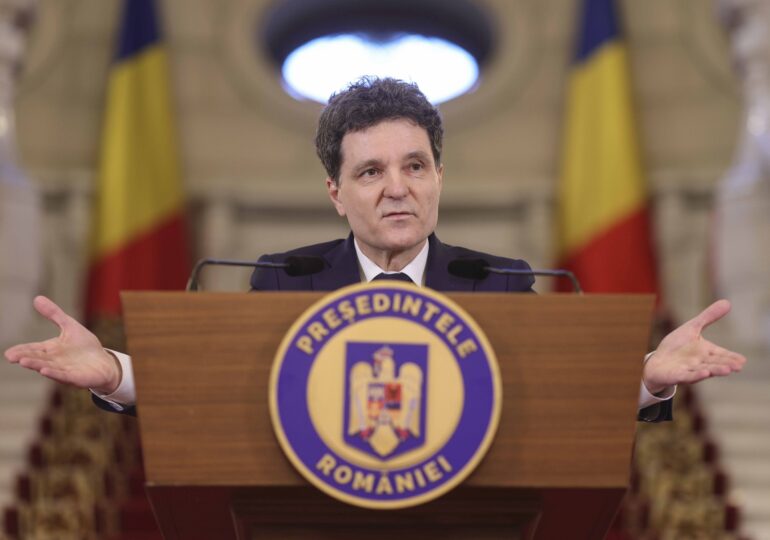
The President of Romania, Nicușor Dan, announced on Wednesday, in a press conference, the appointment of the new heads of the major prosecution offices, just a day after receiving the proposals from the Minister of Justice, despite the negative opinions or lack of opinions from the CSM.
He stated that he asked the new heads of the General Prosecutor’s Office, DNA, and DIICOT for visible results in combating corruption and dismantling major criminal networks, especially in the areas of drugs and tax evasion. The head of state insisted that the system needs to be „energized” and directed towards cases with real societal impact.
He justified his appointments, made a strong case in favor of Cristina Chiriac, the new Prosecutor General, expressed confidence in the decisions he made, and stated that if they are not confirmed, he will be sanctioned by voters in three years.
In the same context, Nicușor Dan rejected any suspicion of political negotiation regarding these appointments, stating that the process unfolded without influences. When explicitly asked if there was any conditioning from the PSD for maintaining the coalition, the response was brief: "Absolutely not."
Beyond the judiciary, the president acknowledged that the lack of a civilian director at the Romanian Intelligence Service for over three years remains a problem, especially concerning public communication and institutional responsibility. However, he emphasized that the service is functioning and that Romania has not experienced terrorist attacks, in a challenging geopolitical context. The appointment of a new director is expected to come "relatively soon."
Politically, the head of state distanced himself from any discussion about supporting Prime Minister Ilie Bolojan, invoking his constitutional role as a mediator and Parliament's responsibility in maintaining the Government.
The central message, however, remained focused on the direction for the prosecution offices. Nicușor Dan called for more firmness and genuine public communication in cases of major interest, warning that lack of response fuels speculation and uncontrolled "narratives." Simultaneously, he conveyed that leaks of information from cases should cease, and information should only be made public after investigations are completed.
When asked about the criticisms in the public space against him ("There are many voices on social media saying they have lost confidence in you"), the president responded curtly: "I await arguments."
spotmedia.ro broadcasted LIVE TEXT the statements of the head of state:
I have signed decrees for the appointment of Mrs. Cristina Chiriac as the Prosecutor General, Mr. Viorel Cerbu at DNA, and Mr. Codrin Miron at DIICOT. They will start on April 15.
I have signed the decree for the appointment of Marius Voineag as deputy at the General Prosecutor's Office, for Ms. Marinela Mincă as deputy chief prosecutor at DNA, for Mr. Marius Ștefan as deputy chief prosecutor at DNA, and for Mr. Alex Florența as deputy chief prosecutor at DIICOT.
I have rejected the candidacy of Mr. Gil Julien Grigore-Iacobici for the position of deputy chief prosecutor at DIICOT.
Following this moment, my expectation from the prosecution offices and their heads is to energize the activities of the prosecution offices to meet the expectations of Romanians. Romanians see corruption.
From DIICOT, I expect the dismantling of major drug networks and large-scale tax evasion networks. Drugs are an extremely harmful social phenomenon that affects more and more Romanians. Tax evasion affects the state budget.
I expect the three appointed chief prosecutors to communicate with subordinate prosecutors and publicly address all deficiencies encountered by prosecutors in their activities.
I have a message for the body of prosecutors because being a prosecutor is a vocation. You become a prosecutor because you want to eliminate criminality that affects the lives of your fellow citizens. Our judicial system has turned prosecutors into a kind of functionaries burdened with thousands of cases and no longer have the necessary time to focus on cases that truly impact society.
Due to the numerous speculations during this time and because I could not speak out, as doing so would influence other authorities, I want to address many of the issues that have emerged in the public space, many of which are false and many of which are issued in bad faith. I accuse those who knew the information and deliberately transmitted it falsely or truncated of bad faith.
It has been repeated endlessly that this entire context is about whether the president approves or disapproves of the PSD proposals. These are not PSD proposals. If Giovanni Falcone were alive and a Romanian prosecutor, and he wanted to become the Prosecutor General, he would have to submit a file to the Ministry of Justice, be interviewed by a commission led by the minister, and the minister, from the PSD, would send the proposal to the president. I don't think Mr. Falcone was a member of the PSD.
Furthermore, it was said that former chief prosecutors would continue to lead the prosecution offices from the position of deputies. There is nothing more false than that. Deputies have their role, but they do not have a say in the decision-making process, just as the vice-mayor does not matter.
Arguments for Appointments
I am a serious person, I have prepared myself. I have spoken for dozens of hours with dozens of prosecutors.
Regarding Prosecutor Chiriac, to prepare for this moment, I had many discussions since January, general, informal, with many prosecutors, but in these discussions, I always asked the question "in your opinion, what do you think are the best structures for DNA, DIICOT, the best prosecutor's office alongside a court of appeal?" Some answered, others said they did not want to evaluate their colleagues. Regarding DNA, DNA Iași was always mentioned among the best. Regarding DIICOT, the DIICOT Timișoara section was always mentioned as the best in the country.
I was very happy to see that Mrs. Chiriac was a candidate and that Mr. Miron was a candidate.
I was extremely surprised when I saw the attacks against Mrs. Chiriac. She led a team of eight to nine people in Iași for four years. In the counties of Iași and Vaslui, we have the president of the Iași County Council, the mayor of Iași, and the president of the Vaslui County Council sent to trial. We have 20 customs officers and border police officers sent to trial. We have the head of Customs in Iași sent to trial. We have a rector and a dean sent to trial for issuing diplomas for money. We have a deputy sent to trial, we have a hospital chief sent to trial.
I read that she has a million euros in her account. It's not a million, it's 10,000 euros. She did not conceal evidence in the case of the former bishop of Huși, but did not report it to the Prosecutor's Office because there were no assaults and no minors in the evidence that reached her.
Who defends a prosecutor in the public space? The regulations prohibit a prosecutor from speaking publicly when under media attack. If their superior defends them, they are lucky. If not, in the public opinion, they will carry a stigma throughout their professional career. This needs to change. In major criminal cases, the prosecutor must explain simply, so the public can understand.
It was also said that the prosecutor was married by the bishop of Huși. That's not true. It was said that the prosecutor made a procedural error in the Buzatu case – the case passed through the preliminary chamber, so the judge found enough evidence for the trial to proceed. There was a practice that both prosecutors and judges applied on how wiretapping warrants were executed, but the High Court came in 2024 with a mandatory decision that said otherwise, some of the wiretapping warrants are no longer valid. That's the procedural error the prosecutor is accused of.
There was also a matter of manipulation and bad faith. It is said that the DNA Iași section had a disastrous activity in 2025 because it had only three indictments. Anyone who knows a bit about what happens in prosecution offices doesn't just look at indictments, but also at guilty plea agreements. Because the Penal Code, the Code of Criminal Procedure have greatly hindered criminal trial activities, for years, the heads of prosecution offices realized that instead of focusing on indictments, it is more efficient to focus on guilty pleas.
Secondly, in 2019, the High Court came and said that the DGA officers can conduct any kind of criminal investigation, and in 2025, it came and said the opposite – if it's not a police officer, any criminal investigation conducted by a DGA officer is null. If you are a head of a prosecution structure, you don't send a case in which you know you conducted an investigation with a DGA officer, but you try to prove through other legal means that the fact occurred.
Lastly, even if you only know how many indictments someone made in 2025, you can still look back at 2024 and see that DNA Iași was the best among the sections.
The President Responds to Journalists' Questions
- Protests against the appointments were mainly made by NGOs and people who supported you, are they justified? You mentioned many indictments, are there also convictions?
Regarding the first question, I hope that the people who supported me are individuals who understand arguments. I am very optimistic that they will carefully consider the arguments.
As for the second question, to reach a conviction takes three, four, five years. We have to wait another one or two years to see if the prosecutor was right about what someone did for four years.
- You mentioned at the beginning of your term that you were not satisfied with the activity of DNA and the General Prosecutor's Office. You have now appointed former chiefs as deputies. Have you reassessed them?
What I reproached Mr. Voineag and Mr. Florența for were essentially two things – on issues such as "CSM refuses to appoint important prosecutors to the special section for magistrates" or what I mentioned, mandatory decisions of the High Court, or the relationship with judicial police officers who assist the prosecution, on various equipment without which you cannot conduct an investigation on a phone, on these matters, we have not heard in the public space, on behalf of the body of prosecutors, a firm position from Mr. Voineag and Mr. Florența saying "our activity is inefficient for these reasons."
The second and more important criticism, and here we don't need to be experts – the citizen does not see that DNA is truly fighting against major corruption.
There are people who have structured the activities of the prosecution offices they led and have a certain expertise in managing many things at once. This expertise can be useful from the position of a deputy, without being the person making decisions.
- You mentioned that these are not PSD proposals. But was there any consultation with coalition leaders?
No. I have a constitutional attribute to pronounce on these matters. The whole process started with an act of will from the prosecutor who assumed they wanted to occupy a leadership position. If you want to fight the mafia, have the courage and present yourself in front of a commission. Between Mr. Pîrlog and Mrs. Chiriac, I believe Mrs. Chiriac is much more suitable, but I appreciated that Mr. Pîrlog came.
- Will we ever find out what happened during the Revolution and the Mineriad?
It's a very good question. In broad terms, we know what happened, the issue is how we associate it with the names of people who actually were active during those periods. What happened, especially during the Mineriads, in my opinion, is very clear.
- Why don't we have a final solution?
It's a management issue.
- Is it a failure of justice?
Without a doubt.
- If on April 20, PSD decides to withdraw support for the Bolojan Government, would you be willing to designate another liberal prime minister?
There are many scenarios, and I wouldn't want... Obviously, there are informal discussions on all these possible scenarios, but I don't think it's useful to analyze all scenarios in the public space.
- How do you view the reform of the special section for investigating magistrates?
There is a legislative solution that states it falls under the competence of the Prosecutor General, not the DNA. There is a structure with 40 positions at the PG and at the prosecutor's offices of the courts of appeal, of which 16 are at the PG, and several requests from the Prosecutor General to fill these 16 positions were successively rejected by the CSM, more precisely by the majority of judges in the CSM. This was the moment for the Prosecutor General to come and say that this was not right.
- Last winter, you mentioned that there was a major problem in justice. Are you still of the same opinion? Will you continue consulting with magistrates as you announced?
It has only been corrected to a small extent. At that time, I said that normally, minimal managerial activity involves announcing 90 days in advance when someone is leaving a position so that the remaining team can adjust. This has not been rectified. Because there was tension between the Government, Parliament, and magistrates, because there was tension between the reformist group in justice and the CSM, I said it was not the time for me to refuse magistrates' retirements over this procedural issue. I will act when things settle down.
Regarding the referendum, yes, I said we will do it, and we will.
- After today's decrees, do you still expect PSD to withdraw its ministers?
I don't see any connection. Since January, I knew that March 31 is the moment when these positions become vacant. I have acted in that direction, to gather all the information, to make the most suitable decision. I hope this moment will energize the activity of the prosecutors. Beyond that, it's a political matter.
- In the case of Mrs. Chiriac, there was a negative opinion from the CSM. Why did you ignore it?
I believe that when Romanians elected a president, they expected to have a president who thinks for himself. I respect the opinion of the CSM, but I have this mandate from Romanians and I acted as I deemed appropriate. I deeply believe that my decision is correct.
I would like to add a nuance here. If I ask you who the best journalist in Romania is, subconsciously, you will think of someone similar to yourself. It's the same in the profession; the prosecutors in the CSM's prosecutor section, people I respect, think implicitly about how they believe the activity in the prosecutor's offices should be carried out based on models they have formed. We need people to break the rhythm in the prosecutor's activities.
- I was looking earlier on Facebook, and there are already opinion influencers who consider these decrees to be a betrayal of the pro-European vote and a surrender to PSD. How do you respond?
I believe I have responded.
- Do you have a guarantee that these appointments are not under the influence of PSD?
I have the guarantee that this choice is good for the moment we are in. I ask you something: if I happen to be wrong, I will be penalized in four years, but if the opinion influencers are wrong, who will penalize them? Those who said they were puppets of Matei Păun, are they being penalized by anyone?
- Crin Bologa discussed here with Iohannis, who told him that political leaders need peace. Do you think politicians will have peace with these appointments, or will the anti-corruption fight reach high-ranking political leaders?
I believe we have the prerequisites to truly look at a social phenomenon. We probably won't see results in three months, but I believe in six months, a year, we will see an improvement in the activities of the prosecutors.
- Can you explain in a few words why you decided to appoint Voineag and Florența even though you criticized them? How many times has Mr. Voineag come to you to convince you that what appears in the public space is not true?
I answered the first question. I mentioned the criticisms against them as heads of the prosecutor's offices. They believe they can help from the position of deputies. Voineag applied for the position himself. If there were no other candidates to prove they were better to be deputy prosecutors general...
He has never come to convince me of anything. He has come, I believe, twice, on current issues of his activity.
- Regarding the functioning of European institutions. What effect will a potential new victory for Viktor Orban in the Hungarian elections have on Romania and the EU? You criticized him for blocking the loan for Ukraine.
I continue to criticize him; it is unacceptable. I wouldn't want to speculate on the election result. Apart from that, there are many nuances. There is an issue with the decision-making process in the EU. It's a problem when someone abuses the unanimity mechanism.
- Do you think there could be a discussion about changing the mechanism in the near future?
The discussion has already started. There are no technical proposals on the table yet. It started precisely from the shortcomings we observed with Hungary.
- Some of your supporters' comments have started to flow on the topic of the appointments at the prosecutor's offices. You told those who protested at Cotroceni that you expect results in about six months. If they do not perform, what will you do? Will you ask the Minister of Justice to initiate the revocation procedure?
I am convinced it is a good choice. I have not asked anyone to submit a blank resignation. They have a three-year mandate. It is a choice I stand by. If I am wrong, Romanians will surely penalize me.
- You say that citizens will penalize you, but citizens are the ones who pay for politicians' mistakes. We see the Pfizer case, there are accusations that a certain Minister of Health did not renegotiate the contract. If it turns out that a renegotiation was possible, will you ask the Prime Minister to take action against the responsible person?
I don't know if it's even a penal case. In any case, on financial matters, the state is represented by the Ministry of Finance. If the Minister, as the state's representative, believes that a dignitary knowingly made a bad decision that affected the budget, they should take action against them.
- You initially said that the expectation is to energize the prosecutors to meet the expectations of Romanians. Do you believe you are meeting the expectations of the Romanians who took to the streets and demanded Voineag's resignation? Is society's reaction important?
I have respect for the reaction of any person in society. On the other hand, based on all the information I am obliged to gather, the decision is mine. I believe I have made a good decision.
- How do you view the fact that some members of your campaign team helped manipulate those photographs?
These two individuals were never part of the campaign team (Andrei Bicuți, Mihai Cojocaru). If what the prosecutors say is true, they should be penalized for the committed offense. If there was any interaction, it was between the team and the contracted companies, not subcontractors.
- You listed the expectations you have from the prosecutors. What areas should they focus on? What are the urgencies?
We are all in the service of the people. If you ask the people, their main issue is corruption, significant and widespread. Corruption should be an objective for both the DNA and the PG. For DIICOT, the major drug trafficking networks and tax evasion. At DIICOT, we had indicators of how many people we send to trial, and then it's very easy to catch some consumers, but that doesn't mean you are fighting against trafficking. We need to look at the big picture, as a whole.
- When will you appoint the leadership of the intelligence services?
At the right time.
- Another stalled case is that of vaccines, with a loss of one billion euros. Will we perhaps see a prosecution?
I would like any kind of case, especially cases with significant financial stakes, to be resolved as quickly as possible. Besides that, regarding the vaccine issue, I expect the official documents signed by state officials to be made public, so that society can form an informed opinion about who signed what. It seems to me that the event's timeline is not very clearly outlined in the public space at the moment.
- Have you asked the Prime Minister for this?
I know that many people have asked, and I support this initiative.
- Considering the consultation in the PSD, what will you tell those in the coalition? To continue in the current form?
I don't want to get into scenarios.
- If a movie were to be made about you, would you want to be a negative or positive character?
My daughter does theater and has always wanted to be the fairy of fairies, but for about a year, she wants to be the negative character; she finds it more interesting. I have run for several positions with utmost seriousness, trying to solve people's problems. Here, you have to be the positive character.
- Have you had discussions within the international coalition regarding the Strait of Hormuz?
Currently, the discussions are at the ministerial level. So far, there hasn't been a discussion among leaders. The will has been expressed by all these countries.
- You have not presided over any CSM meetings so far, you have bypassed the opinions given for candidates. Do you lack trust in CSM?
They have their evaluation, I have a different evaluation. I strongly believe in the evaluation that I and my colleagues have conducted.
- In May 2025, you said you would attend CSM meetings frequently. Do you plan to participate?
Yes, I will attend frequently from a certain point onwards.
- When will this moment come?
This is a systemic and serious issue. There are many unproven statements in the public space. The most comfortable thing for the president would be to have three or four professional bodies, each providing a synthesis of the issues, and for him to make a decision based on uniform information. Unfortunately, information is lacking, there are many opinions, but basic information is missing. For a political decision-maker to have an option, for example, in a negotiation within the EU, it is not enough to make three phone calls, receive three reports, because they do not exist.
- Was there any conditioning from the PSD regarding the maintenance of the coalition and support for the Bolojan Government in exchange for validating these appointments in the prosecutor's offices?
Not at all.
- Have you engaged in negotiations in this regard?
No, not at all. I let the whole process unfold without any influence from me.
- It has been 1,110 days since SRI no longer has a civilian director. What are the costs? Especially since for four years we have had activity reports classified in Parliament.
As far as I know, they have been submitted, they just have not been discussed. They can be discussed, even if they are classified. Obviously, a civilian director is needed so that some of the justified questions can have an appropriate, formal, informal response, for society to understand what this service does.
Beyond this necessary interface, there are things happening. You saw the FBI statement, thanking the SRI. Romania is a country that, in a difficult geopolitical context, has had zero terrorist attacks. It is a service that works.
- Can you provide a timeframe for these appointments?
Relatively soon.
- Do you still support Prime Minister Bolojan in office?
The Constitution gives me a role as a mediator. Beyond that, support for a prime minister, according to the Constitution, must come from Parliament.
- There are many voices on social media saying they have lost trust in you, what do you tell them?
I await the arguments.
- Who should defend the prosecutors?
For example, in the case with the bishops of Huși, when journalists went to the prosecutor's office to inquire, the chief prosecutor of the structure should come out, being a high-profile case, and say what happened. If the head of the structure does not do that, obviously an entire narrative begins to grow that no one controls.
- You repeatedly mentioned in a conference that a prosecutor must submit their file if they want to obtain a position. You have had consultations with dozens of dissatisfied prosecutors, do you know why they have not submitted their candidacies?
Some of them have submitted.
- Why weren't there more submissions?
I don't know. Among the dissatisfied, some have applied.
- Do you believe that there should continue to be leaks from ongoing investigations?
No, there shouldn't be. They should appear when the case is closed.
- So, should we no longer expect leaks from prosecutors regarding cases in progress?
Yes.
- Also in your conference, you gave an example of a lady's good activity in Iași. Don't you consider it risky to argue for the appointment of a female prosecutor based solely on cases related to political figures? Don't you think that other prosecutors may interpret it as a message from you in such a way that in the near future other county heads, mayors will be targeted?
For Romanians, corruption is an extremely important concern. There is no corruption without a political decision-maker. You can't study corruption in such an environment... Among the cases, I referred to those where the political decision-making capacity is the highest. Of course, there is corruption at Customs, at ANSVA as well.
