

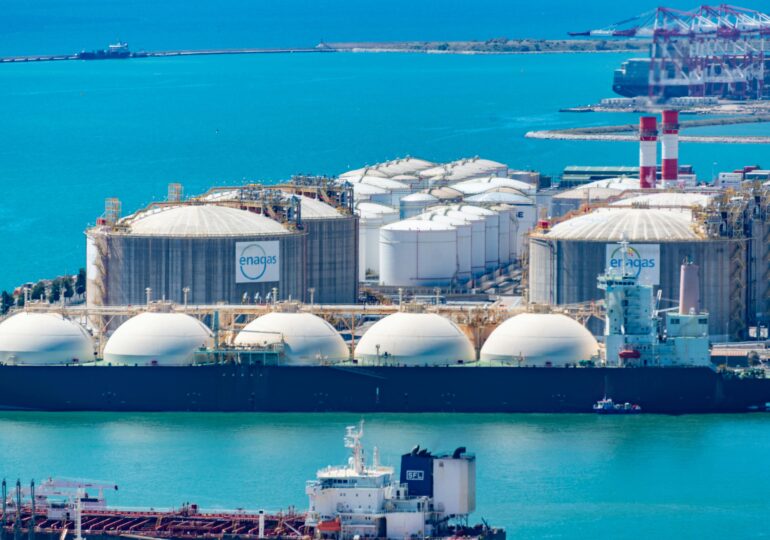
Donald Trump’s influence on the energy supply of the European Union and the United Kingdom is growing, as Europe shifts its dependency from Russia to the United States.
This is the conclusion of an analysis published by The Guardian, which highlights that this shift exposes European states to serious geopolitical and economic risks.
In the context of the war in Ukraine and the sanctions imposed on Russian gas, more and more European countries have turned to imports of liquefied natural gas (LNG) from the US. The study, conducted by researchers from prestigious European institutes, warns that the new energy reality comes at a time when the Trump administration is adopting a tougher and more transactional approach in its relationship with allies.
From Russian gas to American gas
The analyzed data show a rapid and profound change.
LNG imports from the US to the European Economic Area increased by 61% in 2025 alone, with a jump of nearly 500% compared to 2019. Currently, American liquefied gas accounts for almost 60% of the total LNG imports of the European Union.
At the same time, the share of Russian gas transported through pipelines has plummeted: from 60% of European imports in 2019 to just 8% in 2025. In essence, Europe has shifted from one dependency to another, warn the report's authors.
The United Kingdom, equally vulnerable
The situation is similar in the United Kingdom.
Although London covers half of its gas needs from domestic production, the rest comes from imports, mostly LNG. Of these, almost 70% come from the US.
Even though it is no longer part of the European single market, the United Kingdom remains closely connected physically and economically to Europe's gas network.
Gas, a strategic power tool
The report emphasizes that risks are increasing against the backdrop of a change in tone in Washington. The US National Security Strategy, published last November, explicitly talks about "energy dominance" as a means to project American power.
In this context, recent threats by Donald Trump to impose trade tariffs against European allies – including in the dispute over Greenland – take on an additional dimension.
Professor Kacper Szulecki warns that Europe must view this dependency with much greater caution: energy exports are openly treated as a geopolitical lever, and historical precedent shows that the US has attempted to influence European energy policies before.
"The US tried a similar approach in the 1980s, under Ronald Reagan, trying to convince European partners to abandon gas trade with the USSR. But back then, gas liquefaction technology did not exist, so Europe had no alternative to Russian gas delivered through pipelines," Szulecki said.
Risk of higher bills and energy crisis
In the short term, the consequences could be directly felt by the population. EU gas reserves are at their lowest level in years, even below the level at the beginning of the war in Ukraine. A harsh winter, combined with trade or political tensions with the US, could lead to new price hikes and a severe energy crisis.
Although Brussels is considering response measures, including reviewing some trade agreements with the US, the reality is harsh: in the short term, there is no viable alternative to American gas.
Solutions proposed by the report
The authors conclude that Europe must react swiftly and strategically.
Gas and energy, in general, are increasingly functioning as instruments of political influence.
The only medium and long-term way out is to accelerate the transition to an energy system based on renewable sources, more efficient and less exposed to geopolitical pressures.