
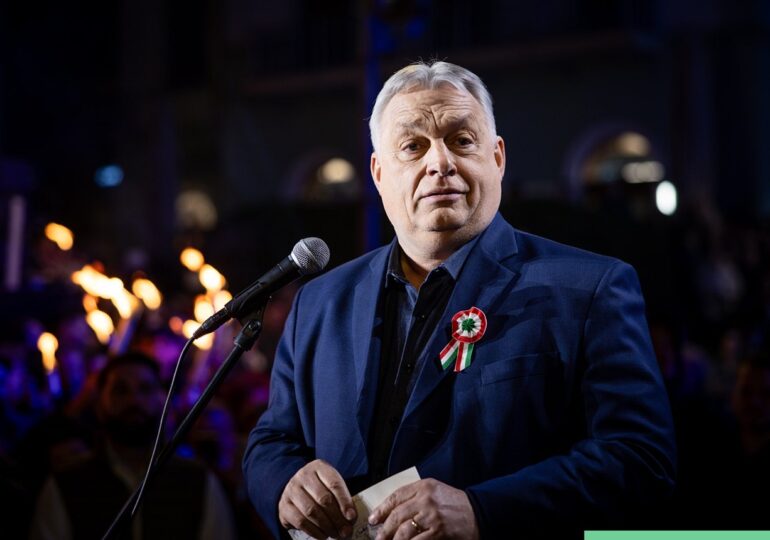
Viktor Orban has long been a challenge and a frustration for the European Union, and his defeat in Sunday’s elections was hailed by top EU leaders as a potential moment of radical change after years of clashes between Brussels and Budapest.
„The heart of Europe beats stronger in Hungary tonight,” Ursula von der Leyen posted on social media.
Orban has often stood in the way of critical political objectives for the European Union, including blocking a loan to Ukraine and packages of sanctions targeting Russia. His administration has long been considered a security risk in sensitive meetings due to its relatively close ties with the Kremlin, reports New York Times.
With the victory of the opposition party in Hungary, led by Peter Magyar, this could start to change.
Magyar and his party, Tisza, have adopted a friendlier tone towards both the European Union and NATO.
As the vote was underway, Magyar emphasized that it was held on the anniversary of a 2003 vote in favor of Hungary's accession to the European Union - a potential signal that he wants to break Orban's animosity towards Brussels.
Radical Change in the Rules of the Game for Europe
The new leadership is expected to pave the way for a €90 billion loan to Ukraine, a loan that has been frozen for several weeks due to Mr. Orban's objections.
"The election results radically change the rules of the game for Europe," said Mujtaba Rahman, Europe director at Eurasia Group, a political risk consulting firm.
But Magyar also holds a skeptical view of certain European policies. At a time when the bloc is trying to cut its energy ties with Russia, he indicated that Russian imports should remain an option. His party has also opposed imminent changes to migration policies.
And there are many areas where Hungary has been just a controversial voice. Now, other disagreements between member states on thorny issues requiring unanimity - including EU expansion - could come to the fore.
"It makes things easier. There is no more systematic blackmail," said Eric Maurice, a political analyst at the European Policy Centre, referring to the frequent obstacles faced by Orban.
Orban's government has been difficult for European officials to manage, as in the case of the €90 billion loan to Ukraine.
European leaders agreed to grant the loan at the end of 2025, and Hungary allowed the plan to be adopted. However, Orban and his party shocked Brussels by halting the loan in February, citing Ukraine's slow repair of a pipeline crossing Ukrainian territory before delivering Russian fuel to Hungary and Slovakia.
The delay was seen as positioning ahead of Hungary's elections, where Orban's party, Fidesz, took an openly anti-Ukraine and anti-European Union stance.
Challenge for EU Officials
Fidesz published unfavorable images of Ukrainian President Volodymyr Zelensky on billboards across Hungary, accusing him and the European Union of increasing unemployment and stagnating economic growth and accusing them of trying to steal Hungarian money.
Orban has also been a constant obstacle to efforts to paralyze the Russian economy with sanctions, often using Hungary's veto as leverage to secure exceptions or access to funding from Brussels.
Orban's government has posed a challenge for EU officials in other ways as well, such as when it decided to ban a Budapest Pride parade in 2025.
Most recently, Orban's Fidesz party has come under intense criticism for leaks of information to Russia. European media reported that members of Orban's government shared information from EU meetings with the Kremlin.
A smoother collaboration with Brussels could prove profitable for Hungary.
Magyar will likely try to unlock billions of euros in funds frozen by Brussels, including a package of around €10 billion in grants that require action by the end of August. Hungary is also working on granting €16 billion in loans for rearmament.
EU Probably Loses Its Most Fervent Internal Critic
Orban's defeat also means that the European Union probably loses its most fervent internal critic.
In the lead-up to the elections, Orban's camp insisted that the European Union was meddling in the vote, often making claims with little evidence.
The Trump administration embraced this line, with Vice President JD Vance accusing Brussels of "one of the most serious examples of electoral interference we have seen or read about" during a visit to Budapest last week.
European Union officials denied the accusations. Throughout the vote, they refrained from commenting on the elections, fearing to reinforce the accusation of interference.
"I always found it strange that a Vice President of the European Commission cannot comment on elections, while the US Vice President will comment on elections and the campaign," said Stéphane Séjourné, Vice President of the European Commission, last week.
On Sunday evening, when the news of Magyar's victory became a reality, European Union leaders embraced the change.
"Hungary's place is in the heart of Europe," wrote Roberta Metsola, President of the European Parliament, on social media Sunday evening.