
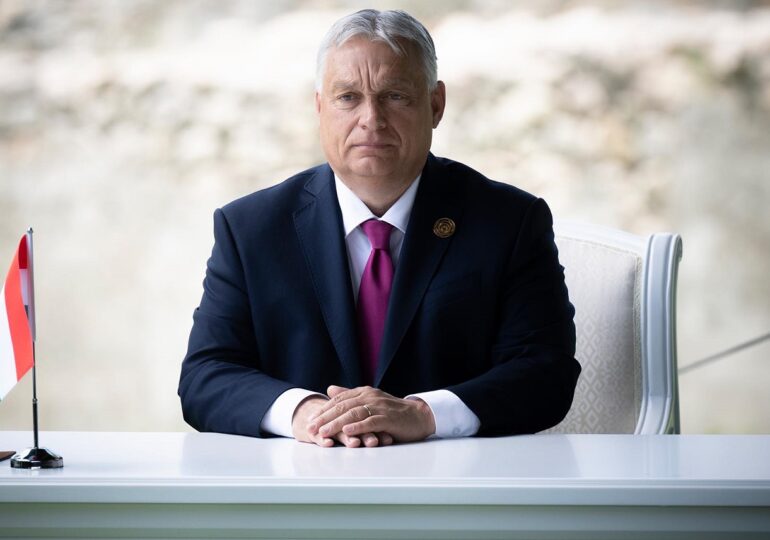
As Hungary heads towards next month’s parliamentary elections, attention in Budapest is already shifting towards the days after the vote and how the loser might react.
As the campaign is already marked by accusations of smear tactics and manipulated polls, concerns about the aftermath are growing. The losing side, whether it’s Fidesz, the governing party of Prime Minister Viktor Orbán, or Tisza, the rising party of Péter Magyar, will contest the result.
Zsuzsanna Szelényi, a former Fidesz parliamentarian and one of the party's early members, told Politico that she is concerned that if Magyar wins, Orbán might be tempted to disrupt or even block the transfer of power.
"Even if the opposition only wins a simple majority, Orbán will have plenty of tools to make forming a new government almost impossible or even convening a new Parliament. He could create a constitutional crisis and declare a state of emergency," she said.
Orbán's supporters, on the other hand, point to the prime minister's past as evidence that he is willing to accept the election results. Dismissed after his first term in 2002, Orbán waited for the right moment and made a strong comeback eight years later. If there is a risk that someone might not accept the results, they say, it is more likely to come from the Hungarian party Tisza.
"They are building the narrative that if they lose the elections, then this is an illegitimate result," said János Bóka, Hungary's EU minister.
"Would Péter Magyar come in front of a camera and say: well, I've heard the voice of the Hungarian people, they want this government to remain in power? Is this a realistic possibility after all this political hysteria they've created?" he added.
What the polls say
Polls conducted by independent and Tisza-friendly polling firms show that the Hungarian movement is ahead, on average, by 8 to 10 percentage points. Others, conducted by polling firms with ideological or financial ties to Fidesz - especially the Nézőpont Institute and the Center for Fundamental Rights - show that Orbán's party has a comfortable lead.
Supporters from both sides of the political divide have accused their opponents of fabricating polls and using them as weapons to try to shape public opinion.
"Regardless of who wins, there will be accusations of stolen elections," said Gábor Tóka, a political scientist at Central European University.
Orbán, he added, is expected to challenge an unfavorable result. "If there is no overwhelming victory against him, I don't see him conceding easily," he said.
"I think he will challenge the vote in districts and could encourage street protests to present the result as illegitimate. Not so much because he believes he can reverse the result, but because the more damage he can do to the new government and undermine it, the greater the chances are for him to return to politics later," he added.
Enormous tension after the elections
The prospect of unrest is not limited to Orbán's supporters. Given the expectations raised by the favorable Tisza polls, "there will be enormous tension in the weeks after the elections if the opposition loses," said Tóka.
Regarding Orbán, his past provides clues on how he might react to a defeat, said Szelényi, the former Fidesz parliamentarian who left the party as its ideology shifted from liberal to national-conservative in the 1990s.
The last time Fidesz lost national elections, in 2006, Orbán initially accepted defeat to the Hungarian Socialist Party.
That changed six months later due to a speech in which socialist leader Ferenc Gyurcsány admitted to lying to win the elections, denying that he would introduce austerity measures.
After spontaneous anti-government protests erupted, Fidesz lawmakers acted to exploit them, dismantling security barriers around the National Assembly so protesters could approach Parliament.
"Fidesz harassed the government with extremely obstructive tactics in Parliament," Szelényi recalled.
Orbán, she predicted, will likely repeat the strategy. "Orbán can make life very difficult for Tisza afterwards. Without a two-thirds majority, Tisza will be blocked in adopting many reforms," she added.
Orbán's Experience in Opposition
However, even some of Orbán's staunchest critics doubt he would go so far as to directly claim that the elections were stolen.
"The political cost of disregarding the results could destroy his chances of a political comeback," said Tóka, noting that Orbán congratulated Joe Biden in 2020, even though Donald Trump claimed the US elections were stolen.
Asked last year in an interview with Mathias Döpfner, CEO of the German media group Axel Springer, which owns Politico, if he would accept the result if he lost, Orbán said he has experience in opposition.
"I am not only the record holder for prime minister. I am also the record holder for opposition leader," said Orbán.
"Fidesz has been in politics since 1988. We have won against the opposition and we have won against the government. We have lost against the opposition and we have lost against the government. All of this has already happened and I have never questioned the election results," said Bóka, the EU minister, to Politico.