

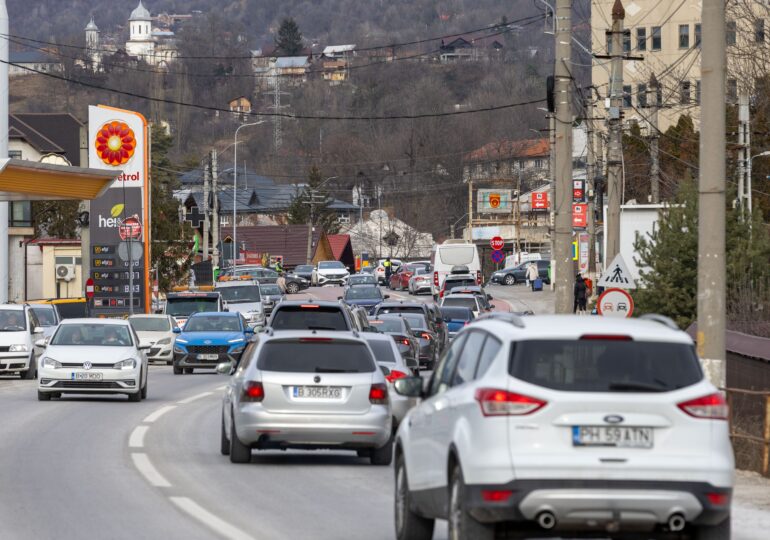
Romania remains the country with the most dangerous roads in the European Union, despite a slight decrease in the number of casualties in recent years. With 78 deaths per one million inhabitants in 2024, our country continues to top the grim ranking of road fatalities.
According to an analysis published by The Guardian, poor infrastructure, weak law enforcement, and a culture of aggressive driving explain why nearly half of the approximately 1,500 annual deaths are pedestrians and cyclists – vulnerable participants in traffic.
"Learning the hard way"
Journalist and radio host Lucian Mîndruță recounted for the cited source how he went through several accidents in his youth: he crashed into a car after avoiding a dog, was hit at an intersection after missing a sign, and skidded on ice, stopping between two trees.
"I wasn't attentive enough, didn't drive slow enough, and wasn't truly conscious," he says. The last serious accident occurred 20 years ago. "I learned the hard way."
The fact that he survived – and without causing someone else's death – is not a given in a country where car accidents are the main cause of death among young people, writes The Guardian.
First tougher measures
Amid public dissatisfaction, authorities have started to tighten legislation. Aggressive behavior – such as driving too close to the car in front or intimidating other drivers – has been explicitly defined in the law, and penalties have increased. At the same time, a network of fixed speed cameras and an automatic system for detecting violations are being introduced.
Alexandru Ciuncan, president of the Coalition for Road Safety, says "things are moving," but "not at the speed we desire."
However, data shows a slight improvement: in 2025, deaths decreased by 13%, and the number of severely injured decreased by 4%, according to police statistics cited by the British publication.
Brussels calls for correct enforcement of rules
However, structural change remains slow. In October, the European Commission sent Romania a letter of formal notice for the correct implementation of the road safety directive.
Activists speak of an "egoistic" driving culture and warn that changing mentalities could take more than a decade. In rural areas, the lack of sidewalks and safe crossings doubles the mortality rate compared to cities.
Pollution, "clunkers," and the SUV boom
Bucharest is the second most polluted capital in the EU, according to the European Environment Agency, and traffic generates around 60% of air pollution. The aging car fleet, dominated by imported second-hand cars, exacerbates the issue.
Raul Cazan, president of the 2Celsius organization, warns that old vehicles not only mean higher emissions but also additional risks in case of accidents: "We are not just importing pollution from the West. We are also importing danger."
At the same time, SUVs represent nearly half of newly registered cars. According to the Transport & Environment organization, the increased size and height of bonnets reduce visibility and increase injury severity in case of impact.
Speed, the main cause of tragedies
An analysis by the Coalition for Road Safety shows that excessive speed was the main cause of deaths in 2024, and "pedestrian indiscipline," including jaywalking, is frequently mentioned in cases of severe injuries.
Almost half of the deaths occur on national roads with high speed limits that pass through communities.
Looking back at his accidents, Mîndruță says he understood how dangerous individualism behind the wheel can be. "Killing someone would have been a nightmare."