
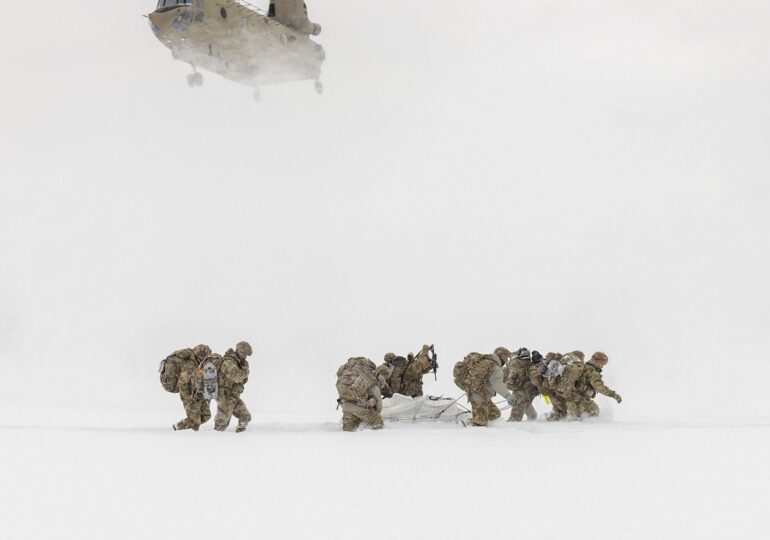
The US claims that occupying Greenland is vital for security, but analysts say that disagreements with allies would make this territory less secure. Additionally, armies in northern Europe are better adapted to Greenland’s conditions and have demonstrated this in a NATO exercise where Americans had to ask them to go easier.
The US National Security Strategy, published in November, does not mention Greenland. However, the strategic defense analysis conducted by the British government in June last year warned of the likelihood that the Arctic and the far north could be ice-free by the summer of 2040. This would allow „more actors access and create a new arena for competition in the extended vicinity of the United Kingdom,” the report states.
Greenland was not specifically mentioned in this document. The lack of American attention and any pressing threat from Russia or China means that NATO strategists working on an Arctic mission centered on Greenland must determine exactly what is needed to defend this territory. "It's about aerial surveillance systems, aircraft, or naval presence, and what kind?" said a diplomat to The Times.
The US Army has no experience in the Arctic region
The most important thing is that the US has few resources or military experience suitable for the Arctic. NATO's European allies, especially Scandinavians and the United Kingdom, are the ones with forces prepared for the Arctic, writes the quoted newspaper.
A military source noted that during the Joint Viking exercise conducted last year by NATO in northern Norway, American troops faced difficulties.
The exercise commanders had to ask Finnish reservists, the formidable Arctic warriors playing the role of invaders in military exercises, to go easier on the Americans. "The Finns had to be told not to defeat the Americans anymore, as it was embarrassing and demoralizing for them," a military source said.
For example, this is how Norwegian soldiers trained American soldiers: this soldier had one minute to get out of the water carrying a one-kilogram backpack.
Furthermore, the US depends on Finland for the best Arctic icebreaker technology.
These things demonstrate that Americans cannot handle Greenland on their own. "Europeans have the savoir-faire," a military source said. "If Trump wants to defend the region, he is going about it the wrong way, criticizing his Arctic allies," the source added.
A realistic scenario
America's dependence on European forces in Greenland is perfectly illustrated in the following very plausible scenario.
The Russian submarine Vladimir the Great, codenamed Project 955A, armed with 16 ballistic missiles, hides under the polar ice after leaving Murmansk, before attempting to slip through the maritime chokepoint between Greenland, Iceland, and the United Kingdom.
The Russians are unaware that a Royal Navy Astute-class attack submarine is on their tail. Information on the location of the Russian submarine is relayed to the American side. If the Russian submarine evades surveillance, they have failed in their mission, and the United States would be exposed to an increased risk of attack.
"This collaboration prevents a Russian submarine from remaining undetected off the coast of America," says a naval source.
For now, considering that Russian activity is considered minimal, the task is being efficiently managed. But if Washington were to try to forcibly take over Greenland, the danger to the United States could increase, as longstanding agreements on vital information sharing could unravel.
"The US, Norway, and the United Kingdom have a trilateral agreement on maritime patrolling to track Russian submarines and keep them as far east as possible. It's an alliance-wide operation. This could collapse if Trump seizes Greenland, making the US more vulnerable, not safer," said Ed Arnold, senior researcher for European security at the Royal United Services Institute.
An unimaginable rupture
Tom Sharpe, former commander of the Royal Navy, cannot imagine that this close bond that has worked for decades could cease. "It is inconceivable to me that such cooperation will disappear, and yet here we are."
If we remove the so-called "aquatic space management" by allies, he said, "all our submarines, both for attack and deterrence, become less secure."
Justifying a US takeover, President Trump said: "If we look beyond Greenland right now, there are Russian destroyers, there are larger Chinese destroyers, there are Russian submarines everywhere."
The American president's statements that the island is threatened by Russians and Chinese have puzzled military strategists and NATO intelligence specialists.
Some experts believe there is no information suggesting a significant Russian presence, and Russian forces' maneuvers in the Arctic have mainly focused on Norway, Finland, and Sweden.
Information contradicts Trump
Currently, the threat to Greenland from the Russian and Chinese navies is considered insignificant. Defense and security pacts, including a treaty allowing American military access to Greenland, ensure that any threat can be managed.
Arnold stated that the Russian threat to the region has decreased in recent years as Moscow has shifted its resources to Ukraine. Chinese activity is limited to scientific exploration as a potential cover for future military activities but is not considered an immediate threat.
According to Ed Arnold, the information does not support how Trump portrays the situation in Greenland: "The Russian threat is more severe than that from China, but it has decreased in recent years. A lot of resources have been invested in Ukraine. Russia's position in the Arctic is weaker now than at any time, probably in the last decade and a half."
A report by the Oxford Institute for Energy Studies, published last month, found that China's involvement in Arctic mining is declining in Canada and Greenland, "due to political factors, as well as high operating costs and risks."
Everyone wants a piece of the pie
Analysts almost unanimously note that the United States has not presented Greenland as an urgent security issue at recent NATO meetings. The Pentagon's Arctic strategy for 2024 only mentions it in the context of increased air and maritime patrols, something NATO was already considering.
Former Supreme Allied Commander Europe, General James Everard, believes there is no "military threat" in the near future, but it's about something else. "There is no immediate military threat, but Greenland is rich in minerals. Everyone wants a piece of the pie, so there are long-term commercial and security risks that need to be managed," he explained.
"NATO has a good strategy for engaging forces, which can be expanded as needed, but an agreement on their role and purpose must be reached," Everard added.