

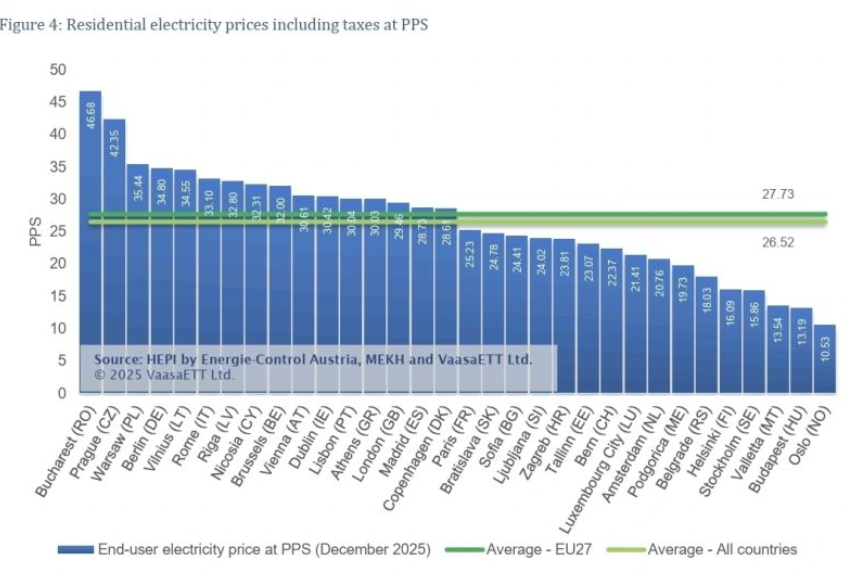
Bucharest is currently the most expensive European capital when we compare the price of electricity to the purchasing power of the population.
The conclusion comes from an analysis conducted by Ziarul Financiar, based on data from the Household Energy Price Index (HEPI), and is publicly highlighted by Alexandru Chiriță, the CEO of Electrica, one of the most important players in the Romanian energy system.
According to HEPI statistics, in December 2025, Bucharest ranked 1st out of 33 European capitals analyzed in terms of the cost of electricity paid by residential consumers, adjusted for purchasing power. Alexandru Chiriță draws attention to the difference between the nominal price and the real impact of the bill on people's incomes.
"December 2025. Bucharest is ranked 1st out of 33 capitals in Europe for the price of electricity relative to purchasing power. Not Berlin. Not Budapest. Not Sofia. Bucharest," writes Chiriță in a post on LinkedIn.
He emphasizes that, viewed strictly as a nominal value, the price of energy in Bucharest - around 28 cents per kWh - seems lower than in other European capitals, for example, Berlin, where energy costs 38.8 cents per kWh.
The major difference, however, arises when prices are reported in terms of purchasing power standard (PPS), an indicator used by Eurostat for statistical comparisons between countries.
"The data is public. HEPI, December 2025. 33 capitals. Germany pays 39 cents per kilowatt. We pay 28. Seems better, right? Only a German earns 3-5 times more than a Romanian. He pays more. Feels less. We pay less. Feel the most in Europe. That's the reality," explains the CEO of Electrica.
Alexandru Chiriță rejects the idea of simplistic explanations for this situation and warns that solely invoking external factors does not solve the problem. "Now, we can do what others do. Blame the ones before. The system. The EU. The war. The crisis. Maybe they are all true. Partially," he further states.
According to ZF's analysis, one of the main structural causes of the rise in energy prices in Romania is the massive reduction in production capacities. In the last ten years, approximately 7,000 MW of energy production capacity has been taken out of operation, and the pace of new investments has not managed to compensate for these losses. In this context, investments in new production capacities are seen as the only sustainable solution for reducing prices in the medium and long term.
Why Do We Have Such Expensive Energy
Romania was, on Thursday, January 15, for the second consecutive day, the most expensive spot market for electricity in Europe, due to very high consumption fueled by the recent low temperatures.
On the other hand, the decommissioning of large production capacities, insufficient investments in new power plants, and delays in developing renewable sources have reduced domestic supply.
These factors are compounded by the operation of the regional energy market, where Romania often ends up importing electricity at high prices during peak periods, as well as the cost structure in the bill, which includes regulated taxes and fees. Even though Romania produces some energy at relatively low costs, the benefit is not fully reflected in the final price paid by consumers, especially in a context of significantly lower incomes compared to Western European countries.
Read a Spotmedia analysis on the reasons why energy is more expensive in Romania than in Germany, even though production costs are lower.