

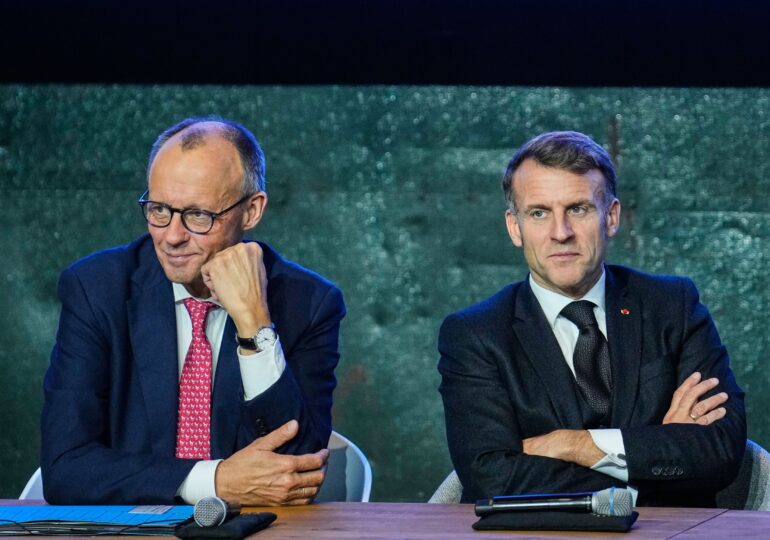
In a moment when the European Union needs a unified stance in the face of new pressures coming from Washington, the Franco-German relationship – considered the political engine of the EU – is going through one of the most difficult periods in recent years.
According to an analysis by Politico, the increasingly visible divergences between Paris and Berlin risk weakening the European effort to build a common front against the pressures exerted by U.S. President Donald Trump.
The crisis has emerged precisely in the context of escalating tensions caused by Trump's threats regarding Greenland and trade tariffs, a file that would have needed, more than ever, close coordination between the two European capitals.
The promise of a "common position" in a tense moment
German Chancellor Friedrich Merz announced that he intends to build, in the coming days, a common position with French President Emmanuel Macron in an attempt to relaunch the Paris–Berlin axis and make progress in the relationship with Washington.
However, this initiative comes after months of mutual frustrations, suspicions, and unresolved conflicts.
French diplomats are concerned about the increasingly assertive stance of Berlin, which seems to position itself as the de facto leader of Europe.
On the other hand, German officials are increasingly irritated by France, citing the deadlock in the joint fighter jet program, Paris's opposition to the EU–Mercosur agreement, and the abandonment of the plan to use frozen Russian assets to support Ukraine.
Macron versus Merz: two different styles in the relationship with Trump
The differences between the two leaders became evident after Trump threatened to impose tariffs on EU states opposing the takeover of Greenland. Macron, faithful to a Gaullist tradition of asserting European autonomy from the U.S., called for a strong response, including the use of the Anti-Coercion Instrument – the so-called EU's commercial "bazooka".
Merz, a declared Atlanticist, adopted a much more tempered approach, relying on dialogue and the possibility of convincing the American president to de-escalate. On Monday, the German Chancellor publicly acknowledged the difference in tone: France "wanted to react a bit more harshly than us," he said, explaining that Paris is less exposed to the risks of a total trade war with the U.S.
Germany, internally divided. France, increasingly irritated
A major obstacle to a common position is the internal division within the German government. While Macron promotes the activation of the Anti-Coercion Instrument, the signals coming from Berlin are contradictory.
"Different German politicians say different things," a European diplomat quoted by Politico said. "If you listen to the Finance Minister, he says we should do it," he added, referring to the support expressed by Lars Klingbeil for the French approach.
On the other hand, the Foreign Minister has shown much more reserve, although "their ambassador had told colleagues just a few days before that the bazooka should be on the table."
The Franco-German engine has not produced anything
Even though Merz is counting on a quick alignment with Macron to manage the crisis caused by Trump, the structural problems in the Franco-German relationship are much deeper. "In the last six months, the Franco-German engine has not produced anything," said an EU official, speaking on condition of anonymity.
The shift in power dynamics fuels tensions.
Germany is preparing to build a significantly larger army than the French and is expected to be the only EU economy in the top 10 globally by 2050. While Macron is constrained by high public debt and internal political instability, Merz increasingly assumes a central role on the European stage.
Ukraine, Mercosur, and the battle for industry
German frustrations are also fueled by differences in approach regarding support for Ukraine.
Berlin believes that France contributes significantly less than Germany, despite the leader's declared ambitions on this file.
Tensions have recently erupted in the debate over the EU's 90 billion euro loan for Ukraine. France proposed that the funds be used for the purchase of European weaponry, benefiting the French industry. Germany, on the other hand, insisted that priority should be given to companies from the states that have contributed the most to supporting Kiev. "This is a pretty clear 'f*ck you' directed at Paris," a EU diplomat quoted by Politico said.
These tensions are compounded by the conflict over the EU–Mercosur agreement and the deadlock in the joint FCAS fighter jet project, valued at 100 billion euros.
According to a German parliamentarian, French companies exert "massive pressure," and discussions have even reached the hypothesis of developing a fighter jet without the French manufacturer Dassault Aviation – a scenario considered "a disaster."
The shadow of the far right
All these tensions are amplified by the political context in France. Rassemblement National (far-right) leads in polls for next year's presidential elections, and this prospect already influences Franco-German discussions in the defense field.
"The possibility of Rassemblement National coming to power already weighs heavily on Franco-German discussions in defense matters," said Jacob Ross, a researcher at the German Council on Foreign Relations, a German think tank on foreign policy and security.