

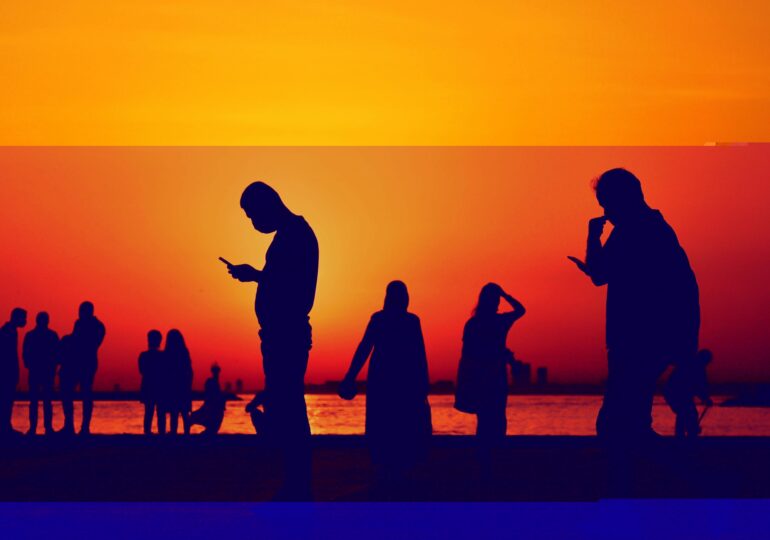
The Edelman Trust Barometer 2026, launched on Tuesday at the World Economic Forum in Davos, reveals a fundamental shift in contemporary societies: people are no longer reacting solely with dissatisfaction or resentment, but are increasingly retreating into individual spaces marked by distrust, anxiety, and lack of empathy.
The study conducted by Edelman indicates a significant erosion of trust in institutions, leaders, and even in other members of society.
From Dissatisfaction to Social Isolation
According to the report, the world has entered a stage described by the authors as “insularity”: people are increasingly living and working in their own bubbles, with limited interactions and a decreased willingness to understand different perspectives. This evolution is fueled by four major factors.
Economic anxiety reaches record levels: two-thirds of employees fear that new trade policies and tariffs will negatively impact the company and, consequently, their jobs.
Meanwhile, optimism about the future is plummeting – only 32% of respondents still believe that the next generation will have a better life than the current one.
The decline in trust in institutions is accentuated by the information crisis: 65% of respondents fear that foreign actors are deliberately introducing false information into national media to amplify internal divisions.
“My Employer,” a Potential Social Mediator
In this fragmented landscape, the Edelman Barometer 2026 highlights a notable exception: the business environment remains the only institution perceived globally as both competent and ethical. Furthermore, the direct relationship with the employer is seen as a space of stability and social reconnection.
“Globally, we have moved from dissatisfaction and resentment to isolating ourselves, living and working in our own bubbles, with less and less empathy and understanding towards those who are different, and diminishing trust in people, institutions, and organizations. This trust needs to be rebuilt, even though it seems like we are at the eleventh hour. The study shows that the business environment, 'my employer,' is seen as a facilitator that can reconnect different groups and, thus, restore trust,” explains Corina Vințan, CEO of Links Associates, an Edelman-affiliated communication company.
She emphasizes that, for the first time, the business environment is perceived as more ethical than NGOs, a shift that puts additional pressure on business leaders to take an active and responsible role in society.
A Growing Gap Between Masses and Elites
The report also highlights deepening differences in perception among social groups. If in 2012 the trust gap between high-income respondents and low-income respondents was six points, in 2026 it has reached 15 points.
At the same time, developed economies are registering, for the second consecutive year, the lowest trust indices, being surpassed by emerging markets.
Misinformation and Withdrawal from the Collective
In the last five years, events such as inflation, the rise of misinformation, the COVID-19 pandemic, trade wars, and the rapid expansion of artificial intelligence have deeply shaped trust in people and institutions. Against this backdrop, institutional leaders are constantly losing credibility, and trust is shifting from collective to individual levels.
“We are moving towards nationalism, at the expense of global connectivity, and towards individual gain, instead of common progress. The mentality has shifted from 'we' to 'me',” warns Richard Edelman, CEO of Edelman.
The Edelman Trust Barometer is a global annual study that measures the public's level of trust in the main centers of power in society: governments, the business environment, the media, and NGOs. It is conducted by the communication company Edelman and is considered one of the most influential and cited international research on trust.