
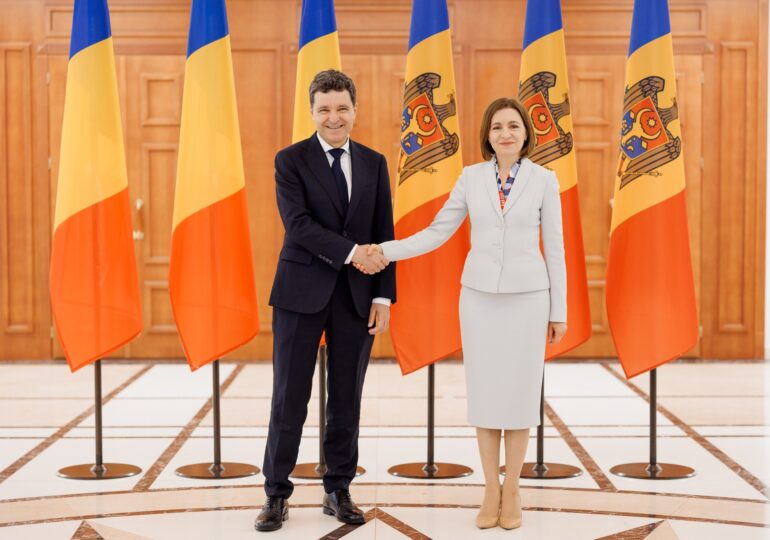
The President of the Republic of Moldova, Maia Sandu, recently made a rare statement for a sitting leader: she suggested that she would support the unification of her country with Romania. The statement comes against the backdrop of increasing pressures exerted by Russia and profound changes in the international order.
„It is becoming increasingly difficult for a small country like Moldova to survive in democracy, as a sovereign state, and of course, to resist Russia,” said Sandu.
She emphasized, however, that at this moment, the majority of citizens of the Republic of Moldova support maintaining independence and the country's European path, not reunification with Romania, and this remains the direction it will follow.
The pressure of the new international order
Journalist Paula Erizanu, from the publication Kiev Independent, discussed this topic with two political analysts: Ileana Racheru and Victor Ciobanu. Racheru argues that Maia Sandu's statement should be read in the context of accelerated global changes following Donald Trump's return to the White House.
"The statement was forced as an assessment exercise: if the international order shifts from a liberal one to a 'realist' one, driven by (Vladimir) Putin and Trump, the Republic of Moldova must choose how it disappears," explained Racheru.
The analyst adds that in such a scenario, even a potential illiberal drift in Romania would be preferable to direct Kremlin influence. "Even a (Viktor) Orban-type regime in Romania - although I don't think the populist far right would win a majority - would be preferable to Putin's regime," she said.
Sociological data indicate opposite developments on both sides of the Prut River. In Romania, support for reunification has dropped from around 70% to 40% after Russia's invasion of Ukraine in 2022. In the Republic of Moldova, on the other hand, public support has increased from 30% to about 40%, according to the most recent surveys.
Signs of political support
Maia Sandu's statement was followed by favorable reactions from both capitals. The Prime Minister of the Republic of Moldova, Alexandru Munteanu, stated that he would vote for reunification in a hypothetical referendum. Both he and Maia Sandu hold dual citizenship, a situation encountered in approximately one-third of the population of the Republic of Moldova.
Deputy Vasile Costiuc, leader of the unionist party Democrația Acasă, announced that he would propose organizing a referendum on this issue.
And the President of Romania, Nicușor Dan, had previously expressed support for reunification, but emphasized that European integration is "one of the possible paths" towards this goal.
According to Ileana Racheru, Maia Sandu's positioning also had a collateral political effect: "it reduced the level of hostility from the AUR voters," the far-right populist party that accused Sandu and the Romanian electorate in the Republic of Moldova for Nicușor Dan's victory in the 2025 presidential elections.
AUR leader George Simion, defeated in the second round of those elections, did not comment on the recent statements. He is banned from entering the Republic of Moldova and Ukraine due to alleged ties with Russian intelligence services.
A shared history, an uncertain future
The territory of present-day Moldova was part of the medieval principalities that laid the foundation for the formation of modern Romania until its annexation by the Russian Empire in 1812. After World War I, the region returned to Romania but was again annexed by the Soviet Union in 1940, under the name of the Moldovan Soviet Socialist Republic.
Romanian language was renamed "Moldovan" and written in Cyrillic script, and the idea of reunification reappeared in the late '80s, with the National Liberation Movement.
According to reports of the time, the first President of the Republic of Moldova, Mircea Snegur, allegedly proposed the reunification to his Romanian counterpart, Ion Iliescu, several times without success, as Iliescu was then perceived as close to Moscow.
Discussions about reunification were abruptly halted in 1992 when Russia militarily intervened on the side of the separatist region of Transnistria. After the ceasefire agreement signed by Boris Yeltsin and Mircea Snegur, the issue was pushed into the background, and Transnistria remained under Russian control.
A forced reunification, in an extreme situation
In the opinion of political analyst Victor Ciobanu, reunification remains, under current conditions, more of an ideal than a realistic project.
"Beyond the opportunity in 1991, I believed in only one scenario: a forced reunification, in an extreme situation. In case Russian troops were to reach Transnistria through Odesa, I think this scenario was discussed behind the scenes. It may remain a scenario," stated Ciobanu.
However, it is not clear whether such a move would be accepted by Romania. "I don't know if Nicușor Dan would pursue reunification in extremis," said Ileana Racheru, warning that such a decision would not belong only to Bucharest but also to Brussels and NATO.
"I believe the West is quite aware that Russia wants to advance," concluded the analyst.
G.P.