


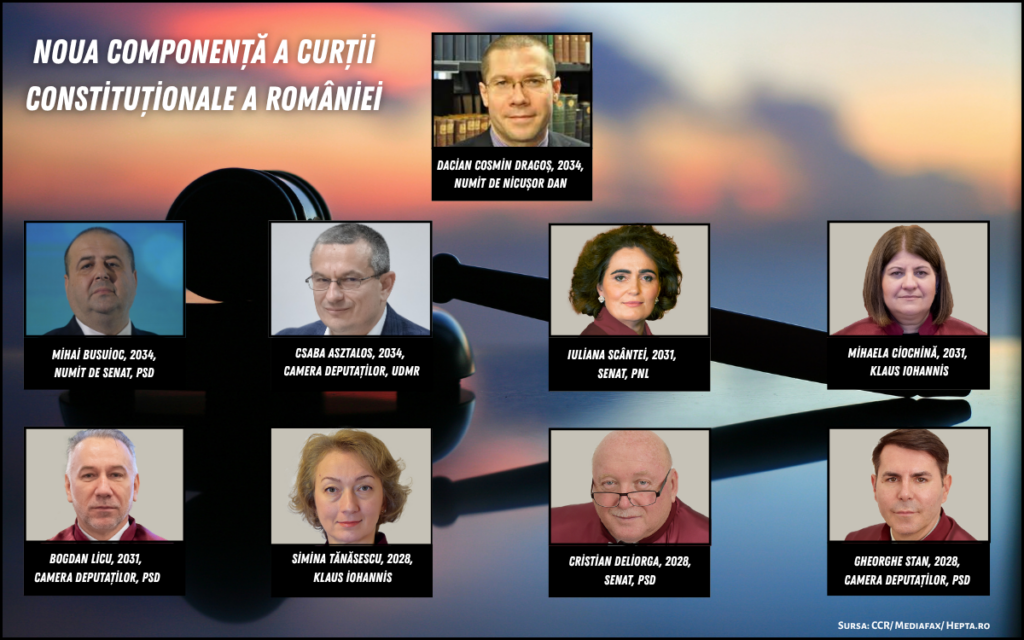
On December 28th, on a Sunday, three days after Christmas, the nine CCR judges gathered to make a decision regarding the special pensions of the magistrates. The vote could not be held due to the boycott initiated by the judges appointed by PSD. The session was postponed to Monday, December 29th, when, once again, the four were absent, failing to ensure the necessary quorum for the validation of the legislation that reduces the pension amount and raises the retirement age of judges and prosecutors.
Over two weeks ago, more precisely on December 10th, the Constitutional Court postponed a decision on the same matter, scheduling yesterday’s session. Many raised eyebrows regarding the date of the new meeting, on a Sunday, very close to the end of the year.
According to CCR sources, the judges appointed over time by PSD, Busuioc, Licu, Deliorga, and Stan, boycotted yesterday’s session by leaving the courtroom. A new meeting was announced for today, December 29th. Additionally, this session was postponed due to the lack of quorum, with the four judges being absent.
The Constitutional Court decided... to continue deliberations on December 29, 2025, at 10:00, regarding the unconstitutionality objection of the Law amending and supplementing certain normative acts in the field of service pensions, an objection raised by the High Court of Cassation and Justice, noting the lack of quorum at the deliberation session held on December 28, 2025.
CCR, press release December 28, 2025
The actions of the aforementioned indicate two important things:
- at this moment, there is an anti-PSD majority within the Constitutional Court, the first since the institution's establishment in June 1992;
- PSD continues to exert pressure on judges nominated by the party, leading them to oppose any reforms in the judiciary system;
The two noticeable effects following the boycott within the CCR describe the current political reality, but this can change in the future, depending on the dynamics between political forces.
Looking at the profiles, education, and social and political activity of the 5 reformist judges - namely Simina Tănăsescu, Mihaela Ciochină, Iuliana Scântei, Csaba Asztalos, and Dacian Cosmin Dragoș - although there may be occasional differences of opinion among them, politically influenced decisions have less impact on them.
An argument in this regard is that Judge Mihaela Ciochină initially voted alongside the four Social Democrats, rejecting the first attempt by the Bolojan Government to regulate the special pensions of magistrates.
Public opinion calls for reduction of magistrates' pensions
It must be noted that CCR judges can block court proceedings if four of them do not attend a session or leave it, due to a legal provision stating that decisions can be made with a majority vote, i.e., 5-4, provided that 6 judges are present, ensuring a two-thirds quorum.
Therefore, for the reduction of special pension amounts and the increase in the retirement age of magistrates, the four CCR judges can theoretically indefinitely postpone making a decision, even if there is a majority considering the law proposed by the Government and adopted by Parliament through the assumption of responsibility as constitutional.
The situation created by the boycott within the CCR has serious consequences, as there is immense societal pressure against magistrates' privileges and corruption in the judiciary.
The pressure exerted by Lia Savonea, the head of the High Court of Cassation and Justice, on some PSD leaders, the influence and control she has over the CSM and the Judicial Inspection have led to the current state of affairs, one that triggers immense public dissatisfaction with the entire judiciary system.
This internal confrontation within the Constitutional Court indicates a broader societal conflict, where there is an attempt to launch a new offensive against corruption, a phenomenon that affects all layers of society, creating a dangerous rift between the general public and state authority.
What is Lia Savonea based on?
Furthermore, it should be mentioned that the current boycott by the four judges practically cannot last long. It resembles more of a strategy to buy time, most likely for conducting negotiations behind closed doors.
Continuing the procedure to block the CCR sessions could, at the limit, lead to a reaction from the President or Parliament, with the possibility of amending the Constitutional Court's operating law.

This being an extreme situation, with none of the involved parties desiring such a crisis, there is a possibility that ultimately the current minority within the CCR will comply and accept the majority's decision regarding the special pensions of magistrates.
The entire authority and control exercised by Lia Savonea over the Romanian judiciary system are based on her assumption that she presents herself as a guarantor of magistrates' privileges.
The pressures, the terror exerted on some judges, the arbitrary actions of the Judicial Inspection to remove magistrates who do not comply with the absolutist leadership have been accepted by a large part of those operating in the judiciary system in exchange for a quick retirement and higher pension income than their salary.
The pressure from within is real, and the informal mechanisms of influence operate much harsher than seen from the outside...
Testimony of a magistrate at the meeting with President Nicușor Dan, regarding corruption in the judiciary
It's a deal created by Savonea to gain the support of a critical mass of magistrates to allow her to influence the decisions of the judicial panels in certain cases, mainly those involving high-level corruption and organized crime.
In a scenario where privileges disappear following a favorable CCR decision to Parliament, the entire structure on which Lia Savonea's power relies would collapse.
After the latest events, it can be said that the year 2026 will be defined in Romania by the major confrontation between citizens and a corrupt part of the judiciary system, with significant political positions in this fight, some of which may lead to the breakup of the current governing coalition.