
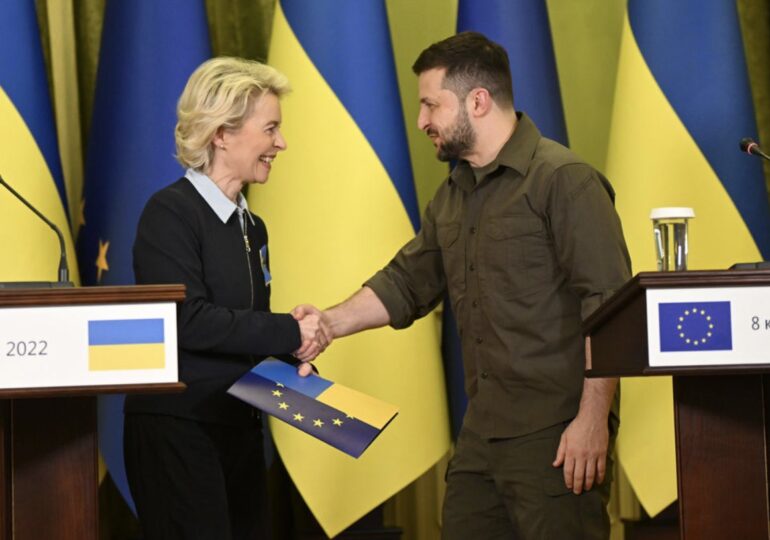
The European Union is considering a major reform of the enlargement rules, which could allow Ukraine to quickly join the bloc in the context of a possible peace agreement with Russia, but with limited rights.
The plan, under discussion in Brussels, would rewrite the accession system used by the EU since the Cold War era, writes Financial Times.
A two-tier model instead of classic accession rules
Specifically, the European Commission is discussing a controversial "light expansion" model that would allow Ukraine to become an EU member, but without full access to decision-making mechanisms. The plan, in a preliminary phase, has already raised concerns in several European capitals, according to FT, which spoke with seven high-ranking officials.
Ukraine officially became a candidate country for the EU shortly after the large-scale invasion by Russia in February 2022 and considers accession as a central pillar of its post-war future and a confirmation of its pro-Western orientation.
Accession in 2027, although reforms could take a decade
In the draft 20-point peace plan, a possible accession of Ukraine to the EU in 2027 is mentioned. However, this timeline is much more ambitious than the EU's internal assessments, which indicate that Ukraine may need up to 10 years to meet the strict accession criteria.
Commission officials acknowledge, however, that Ukrainian President Volodymyr Zelensky could accept difficult concessions in a potential peace agreement - including territorial concessions - only if he can present EU accession as a major strategic outcome.
No voting rights, but gradual access to the single market
According to the discussed plan, Ukraine would enter the EU with limited rights: initially, it would not have the right to vote at EU leaders' summits or ministerial meetings. Instead, Kyiv would receive gradual access to parts of the single market, agricultural subsidies, and internal development funds, depending on meeting post-accession objectives.
Such an approach would radically change the rules set in 1993, which stipulate that states can only become EU members after fully meeting all accession criteria and negotiation chapters.
"Extraordinary times call for extraordinary measures"
A high-ranking EU diplomat, cited by FT, argues that the change is justified by the current geopolitical context.
"Extraordinary times call for extraordinary measures... We are not undermining enlargement. We are expanding the concept of enlargement. The rules were written over 30 years ago. And they need to be more flexible. This is a unique moment in a generation, and we need to face it," the diplomat said.
Concerns about EU stability and the value of accession
However, other European diplomats warn that such a model could undermine the Union's cohesion. "It is a trap set by Putin and Trump, and we are falling into it," said a second EU diplomat, citing major risks to the bloc's unity.
On the other hand, Mujtaba Rahman, Director for Europe at Eurasia Group, one of the world's most renowned political and geopolitical risk consultancy firms, believes that the EU practically has no alternative. "The EU is once again caught between a rock and a hard place. It has no choice but to accelerate Ukraine's accession, but this will open a Pandora's box of political and public policy risks that no one in Brussels fully understands," Rahman says.
Hungary blocks the accession process
Currently, Ukraine's progress on the classic accession path is blocked by Hungary, which has refused to approve the opening and closing of the 35 negotiation chapters.
However, European and Ukrainian officials believe that if the US were signatories to the final peace agreement, this could force Budapest to abandon its opposition.
Von der Leyen: Accession, a security guarantee for Ukraine
The President of the European Commission, Ursula von der Leyen, explicitly links Ukraine's accession to the peace negotiations.
"Accession is both an essential security guarantee for Ukraine and an indispensable engine for future growth and prosperity," she stated.
Collateral effects for other candidates and partners of the EU
Several member states strongly oppose any form of two-tier accession. "You can't have a merit-based process with a fixed end date," warns an EU diplomat. Another official says that imposing such a model could cause "a damaging rupture between Brussels and the member states."
Moreover, changing the rules could also affect other candidate countries, such as Montenegro and Albania, as well as countries with limited progress, such as Bosnia and Turkey. The implications for countries close to the EU but without member status, like Norway or the United Kingdom, remain unclear.
G.P.