
The extraordinary – and absolutely exhausting – focus of American President Donald Trump on the world stage has intensified. Surreal scenes are unfolding these days at the White House.
Donald Trump himself said it: It’s a „crazy world!” Tension has been strongly felt in Washington, stretched across the Atlantic and covered the Middle East. Everyone was expecting fire to rain from the sky.
Would Trump attack Iran to fulfill his promise that "help is on the way" after the brutal repression of protesters?
Or would he take a defensive action, relying on apparent and questionable assurances from a source in Iran that the executions would cease?
"We will watch and see what the process is," he told reporters.
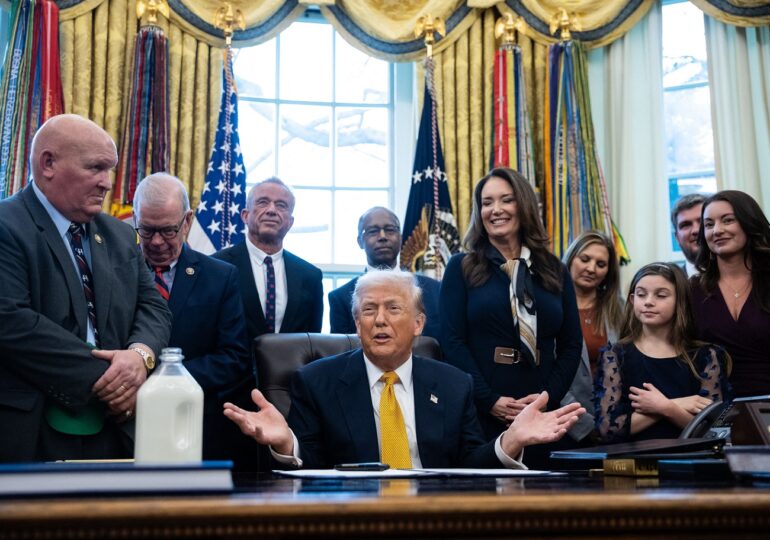
The President with the Milk Bottle on the Desk
Everyone is waiting to see what Trump will do next. And he loves it, sitting behind the desk in the Oval Office, throwing threats, innuendos, and insults, like a conductor leading an orchestra - but evoking not harmony, but global chaos, writes CNN.
Asked how he can trust the promises of an Iranian regime that just imposed brutal repression and killed thousands of people after decades of severe authoritarianism, Trump offered one of his classic final conclusions to the Americans.
"We'll find out," he told reporters. "I'll find out after that. You'll find out, but we've been told by reliable sources and I hope it's true. Who knows, right? Who knows. A crazy world."
One of the craziest things was that Trump talked about a serious war and peace issue during an Oval Office event promoting... whole milk that schools will be able to serve to children under a recently passed law.
"Do you remember the old times when we were kids?" Trump asked journalists who wanted to know if he was about to launch an attack on Iran.
In a dizzying digression, the president continued: "Everyone shared a bottle. Today, we tend not to do that. But if you want, if you trust the person you're drinking after, it's right here, it's yours. Okay?"
A Surreal Day at the White House
As often happens in the Trump era, Wednesday was a surreal day in Washington.
The White House received a delegation from Greenland and Denmark following Trump's request to take ownership of the world's largest island. CNN also reports on how bizarre this visit was.
Officials were in Washington to show that the semi-autonomous Danish territory was not for sale and that Trump should not try to buy or invade it.
In his first term, the idea of trying to acquire Greenland to go down in history as one of the presidents who honored America's "manifest destiny" with a new territory was considered a joke. But in his second term, an unbridled supreme commander is taken very seriously by European leaders whom his national security strategy promised to replace with right-wing populists.
The confrontation is even stranger as Greenland is a NATO territory. Trump's claims that Denmark cannot defend it make no sense: Denmark is part of the most powerful military alliance in the world. Any attack on the island would be considered an attack on all NATO members based on a guarantee of mutual defense.
The worst thing that could have happened in discussions with JD Vance and Secretary of State Marco Rubio was an explosion reminiscent of the attacks Vice President brought against Ukrainian leader Volodymyr Zelensky last year. Such a disaster seems to have been avoided, though the delegation, obviously concerned, came out to say that there is still a "fundamental disagreement" about what should happen with Greenland.
Later, in the Oval Office, the president complained that he needed Greenland for the Golden Dome missile shield, which he proposed and warned that Russia and China are preparing to enter this territory, where there is already an American base.
He was also extremely ironic about the military prowess of a brave NATO ally who sent its soldiers to die alongside Americans in the wars after September 11, due to the famous mantra "an attack on one is an attack on all" that Denmark and all other members invoked to the benefit of the US after the al-Qaeda attacks in 2001.
"They put an extra dog sled there last month. They added a second dog sled. That won't solve the problem," Trump said about Denmark's defense capability in Greenland.
Allies Defend Greenland from the US
Throughout the day, the Greenland crisis took an even more extraordinary turn. Denmark announced that it is sending additional military personnel to the island, and its Scandinavian "cousins" have also signed up. Sweden is deploying an unspecified number of troops to the island. Norway is deploying two individuals.
Additionally, Germany announced that it will send 13 soldiers on an "exploration mission" to join their NATO comrades. And Emmanuel Macron announced Wednesday evening that French forces have been sent to join Operation Arctic Endurance, hastily organized in Greenland. "The first French military elements are already on their way. Others will follow," he wrote on X.
Such deployments are obviously symbolic - they would not equate to what the powerful American armed forces do. But the symbolism is still stunning: European states are sending their people to pretend to defend NATO territory not from Russia, China, or a terrorist group, but from the President of the United States - the most important and powerful leader of the Western alliance.
So, what happens next? Does Trump maintain pressure to try to force Denmark to sell Greenland? - although he has offered no plan on how to come up with the hundreds of billions of dollars such a move would entail.
Or will he continue in the style of the raid that ousted Venezuelan leader Nicolas Maduro by sending American forces to conquer Danish territory? Such an action would pose a major dilemma for Pentagon leaders leading NATO.
Trump doesn't say anything. "We'll see what happens with Greenland," he replied, using a favorite expression, while adopting his frequent posture of a foreigner commenting on events in which he is, in fact, the sole decisive actor.
A President Juggling Multiple Crises
The world is facing a president who governs capriciously and whose strategy is not to have an apparent strategy but to keep everyone in suspense, highlights the American television station.
Trump's supporters argue that his unpredictability is a plus; that he has put the world on edge and rebuilt American power and influence. If adversaries of America cannot be sure what he will do next, how can they challenge the US?
Trump can boast of undeniable achievements in foreign policy. He has caused serious harm to Iran's nuclear program, with only negligible reprisals from the Islamic Republic, a step other presidents have not dared to take.
He may have no plan for post-Maduro Venezuela, other than selling oil - but the besieged and impoverished people of the country will not miss the dictator. And on Wednesday, the administration announced the start of the second phase of Trump's peace plan for Gaza, focusing on beginning the demilitarization of Hamas and the reconstruction of the Strip.
However, there is still a sense that Trump is improvising, like a juggler frantically trying to keep multiple balls in the air simultaneously, managing to catch them at the last moment.
Despite a series of successful - and dramatic - military operations, Trump's luck may not last forever. And his arrogance could push him too far, notes CNN.
The situation in Iran is a perfect example of his impulsive and often impenetrable style of leadership.
For days, Trump seemed to be inexorably heading towards new military strikes on Iran, after repeatedly warning that he would punish the fragile clerical regime for ignoring his warnings not to repress protests with bloodshed.
Every sign pointed to action. The administration ordered its personnel to leave its vast base in the Qatari desert, a possible target for any reprisals. Several countries urged their citizens to leave Iran and postpone travel in the region.
On Wednesday evening, Iran closed its airspace, apparently to facilitate the identification of any approaching American or Israeli warplanes. Flight tracking systems showed flows of commercial aircraft deviating from its territory - normally a busy air route between Europe and Asia.
Trump has created huge expectations
Despite all his bravado, Trump may have doubts. The act of ordering the US military into battle is gut-wrenching for any president.
Any attack on Iran, intended to stop the regime's repression machinery in Tehran, should be broad and deep. However, the type of rapid and sharp shock that characterized American attacks in Venezuela and Iran last year may prove ineffective, and the US could be dragged into a longer adventure that Trump's supporters, "America First", already disturbed by his global power grab, could oppose.
Of course, the possible deviation from Trump's military action could be a stratagem. Before attacking Iran's nuclear program last year, he gave the impression that Tehran had a few more days to reach an agreement - then sent American bombers on a bold mission around the world to target its nuclear sites.
Nevertheless, Trump has also created huge expectations. Previous presidents have been careful to avoid any impression that they would call on Iranian protesters to take to the streets, to avoid giving the regime an excuse to claim they are acting on behalf of the Great Satan, the United States.
But Trump had no such concerns. "Iranian patriots, CONTINUE TO PROTEST - TAKE CONTROL OF THE INSTITUTIONS!!!... HELP IS ON THE WAY," the president wrote in a post on Truth Social on Tuesday.
Of course, protesters facing the brutality of their leaders would perceive this as a call to action and a promise of support.
"If he does nothing, history will consider this a strategic and moral betrayal, as he encouraged protesters to take to the streets for weeks, continuously assured Iranians that he supports them, and watched as thousands of protesters were killed," said Karim Sadjadpour, of the Carnegie Endowment for International Peace.
"At the same time, military action is fraught with risks," said Sadjadpour. "There is no miraculous solution whereby we can clearly eliminate the regime and usher in a secular democracy."
It is hard to see how the president will get out of this tough situation. Threats, deception, and juggling all aspects of foreign policy in the world can only work for a limited period. An American president who disdains traditional political processes, acts on instinct, and claims to be a man of peace while developing an increasingly appetite for spectacular and violent military actions is aware of all aspects.
As he himself said, it's a "crazy world," concludes CNN.
T.D.