

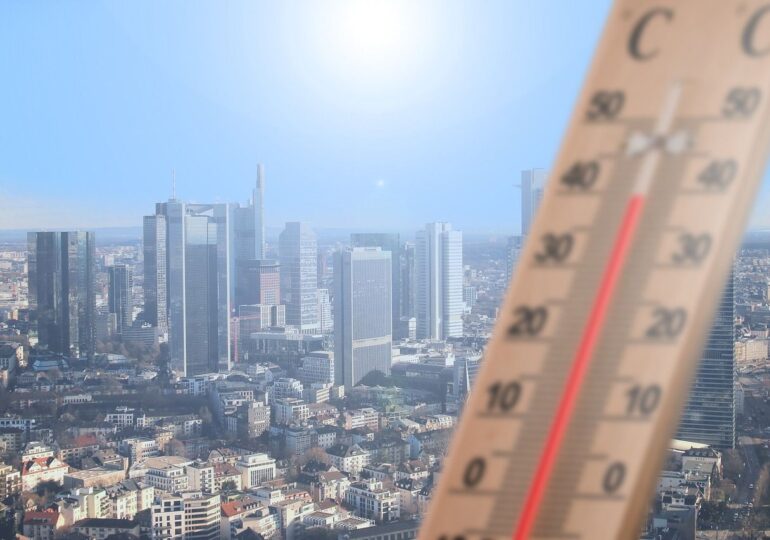
The world is rapidly approaching the 1.5-degree Celsius limit, a critical threshold for intensifying the dangerous effects of climate change.
Global average temperatures are currently about 1.4°C above pre-industrial levels, according to data published by the European climate monitoring service Copernicus Climate Change Service. According to the same data, cited by Politico, the year 2025 was the third warmest ever recorded globally.
Copernicus data indicates that if the current warming trend continues, the 1.5°C threshold set by the Paris Agreement will be exceeded before the end of this decade.
In the agreement signed in 2015, governments committed to limiting global warming to "well below" 2°C and ideally to 1.5°C. Scientists warn that every tenth of a degree increase raises risks, from more intense heatwaves to accelerated sea-level rise.
"It is practically inevitable that we will exceed the 1.5°C threshold"
Carlo Buontempo, Director of the Copernicus Climate Change Service, says the world is entering a new phase of the climate crisis. "With the 1.5°C threshold, in terms of the Paris Agreement, so close, we are practically entering a phase where it will be about managing this overshoot," he said.
Buontempo warns that "it is practically inevitable that we will surpass this threshold" and that the essential decision lies in how societies will manage the "increased and amplified risks" that will follow. "The greater the overshoot and the longer it lasts, the greater the risk," he added.
Why exceeding the 1.5°C threshold matters
Scientists warn that surpassing 1.5°C can trigger so-called climate system "tipping points," such as accelerated degradation of tropical forests or collapse of ocean circulation, with irreversible effects.
In theory, temperatures could later be brought back below this threshold through carbon dioxide removal technologies, a scenario known as "overshoot." However, these technologies are not currently available at the necessary scale.
The last three years, unprecedented in history
The hottest year remains 2024, with a warming of 1.6°C, the only one that has already exceeded the 1.5°C threshold. However, the targets of the Paris Agreement refer to long-term trends.
According to Buontempo, three different Copernicus models - including five-year averages and 30-year linear trends - show that global warming has already reached about 1.4°C.
In 2025, the global average temperature was 1.47°C above pre-industrial levels, only marginally lower than in 2023. This happened even though the El Niño phenomenon ended in mid-2024, and a La Niña cooling phase appeared towards the end of last year.
"The main reason is the accumulation of greenhouse gases"
"The last three years, in particular, have been extremely warm compared to previous years," said Samantha Burgess, Deputy Director at Copernicus. She emphasizes that taken together, these three years have exceeded the 1.5°C threshold, an unprecedented fact.
"The main reason for these record temperatures is the accumulation of greenhouse gases in the atmosphere, dominated by the burning of fossil fuels. As greenhouse gases continue to accumulate in the air, temperatures continue to rise, including in the ocean. Sea levels continue to rise, and glaciers, sea ice, and ice caps continue to melt," Burgess said.
Europe, wildfires, and extreme heat stress
For Europe, 2025 was also the third warmest year in history.
Heat and wind conditions have favored record vegetation fires, generating the largest emissions associated with fires since monitoring began 23 years ago.
Globally, half of the world's population has experienced an above-average number of days with severe heat stress, meaning temperatures felt of at least 32°C. In regions such as Australia, North Africa, or the Arabian Peninsula, there have been more days of extreme heat stress, with temperatures felt above 46°C.
"Today's children will be exposed to more risks"
"The summers we are facing now are very different from the summers our parents and grandparents experienced," Burgess warned. "Today's children will be exposed to more risks related to heat and climate than we or our parents were," she said.
The polar regions have also strongly felt the warming: Antarctica had its warmest year on record, and the Arctic its second warmest.