

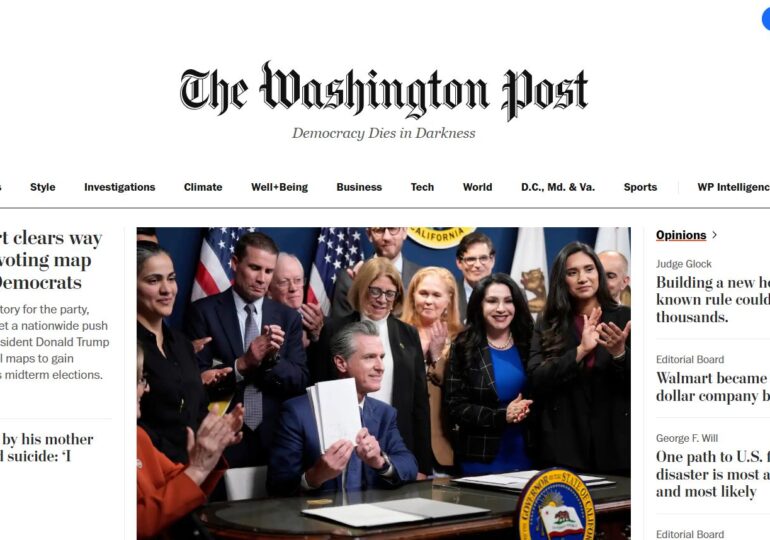
Layoffs and restructuring recently announced at The Washington Post are not just an economic adjustment, but risk affecting the very identity of one of the most important press institutions in the United States.
This is the conclusion of an extensive article published by The Atlantic, authored by journalist Ashley Parker, a former WP reporter for eight years.
In the analysis published by The Atlantic, Parker argues that Jeff Bezos, the billionaire owner of WP, and Will Lewis, the editor appointed in late 2023, are "step by step" heading towards the destruction of what made the publication special for almost 150 years: an indispensable national institution and a pillar of American democracy.
Parker describes a weakened newsroom through successive cuts, dismantled sections, and a leadership that fails to provide clear direction for the publication's future. Although the text has a strong personal dimension, it raises a broader issue: what happens to general-interest media when it is treated solely as an "economic" asset.
The Announcement That Shocked the Newsroom
According to the report in The Atlantic, the most recent decisions were communicated in an early morning online meeting. The editorial leadership announced the closure of the Sports department, the Book section, the halt of the newspaper's flagship podcast, and massive cuts in the International and Metro departments, alongside layoffs in almost all teams.
Employees were then left to wait for an email confirming whether they would retain their jobs or not.
The absence of editor Will Lewis from this meeting is mentioned as a symbolic detail of the tense relationship between management and the newsroom.
These decisions come after years of successive cuts: the discontinuation of the Sunday magazine, reduction of staff by several hundred positions, and a drastic downsizing of the Metro section. All of this occurred without a clear acknowledgment of the management errors that contributed to the financial decline, notes Parker.
A Newspaper That Was Part of the City's Life
One of the central arguments of the text is that The Washington Post has never been just a news publication, but an essential component of civic and cultural life in Washington and throughout the country.
The author evokes how the newspaper accompanied generations of readers in understanding major events – from political scandals to local tragedies – and became a form of collective memory.
This dimension is important to understand why the cuts are not perceived only as an internal issue. When entire sections are eliminated and experienced journalists are lost, the newspaper's ability to provide context, continuity, and depth also disappears.
A Diminished Product
In the analysis published by The Atlantic, Parker emphasizes the essential role played by the Metro and International sections in WP's history.
Watergate started as a local news story, pursued diligently by reporters who knew the city, its institutions, and sources.
Over the decades, The Washington Post repeatedly turned local events into national issues: the September 11 attacks, the Virginia Tech massacre, the January 6 Capitol riot.
This type of journalism was made possible precisely because of an extensive and well-rooted newsroom both locally and internationally.
The drastic reduction of these structures risks turning political coverage into a poorer, more technical product, less connected to the reality of the society it reflects.
A Unclear Strategy and Unrealistic Objectives
The article in The Atlantic also criticizes WP's management discourse, described as dominated by corporate jargon and hard-to-sustain objectives.
An example is the target announced for 2025: increasing from about 2.5 million subscribers to 200 million paying users, in a context where the publication had already lost a significant number of subscribers.
The author emphasizes that there is no simple formula for the financial salvation of a general-interest newspaper, but warns that reducing journalism to a minimalist product risks driving away even the loyal audience that WP has.
The New York Times Counterexample
Parker also invokes The New York Times as a counterexample to show that generalist press is not, by definition, economically doomed. The author highlights that NYT managed to strengthen its position precisely through diversification and expansion, not by reducing editorial ambitions: investments in complementary products, from audio and video to games, gastronomy, and in-depth narrative journalism.
The model shows that there is an audience willing to pay for quality content if the publication offers something for different audiences, without abandoning its core mission. In this context, the warning is that The Washington Post seems to be moving in the opposite direction: narrowing its offering and abandoning segments of its current audience in search of a new one that may not exist, notes the author.
The Newsroom Culture, an Invisible Loss
Beyond numbers and organizational charts, the article draws attention to another type of loss: the disappearance of an editorial culture built on collaboration, solidarity, and institutional memory. The Washington Post was known as a "writers' newspaper," a place where ambitious projects could start from any corner of the newsroom and where teamwork was essential.
Each forced departure means not only one less position but also years of experience and knowledge lost. A newsroom without this memory becomes easier to restructure but harder to regain as a relevant and credible institution.
Losing a Reference Point
The final message of the analysis is that the stakes go beyond the fate of a single newspaper. The Washington Post has been, for decades, a reference point for accountability journalism and in-depth reporting on the political and social life of the United States.
If this institution is reduced to a smaller, more convenient, and less ambitious version, the loss is not just of the dismissed journalists. It is also a loss for readers, the community, and a democracy that depends on the press to understand and control power.
Who is Ashley Parker, the Author of the Article
Ashley Parker is a journalist at The Atlantic and a three-time Pulitzer Prize winner. She worked for eight years at The Washington Post, where she covered Donald Trump's first term, served as the White House bureau chief in the first two years of the Joe Biden administration, and followed the 2024 presidential campaign as a political correspondent.
Prior to that, she worked for over a decade at The New York Times and is a political analyst for NBC and MSNBC.