
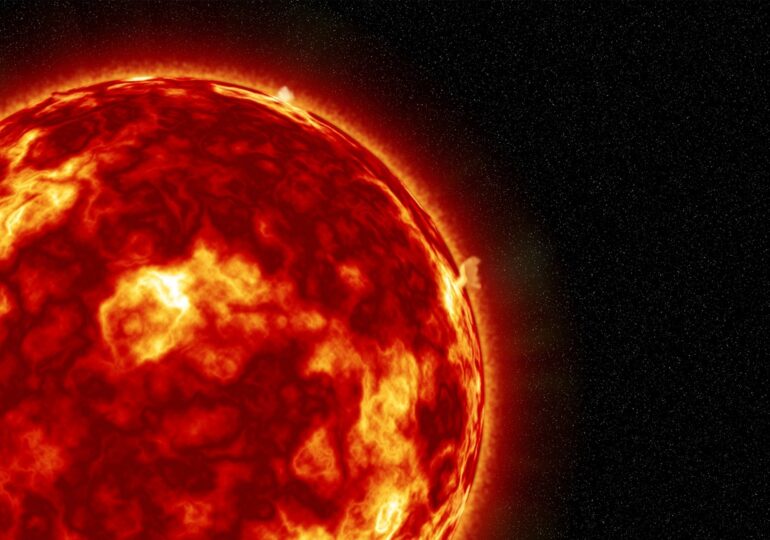
A powerful X-class solar eruption has thrown a coronal mass ejection (CME) into space, expected to reach Earth in about 24 hours.
If the coronal mass ejection arrives as expected and has the correct magnetic orientation to be „geo-effective,” we could witness strong (G3) or even severe (G4) geomagnetic storm conditions tonight, according to the UK Met Office.
If these conditions are met, the aurora borealis could be visible much further south, in Northern California and Alabama.
Space weather forecasters are analyzing data and running simulations to narrow down the arrival window of this CME, as reported by Space.com.
Scientists and aurora hunters on alert
It is known that CME arrivals are difficult to predict. The speed, direction of travel, and - most importantly - their magnetic orientation determine how strongly they will interact with Earth's magnetic field (if they will interact at all).
If the magnetic field of this CME is oriented southward, it can more easily connect with Earth's northward-oriented magnetic field, allowing energy to flow back into our planet's magnetosphere and trigger geomagnetic storm conditions.
If it is oriented northward, Earth's magnetic field largely deflects the incident energy, essentially "closing the door," and what seemed to be a spectacular space weather event may turn out to be a non-event.
Some CMEs contain a mix of southward and northward magnetic fields, which can lead to on/off or fluctuating geomagnetic activity. These events keep space weather forecasters and aurora hunters on alert.
We will not know the true magnetic orientation of the CME until it is much closer to Earth, when it will be directly sampled by solar wind monitoring satellites like DSCOVR and ACE.
What is an X-class solar flare
Solar flares are classified by intensity, in increasing order from A, B, C, and M to X, with each letter representing a tenfold increase in intensity.
X-class flares are the most powerful flares, with the number following X indicating the strength of the event. Today's flare was measured at X1.9, placing it at the upper end of solar eruptions.
The strong eruption originating from sunspot region AR4341 peaked at 18:09 GMT, according to the US National Oceanic and Atmospheric Administration's Space Weather Prediction Center. The eruption caused radio blackouts on the Sunlit side of Earth, with the most severe disruptions concentrated over the Americas.
How strong will the geomagnetic storm be
A CME is a massive ejection of plasma from the Sun carrying a magnetic field. If a CME impacts Earth's magnetosphere - the protective magnetic "bubble" generated by our planet - it can trigger a geomagnetic storm.
These geomagnetic storms vary in intensity and are classified on a scale from minor (G1) to extreme (G5). Current forecasts from the UK Met Office suggest that this approaching CME could produce strong (G3) to severe (G4) geomagnetic storm conditions.
Storms of this magnitude can disrupt satellite operations and affect GPS navigation. They can also supercharge auroral activity, pushing the potential for the aurora borealis further south, well beyond its usual high-latitude regions, toward mid-latitude regions near the 45° latitude.