

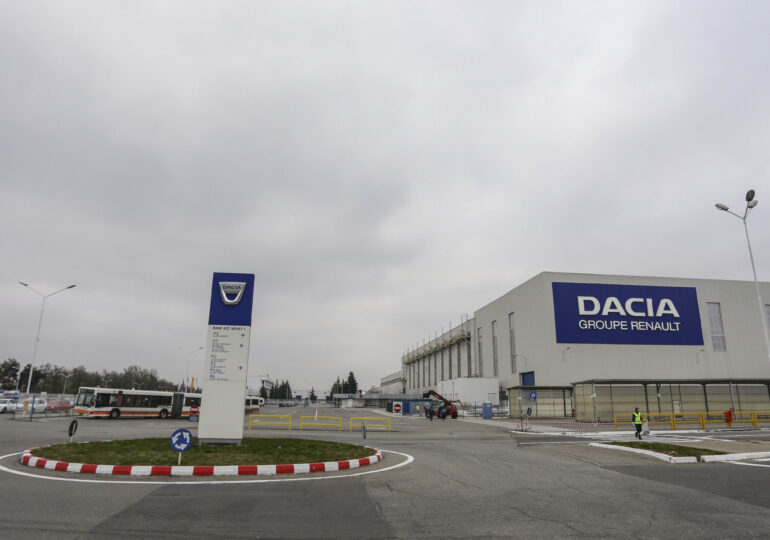
The Competition Council in Romania has fined eight automotive companies a total of 163.71 million lei (over 32 million euros) for participating in an anti-competitive agreement aimed at dividing the labor market to limit employee mobility and maintain low wages.
Dacia and Renault received the highest fines, 16 million and 9 million euros respectively.
Following the investigation, the competition authority found that the 8 companies agreed not to compete with each other in recruiting and hiring specialized labor in the field of vehicle production, engineering services, and technical consulting in Romania.
Furthermore, the companies agreed not to recruit each other's personnel without prior consent from the originating company.
List of Fines Imposed
The fines imposed by the Competition Council are:
- Akkodis Romania SRL – 5,539,871.75 lei
- Alten Si-Techno Romania SRL – 10,651,566.50 lei
- Automobile-Dacia SA – 81,530,497.62 lei (16.2 million euros)
- Bertrandt Engineering Technologies Romania SRL – 7,710,801.66 lei
- Expleo Romania SRL – 7,428,131.86 lei
- FEV ECE Automotive SRL – 1,398,870.03 lei
- Renault Technologie Roumanie SRL – 46,294,136.03 lei (9.2 million euros)
- Segula Technologies Romania SRL – 3,158,982.76 lei
What Are "No-Poaching" Agreements and Why Are They Illegal
According to the Competition Council, such practices are known as "no-poaching" agreements, where companies agree not to hire or make job offers to employees of competing firms, thus foregoing competition in attracting and retaining staff.
"This is the first case in which we sanction such anti-competitive practices where companies do not compete to attract specialized labor.
Human resources represent an essential parameter of competition between companies, considering the proportion of personnel costs in total expenses, labor shortages, or employee/collective mobility.
This type of behavior, 'no-poaching,' is particularly harmful both to competition by creating artificial barriers in the market and to employees whose mobility opportunities are affected," said Bogdan Chiriţoiu, President of the Competition Council.
Leniency, Acknowledgments, and Sanction Application
During the investigation, one company benefited from the leniency program by providing documents and information that significantly contributed to proving the anti-competitive agreement and received a substantial reduction in the fine. Five other companies admitted their actions and also obtained reductions in sanctions.
The investigation was initiated following a complaint received through the Competition Whistleblower Platform.
The Competition Council's decisions are enforceable, and the amounts resulting from fines represent revenues for the state budget. The enforcement and recovery of these fines fall under the responsibility of the National Agency for Fiscal Administration (ANAF).