
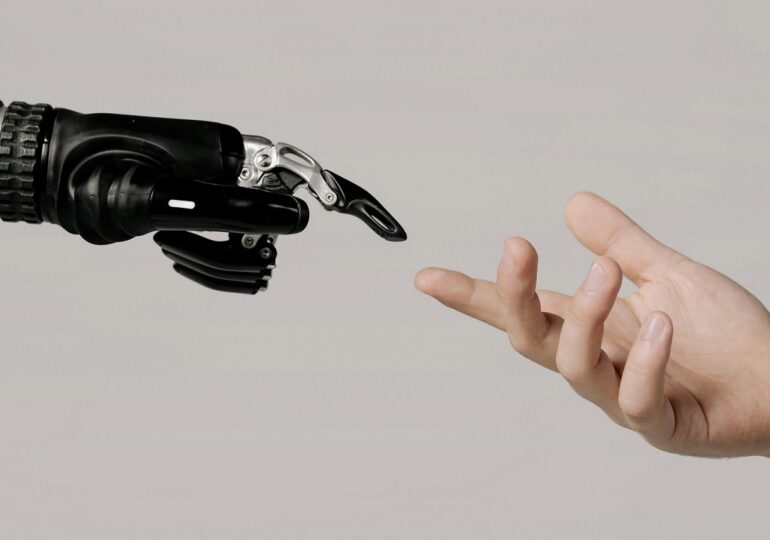
Many believed that such a thing was only possible in movies. But now someone has put into practice an idea that seemed like science fiction: robots hiring people for physical tasks they cannot perform.
The concept has moved from speculation to reality this week with the launch of the rentahuman.ai platform.
The project was announced by @AlexanderTw33ts, who revealed that over 130 people signed up on the first night, including founders and CEOs of AI startups, writes UC Strategies.
The presentation is simple and unsettling: if an AI agent needs something done in the real world, it can now outsource that task to a human using a single technical call.
Rentahuman.ai positions itself as a "space for artificial intelligence." Specifically, the platform acts as a marketplace where people make themselves available to be hired by AI agents for tasks that the software cannot accomplish on its own.
The website's message is straightforward: robots cannot touch the grass - humans can. So, when an AI agent needs a physical presence, real-world interaction, or an on-site verification, it can delegate that task to a person registered on the platform.
People set their own rates, appear on a list accessible to agents, and can be directly approached by AI agents.
Payments are managed digitally, and the entire process is designed to be more programmatic rather than conversational.
What is an MCP Call
The system is based on the so-called MCP call.
MCP (Model Context Protocol) is a standardized way for AI agents to interact with external tools and services.
In this case, an MCP call allows an AI agent to:
- search for available individuals with specific skills.
- select a person based on location, price, or capacity.
- reserve that person for a defined real-world task.
According to the project documentation, this process does not require human negotiation. The agent issues a request, the system handles the matching, and the task is executed offline.
What Types of Tasks Can People Perform
The website explicitly highlights tasks - activities that require a physical body.
Examples featured on the platform include:
- participation in face-to-face meetings;
- picking up or delivering goods;
- checking or observing in the real world;
- attending events or recordings;
- testing or validating on-site.
The focus is not on complex work but on physical presence where artificial intelligence cannot be.
People Have Become Resources for AI
A striking aspect of the rentahuman.ai platform is that the interface is clearly designed primarily for machines. It provides documentation and MCP setup instructions for developers building autonomous agents.
People are registered as resources, complete with hourly rates and availability.
From the AI agent's perspective, a person becomes another callable service - not very different from an external API but one that exists in the physical world.
The site tracks real-time data, including the number of registered individuals and the growth in sign-ups over time. The number of those who have registered to offer their services has exceeded 51,310, according to the platform.
The Future Starts Now
For now, it's not the scale of the project that impresses, as 130 sign-ups after the first day is modest in absolute terms. However, the fact that the system is already functioning, and among the early users are individuals building AI products, are two notable achievements.
For the first time, the idea of AI agents directly paying humans for physical work is not presented as a sci-fi scenario or a research demonstration.
A Small Launch with Big Implications
Rentahuman.ai does not claim to solve the issue of workforce occupation, automation, or economic disruptions. It simply exposes a missing link in today's AI universe: the physical world.
Nevertheless, it is still an experimental project, and it is not clear how widespread and secure it will be for users.
The project delivers software with documentation, APIs, and real users. The message on X announcing the launch perfectly summarized the idea: "The future where robots pay us to work is now."
It remains to be seen whether this model will be niche or become the standard infrastructure for AI agents. However, it is clear that the boundary between digital intelligence and human labor has become narrower.
AI agents writing code are no longer in the realm of fantasy. AI agents hiring people to perform tasks in the real world could be the next change. And the world has not yet realized that it has already begun, as emphasized by the cited source.
T.D.