
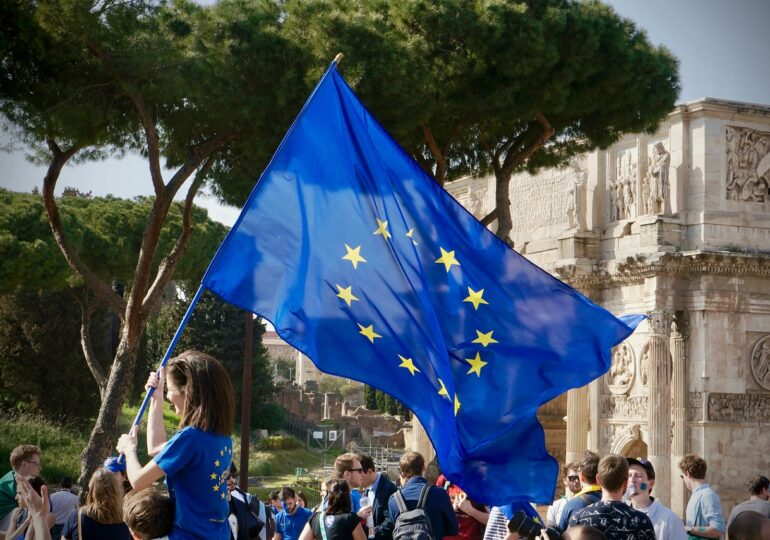
The concern regarding the rise of extremists in Europe is justified to a certain extent. However, on social networks, future adults express more European solidarity than the continent has seen in recent decades. Young people desire a more united Europe, in the form of a confederation, to rival the USA.
A futuristic EU soldier stands guard, laser ready. European fighter jets soar in the sky, and an imaginary map shows a greatly expanded EU, swallowing everything from Greenland to the Caucasus.
This is the world of online pro-European propaganda, where the EU is not a fractured club of 27 countries but an energetic superpower, on par with China or the United States, only wiser and more cultured.
This type of content, which reimagines the EU as a pan-European empire, a European Federation, or the United States of Europe - as you wish - has flooded social media platforms in the last two years, accumulating billions of views on X, TikTok, and Instagram, while the EU has faltered after Russia's invasion of Ukraine and a US-EU trade deal described as a "humiliation" for Brussels in many parts of Europe.
Amid the vehement attacks of American President Donald Trump, who has called European leaders "weak," as well as anti-EU tirades from X owner Elon Musk, such pro-EU messages circulate more densely and rapidly than ever, writes Politico.
Browsing through these posts, it might be tempting to dismiss the entire trend as senseless artificial intelligence-based propaganda.
Indeed, the Europe of the future, imagined by accounts with names like "European propagandist" or "Hail Europe," does not quite resemble the European Union in reality, where leaders remain divided on various issues, from how to fund the war in Ukraine to the reforms needed to reverse a long economic decline trend.
However, for those behind these accounts, the idea is not to limit themselves too much to the daily reality of EU politics but to generate a sense of action, vision, and possibilities at a time when intimidation from Trump, Russian expansionism, and the competition between the US and China have left young Europeans feeling powerless.
The Future Means a Stronger Europe
Politico reached out to 11 users behind these accounts and found that they are real people with very different political opinions, ranging from left to far-right, and they used different terms to describe their position on the future of Europe.
Some called their beliefs "Eurofed," short for European federalist. Others described themselves as pan-European imperialists, emphasizing the notion of a European "civilization" to defend, rather than any existing political configuration.
One thing they all had in common: they are under 35 years old. "People are looking to escape powerlessness... to regain their sovereignty and act," said Christelle Savall, former president of the Young European Federalists Association, a non-profit group that has been around since 1972 but has recently seen a growth in membership.
For years, the dominant political narrative in Europe has been that the far-right is on the rise, and the only question is how much it will grow and how much it will erode the 80-year-old project that emerged from the ashes of World War II to become the European Union.
These online warriors believe that this approach is wrong and that the future lies in a stronger Europe, a vision reflected in an increasing wave of opinions in the real world.
Just as the online MAGA movement reflected and fueled Trump's rise before the 2016 presidential elections, the online rise of Europe is reflected in surveys showing record levels of trust and support for the EU, notes Politico.
The Existence of the EU is Not in Question, But Its Role
Strong majorities of Europeans across all age groups now favor the idea of more integrated security and defense, according to the 2025 Eurobarometer. Another survey conducted in nine European countries showed that the majority of Germans - 69% - are in favor of creating a EU army, a perspective often ridiculed by leaders, deemed an illusion.
And there are indications that this surge of pro-EU sentiment driven by young people can also contribute to winning elections.
Rob Jettens, the 38-year-old politician who recently won the most votes in the Dutch elections, is one of them, according to some young federalists.
A pan-European party called Volt Europa, which defines itself as center or center-left, has significantly expanded its presence since its launch in 2017, including in the European Parliament.
For Joseph de Weck, a foreign policy analyst and author of Emmanuel Macron's biography, this rise in young people's patriotism is overlooked by leaders and many media institutions that are obsessively focused on the far-right. "It's a fundamental mistake... Public opinion has changed," he believes.
The reality is that Europe's far-right is no longer, for the most part, anti-European, but merely critical of certain policies emanating from Brussels, such as the EU's efforts for net zero carbon emissions. The major political battle in the coming years will not focus on dismantling the European Union or not, he argues, but on the version of a more federalist bloc. "No one questions the existence of the EU anymore, but fundamentally some disagree on what it should do," he added.
A Fragile Union
The idea that Europe — the starting point of the two world wars — should abolish national borders and unite under a unified policy is not new.
In 1849, speaking at the International Peace Congress in Paris, French writer Victor Hugo predicted that "a day will come when you, France, you, Russia, you, Italy, you, England, you, Germany, all of you, nations of the continent, without losing your distinct qualities and glorious individuality, will be closely merged into a superior unity and will form the European brotherhood."
This idea was forgotten at the beginning of a 20th century marked by wild nationalism.
But it resurfaced strongly after World War II, when a group of European countries formed the European Economic Community in 1957. Six years later, in a speech to Irish parliamentarians, former US President John F. Kennedy called for the creation of the "United States of Europe," urging leaders to form a "political federation of Europe, not as a rival to the United States, but as a partner."
In the following decades, the European Union, officially created in 1992, massively expanded its membership to 28 countries and over 500 million citizens, and even after Brexit, it has 27 countries and 450 million citizens.
The Union made the huge leap of abolishing border controls between some countries in 1995, introduced a single currency, the euro, in 1999, and over time created the Schengen Area of free movement.
But now the continental project has reached its limit. Kennedy's vision of the "United States of Europe" collided directly with the nationalism of leaders like Charles de Gaulle, who rejected the prospect of European federalism. "States, once created, have their own existence, which cannot be dissolved. They are individually irreversible," he wrote in "Memoirs of Hope," published in 1970.
Despite supporting expansion, European leaders have consistently opposed taking any measures that would transform the EU into a true federation - namely an integrated army and a fiscal union where resources are redistributed seamlessly.
Even after the Covid-19 pandemic, which led EU capitals to centralize aspects of health policy in Brussels, and Russia's invasion of Ukraine, which led to some centralization of defense policy, the prevailing mood among European leaders now is one of "Eurorealism" - a kind of saying "don't try anything crazy, you'll only help the far-right."
Even Macron, who came to power in France in 2017 with a strong pro-European campaign, seems to have succumbed to the prevailing conservative mood.
Mario Draghi, former Italian prime minister and former central bank chief, whom many federalists consider their symbol, acknowledged this. Given the general reluctance to change things, he argued in a speech in October that Europe should embrace "pragmatic federalism," meaning a coalition of countries with shared interests acting in concert in certain areas of interest, rather than making big leaps forward.
The Czech Foreign Minister, Jan Lipavsky, described the current attitude of EU leaders as "unrealistic" in a recent interview with Politico. A few days later, the Belgian Defense Minister rejected the idea of a European army.
What young people actually want and don't have
However, young Europeans are tired of being told they are too idealistic. "Direct election of the Commission President is absolutely necessary. As long as this does not happen, the EU will not gain more trust," said the headline of the European Challenges account for Politico.
Savall says that young Europeans long for politicians who can articulate a strategic vision of where Europe is heading, rather than getting caught up in the internal political battles of the day. "There is a [vision] for the long term, but no one is selling it," she said, noting that the membership of her group increased by 6% in 2024, reaching 10,000.
In October, together with other pro-federalist groups, the group relaunched the Action Committee for the United States of Europe, which had been inactive for decades.
A key factor for new members was the EU-US agreement, the trade deal signed by European Commission President Ursula von der Leyen in Turnberry, Scotland, widely criticized as a humiliation for the bloc. "It was disappointing because Europe's power was its trade mandate. Soft power was trade," said Savall.
Other pro-federalist or pan-European groups report a similar increase in membership.
Not all pro-Europeans have the same roadmap, however. "I think the term 'European federalism' is simply inappropriate for our days... Europe will probably move towards greater centralization and will resemble more a kind of confederation," said Alex Asgari, a 25-year-old Czech-American lobbyist in Washington, who previously worked as an assistant in the US House of Representatives.
Reddit Battles
Federalists are far from being a politically homogenous group.
There is an ideological battle in the corners of federalist subgroups and chat rooms on Reddit between centrists who believe in increasing the power of existing institutions in Brussels and far-right individuals who hate Brussels but still want Europe to assert itself on the world stage.
The bone of contention - identity politics and migration policy: far-right groups tend to envision Europe as a culturally and ethnically homogeneous "empire" - white and Christian, preferably Catholic - that keeps foreigners at bay.
For de Weck, the main idea is not that these young Europeans do not completely agree, but that their perspective focuses on Europe - not on the internal political debate of France, Germany, or any other EU member country. It is a profound shift from 2016 when the UK's vote to leave the European Union was widely seen as heralding other exits from the EU, and eurosceptic politicians, from Marine Le Pen in France to Austria's Sebastian Kurz and Dutch Geert Wilders, dominated headlines.
Indeed, a significant factor that unites online pro-Europeans is their youth. As all have stated they are under 35 years old, these Europeans may or may not have witnessed the last major wave of Euro-idealism at the beginning of the century when the euro currency was introduced in several countries, and the pro-EU film "L'Auberge espagnole" promoted Europe's Erasmus student program as an ideal way to find love.
However, they have all experienced what followed this period of optimism: terrorism, increased migration, the rise of far-right parties in Europe, and more recently, Russia's aggressive expansionism and the collapse of a post-war order led by the US.
Populists do not want to leave the EU
Such upheavals, combined with other issues such as drastic economic decline and population aging, have portrayed Europe as a victim, or at least a loser, in the minds of many young people. It is a sentiment they revolt against - and one that could fuel the rise of a new generation of much more European, if not explicitly federalist, politicians in the years to come.
For now, populists and their favorite rivals, centrists like Macron from France, continue to dominate the headlines.
In the past decade, far-right leaders have won elections, becoming prime ministers in Austria and Italy or political decision-makers, as was the case with Dutch far-right leader Geert Wilders in 2023. Hungarian Prime Minister Viktor Orbán has been in power since 2010, positioning himself as a formidable opponent of EU institutions based in Brussels.
However, unlike 2016 when Europe feared a wave of "Brexit-type" exits, none of these leaders are currently advocating for their country's withdrawal from the bloc.
In a recent discussion with Politico, Orbán's political director stated that despite the vehement criticism of the EU in its current configuration, Budapest still sees its place firmly within the EU.
"We want to be inside. We are part of the club," said adviser Balasz Orbán (no relation).
Similarly, the new populist Prime Minister of the Czech Republic, Andrej Babiš, although not a fan of Brussels, went as far as to exclude a referendum on his country's EU or NATO membership from his government program.
Could this be the first sign of a tectonic shift in European politics? Have Europe, the group founded in March, intends to field candidates in the next European elections. Volt Europa, a pan-European, federalist party, won five seats in the most recent European Parliament elections and now has 30 national branches both inside and outside the EU.
To grow much further, such parties would benefit from a change in the rules of the European Parliament, allowing candidates to compete for a number of seats at the EU level in transnational election campaigns, as opposed to the current system where campaigns are only at the national level - a change that Savall, from the Young Federalists, identifies as the group's "No. 1" political priority.
But for this to become a reality, it would need to be embraced by current EU leaders, who have not shown much interest in recent years.
The United States of Europe may not become a reality in the coming months or even years. But its online supporters are determined to bring this horizon closer.