
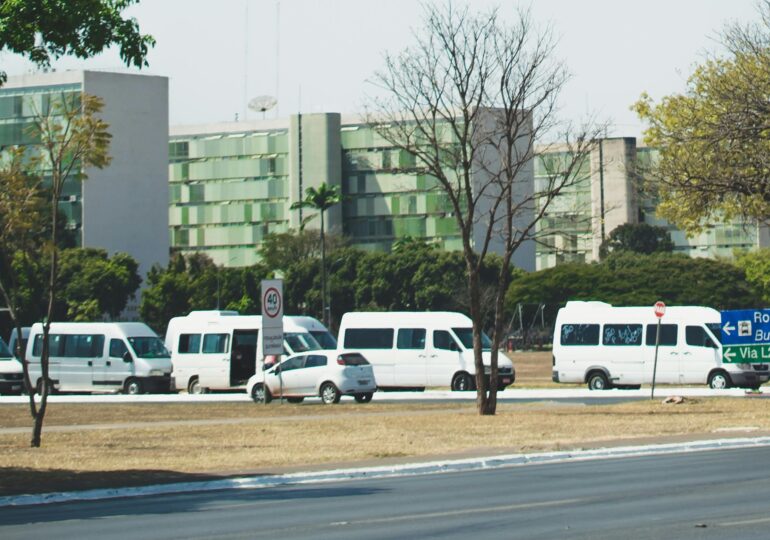
It took four months for the Ministry of Investments to notify the European Public Prosecutor’s Office about the robbery involving school minibuses purchased at inflated prices with funds from the PNRR. Minister Dragoș Pîslaru says that the entire decision-making chain, from the Ministry of Education to local authorities, ignored the „reasonableness” criterion for spending public money.
The purchase of electric school minibuses from the PNRR officially reaches the attention of the European Public Prosecutor’s Office. Minister of Investments and European Projects, Dragoș Pîslaru, announced that he has notified the institution led by Laura Codruța Kovesi, after the MIPE’s Control Body found huge differences in the prices paid by counties for the same type of minibus. In some cases, an identical vehicle cost 99,000 euros, while in others, it cost no less than 263,000 euros.
The Minister explained to Digi24 why the action was taken only now, even though checks on these acquisitions began in August.
„Romanian administration does not excel in terms of reaction speed,” said Pîslaru. „We had the ministry’s Control Body team conducting more of an analysis related to the reasonableness of prices, and there were – and still are – ongoing investigations of classic fraud suspicions for the two departments, namely the national coordinator of the PNRR, which is at MIPE, and the coordinator of reform and investments at the Ministry of Education.”
According to him, the verifications overlapped. „There were practically three controls or analyses in parallel. At one point, I finished, at one point I had a preliminary report and I asked a series of additional questions, meaning I was not convinced by the information my colleagues gave me and I requested, for example, another return to the Ministry of Education,” said Pîslaru.
Minister detailed the Control Body’s conclusions. „It’s about the fact that out of the over 240 million lei used nationwide, there is a significant price variation, from 99,000 to 263,000 euros, and obviously, even for someone who is not a specialist, making an analysis related to what the prices are in the market, we find that there are prices much higher than those that could be justified,” Dragoș Pîslaru added.
The main issue is the lack of price analyses. „I am not necessarily an authority on price construction, but obviously, one of the very important findings is that there was no analysis regarding the reasonableness of prices when, for example, the tenders were being considered,” the minister pointed out.
He also criticized the role of the National Authority for Public Procurement. „Another somewhat bizarre thing is that there is a national public procurement authority that issued conforming opinions regarding the specifications. Although there is a very clear requirement for these inspectors to verify the reasonableness of prices, there was no such verification,” Pîslaru said.
Pîslaru stated that with the money spent at inflated prices, more minibuses could have been purchased. However, he emphasized that the structure of the acquisitions – organized separately by each county – is legal, even if inefficient.
„I and MIPE are neither a judicial authority nor prosecutors to be able to analyze these things,” Pîslaru pointed out, adding that the report indicates a lack of concern for the „reasonableness and efficiency of spending public money” throughout the process, from drafting the specifications to finalizing the acquisitions.
The Minister also said that it is worth analyzing whether „there were agreements between companies” and why certain technical specifications were established, even if they were considered „indicative.”
He also provided a price reference: „The starting price for a minibus, without the bodywork and the addition of those batteries, was around 75,000 euros in the market.”
The decision to notify the European Public Prosecutor’s Office comes after the MIPE analyzed the project „Electric minibuses for students,” funded by the PNRR, under the „Education / Green Schools” component.
MIPE’s main findings:
– 74 separate acquisitions in 40 counties generated huge price differences for similar minibuses: 99,000 – 263,000 euros/unit, with no technical justifications.
– MIPE believes that irregularities could indicate „agreements between companies (cartel pricing).”
– Price differences could create a „potential budgetary prejudice” and affect the efficiency of using PNRR funds.
– Discrepancies were identified between the localities that requested minibuses and those that received them.
The revelations from Reporter de Iași:
An investigation published at the beginning of August by Reporter de Iași shows how a European program that was supposed to bring 3,200 electric school minibuses to Romania turned into a huge business for a single company. The project aimed to purchase 3,200 electric minibuses, mainly for schools in rural or isolated areas. The total budget was 250 million euros.
Out of the planned 3,200 minibuses, only 1,300 were purchased. Prices even reached 260,000 euros, over twice the real estimated value. A similar fully equipped minibus would cost under 100,000 euros.
Aveuro Internațional, a company from Câmpina, won tenders in over 60% of counties, with contracts worth over 135 million euros. The company’s owner, Vlad Papuc, is the son of a PNL leader from Prahova and close to the baron Iulian Dumitrescu, who is under investigation for corruption.