

The internal reaction against the anti-immigration campaign launched by President Donald Trump is intensifying, but the harshest echoes paradoxically come from outside the United States.
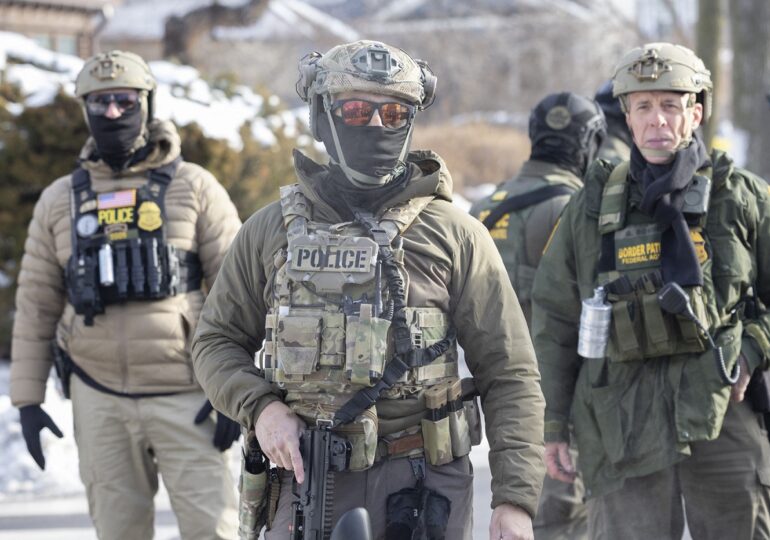
The massive deployment of federal immigration agents in major American cities, against the backdrop of a mass deportation policy, has sparked protests, political criticism, and increasingly heavy comparisons with hard-to-control paramilitary forces, as shown in an analysis by The Washington Post.
In Congress, Democrats have tried to limit the expansion of these operations, and against this backdrop, a major funding package recently failed in the Senate.
Tensions have been heightened by the killing, this month, of two American civilians who were monitoring federal agents' interventions in Minneapolis - an episode that has sparked public outrage and forced the White House to consider recalibrating its strategy.
Direct Criticism from Europe: "a kind of militia"
The dissatisfaction does not stop at the borders of the USA. In Italy, the mayor of Milan, Giuseppe Sala, publicly criticized the arrival of representatives of the Immigration and Customs Enforcement (ICE) agency, expected in the context of preparations for the Winter Olympics.
Sala said that Milanese people do not want "this kind of militia," referring to recent violent episodes in the USA, and made a direct appeal to the Italian government: "Can't you tell Mr. Trump 'no' once? Just once!"
This stance is all the more notable coming from a close ally of Washington and reflects a broader unease about how American agents operate on the territory of other states.
Diplomatic Protest and Travel Warnings
Ecuador went further, lodging an official protest after an ICE agent tried to enter the Ecuadorian consulate in Minneapolis without permission - a gesture considered a violation of the Vienna Convention. The reaction is surprising even because the President of Ecuador, Daniel Noboa, has close relations with the Trump administration.
In Germany, the Foreign Ministry issued a travel warning for certain areas in the United States, warning that in cities like Minneapolis, demonstrations can escalate into violent clashes with immigration and security authorities.
Pressures in France: ICE Links Under Authorities' Scrutiny
France is also facing echoes of the scandal. The Paris government is pressuring the technology company Capgemini to clarify the relationships of its subsidiary in the USA with ICE, amid public outrage.
The French Finance Minister, Roland Lescure, has called on the company to provide "extreme transparency" regarding the nature of its activities in this field. "I urge Capgemini to shed light, in an extremely transparent manner, on its activities, on this policy, and undoubtedly to question the nature of these activities," said Lescure.
Huge Budgets and Accusations of "Paramilitarization"
ICE and other agencies within the US Department of Homeland Security have benefited from massive budget increases under the Trump administration. ICE's budget, taken separately, exceeds the annual military expenditures of most European armies.
This financial and operational expansion fuels accusations that the USA is developing a new "paramilitary" force, closer to a political agenda than the classic enforcement of the law, as reported by The Washington Post.
At the same time, the Spanish newspaper El País warns that "public safety is not a marketing tool," and the escalation of tensions in a heavily armed society could have serious consequences for American democracy.
Alarm Signals for the Rule of Law
Political scientists and analysts emphasize that excessive militarization of law enforcement is associated with more violence and abuses, with no clear benefits for public safety.
Erica De Bruin, a specialist in civil-military relations, notes the increasingly evident similarities between US federal immigration forces and informal paramilitary groups in other countries, characterized by low control and heightened political polarization.
Moreover, The Economist identifies three classic signs of "paramilitarism": the use of force as the first solution, the weakening of internal discipline mechanisms, and the treatment of civilians as "enemy support networks."
"Ministry of the Interior" of America?
Officials in the Trump administration reject the criticisms and claim that analogies with a modern "Gestapo" endanger federal agents. However, viewed from the outside, developments in the USA seem familiar to societies that have gone through authoritarian regimes.
A former American national security official, Steven Cash, warns that the Department of Homeland Security has come to function as an "Interior Ministry" of America: a heavily armed structure, poorly controlled, and increasingly isolated from democratic oversight. In this view, immigration law enforcement has evolved from an administrative activity into an internal security apparatus with a direct impact on communities.