

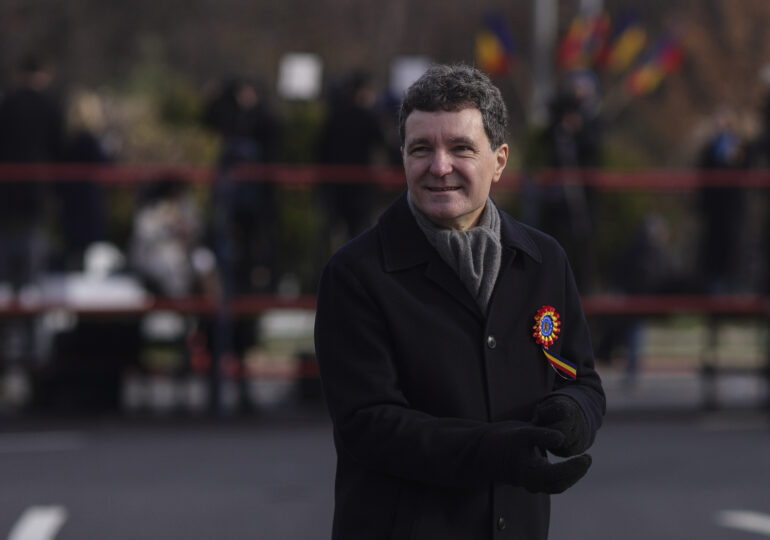
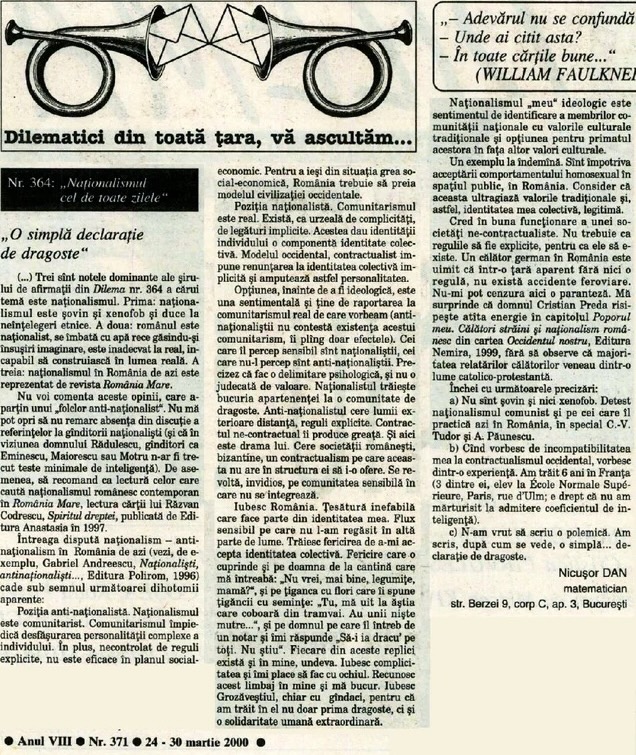
25 years ago, with a few months before Romanians were called to the polls to choose between Ion Iliescu, a former communist activist with studies in Moscow, and Corneliu Vadim Tudor, a writer and antisemitic journalist, a young mathematician leading an association aimed at saving Bucharest wrote an article in the cultural publication „Dilema,” which sparked a debate on nationalism.
„My ideological nationalism is the sentiment of identifying members of the national community with traditional cultural values and opting for their primacy over other cultural values,” wrote Nicușor Dan in March 2000.
If he had led the country back then with such a vision, similar to the one promoted by Virgil Măgureanu, the first head of the SRI, within the corridors of power in Bucharest, Romania’s Euro-Atlantic integration would have been called into question if not postponed, just as it happened in 1999.
Today, as he truly leads the country, there is a clear conflict between what Nicușor Dan believes and the expectations of those who voted for him.
It is an epic confrontation between the closed, nationalist, and traditionalist vision of the president and the liberalism, Westernism, and progressivism of those who voted for him.
In May 2025, the election was, in a way, similar to that a quarter of a century ago, between a nationalist, conservative candidate disguised as pro-European, and a candidate created and funded by the SRI, entangled in the threads of Russian espionage. That is, Nicușor Dan and George Simion.
With each passing day, this conflict becomes more visible, but more important than its visibility is the fact that it weakens the presidential institution.
Nicușor Dan's fight against the law combating fascism and legionarism clearly describes the conflict between nationalist extremism and liberalism, one that weakens the presidential institution.
Although the law passed through the filter of the Constitutional Court, Nicușor Dan refused to promulgate it, postponing its entry into force by sending it back to Parliament.
"The law sent for promulgation does not meet the conditions of predictability regarding the very constitutive content of the offenses it institutes. It operates with insufficiently defined criminal legal categories, which can lead to non-uniform and even abusive interpretations," wrote the president in the reasoning for refusing to promulgate the law.
According to the above quote, one would expect to find in the law some legal abomination, one that, following consultation with specialists, requires urgent intervention by parliamentarians.
Ion Creangă, the Fascist
"The law classifies as a crime the transmission of any materials containing antisemitic or xenophobic ideas, including classic works," wrote Nicușor Dan.
But "Romanian or foreign classical literature contains numerous works containing xenophobic ideas (Ion Budai-Deleanu, Nicolae Filimon, Vasile Alecsandri, Ion Creangă, Mihai Eminescu, William Shakespeare, Christopher Marlowe, Walter Scott, Charles Dickens, Joseph Conrad). Thus, the transmission of such works is 'classified as a crime, punishable by imprisonment from one to five years,' explained the president.
In fact, the association Nicușor Dan makes between fascism and classical works of Romanian and universal literature is untrue and forced.
The very term "classic work" defines the transition of the respective creation into the fundamental cultural realm, removing it from the realm of political propaganda, and, secondly, a law only acts for the future.
Thus, Ion Creangă cannot be sent to prison because he is no longer among us, and his readers can be found guilty of fascist propaganda by a court only if they are filmed with a fascist armband or in black shirts with diagonal stripes, reading "Childhood Memories," and then posting the video on TikTok.
The president's gesture of challenging the law combating fascism and legionarism is "interpreted as an extraordinary encouragement for that segment of society that essentially wants to destroy democracy in Romania. An encouragement for the further promotion of the Legionary ideology, the leaders of extremist organizations, inevitably, of antisemitism, and all forms of extremism," says Deputy Silviu Vexler, the initiator of the law contested by the president.
It is too early for this, at least debatable, position of Nicușor Dan to provoke an international scandal, but in a political context generated by certain future events, the president's positions on fascism and legionarism will become problematic for Romania's credibility from a political, social, and economic perspective.
Marriage of Convenience
However, the conflict between presidential conservatism and the liberalism of a large part of Romanian society was visible in the campaign for Bucharest, where Nicușor Dan suffered a bitter defeat, with USR deputy Cătălin Drulă, the candidate he supported, finishing in 4th place. For reference, the liberal and progressive candidates (Ciucu, Drulă, and Ciceală) received 56% of the votes of the people of Bucharest.
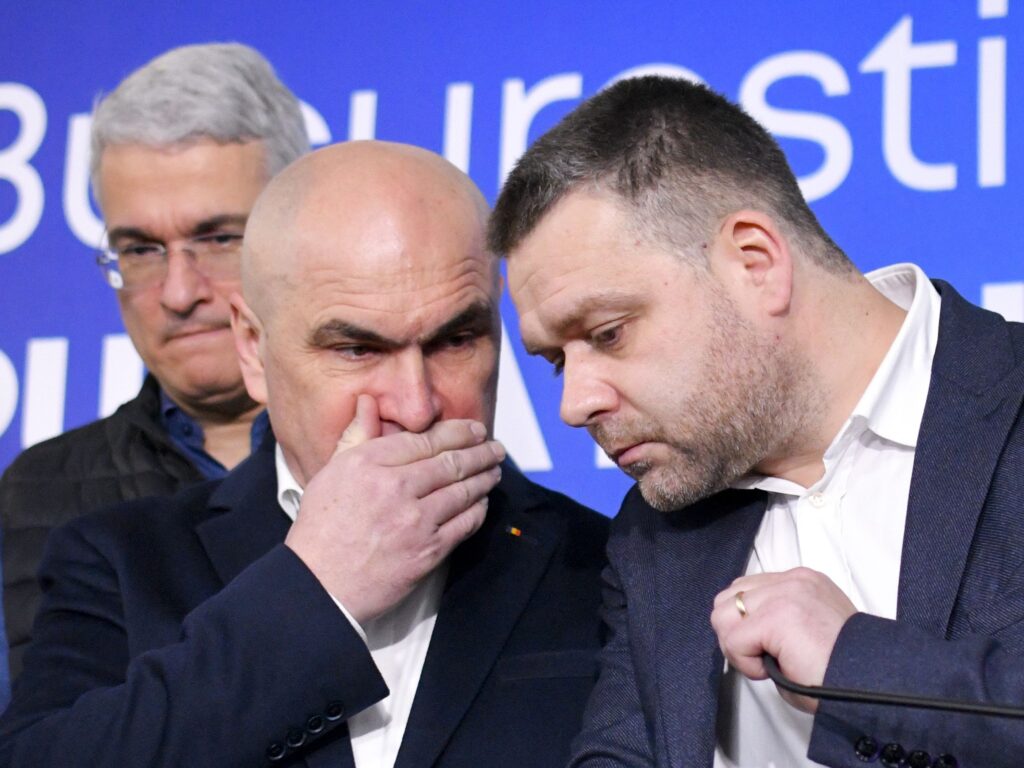
The weak chemistry and communication between the president and the former USR leader were impossible to hide, the latter being a politician with strong democratic and pro-European views, well outlined.
In reality, the president mostly confused Cătălin Drulă due to his lack of conviction in terms of support, the timidity, and fragility of the relationship between the two. It seemed more like a marriage of convenience than one of love, and the sense of falsity did not go unnoticed by at least a part of the public opinion.
Although Nicușor Dan's political vision is closer to the nationalist-securist one, promoted by Virgil Măgureanu after 1990, than to the liberal one revived in Romanian society by Corneliu Coposu, Radu Câmpeanu, and Ion Rațiu, the current president had the talent to hide his deep convictions behind strongly progressive political movements such as the one against Gold Corporation - Roșia Montana and the one to save Bucharest, which led to the emergence of USR (Save Romania Union).
The first major conflict between Nicușor Dan's values and the political reality in Romania emerged in 2018 during the campaign to amend the Constitution related to defining the family.
At that time, the current president wanted to push the party he had founded onto a path controlled by Russia's influence agents, who financed an extremist organization, the Coalition for the Family, with the aim of causing a political crisis in Romania.
Following a vote by USR members, which did not give him the upper hand, Nicușor Dan left the party.
Solidarity Independence Was Decorated
The inadequacy between the President of Romania and those who voted for him tends to turn into an open conflict in the coming months.
There are strong criticisms from military personnel and security experts, atlanticists, who consider that the introduction of the term solidarity independence in the national defense strategy actually represents a detachment from NATO's political values.
In the context of the crisis caused by Donald Trump in the US-Europe relationship, this is less visible, but from the end of next year, after the elections for the US House of Representatives, it may become an embarrassing concept for Romanian diplomacy.
It should be noted that the author of this article initially interpreted the concept of solidarity independence differently, but after several interviews and discussions with national security experts and military personnel who have interacted with NATO over the years, the prevailing idea is that this concept will at least stir perplexity within the alliance regarding Romania and will not bring anything good.
The President has sparked a new controversy among his supporters by decorating only one person on December 1, Romania's National Day, a war veteran, "a soldier in the Nazi-Romanian troops," accused of committing pogroms in Iași and Odesa during World War II.
Probably, if Ion Vasile Banu had been one of those decorated on the National Day, the impact on a part of public opinion would have been smaller, but the singular gesture clearly indicates that the President of Romania sought to convey a political message.
"On December 1, he decorated only one person, Ion Vasile Banu, a former soldier in the Nazi-Romanian troops, who, in 1941, committed the pogroms in Iași and Odesa, as well as numerous other massacres and deportations to concentration camps, advancing as invaders into the territory of the USSR up to the Don River bend and Stalingrad," journalist Cristian Tudor Popescu wrote on his Facebook page.
So far, Nicușor Dan's perilous attempts to win the favor of AUR and the extremist-populist segment of society have had only one effect, that of alienating his relationship with the voters who propelled him to the Cotroceni Palace.
George Simion, Lavric, and Lulea will have no problem supporting the President's suspension in the event that the smoldering conflict between the President and USR-PNL intensifies.
Even if the suspension process is not initiated yet, the coalescence of an anti-presidential parliamentary movement would suffice to annul Nicușor Dan's political influence.