

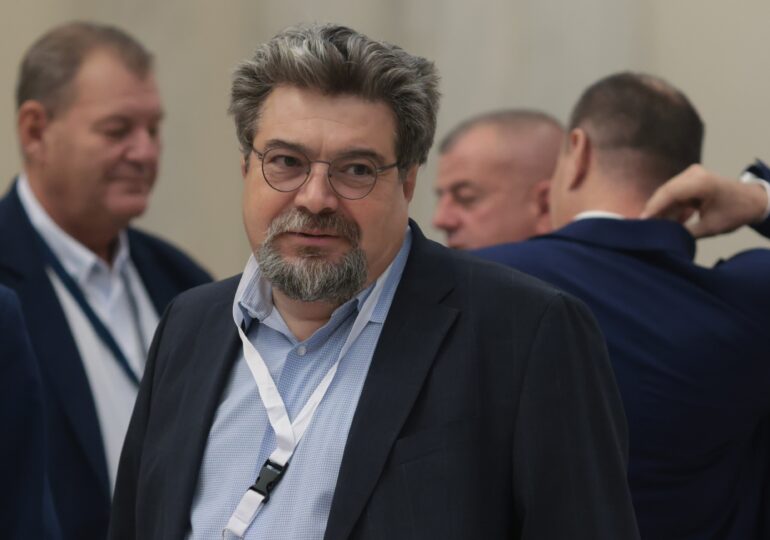
Professor of political science Andrei Țăranu explained, in a discussion with spotmedia.ro, that our country is terribly lacking in political culture, which explains the low appetite of the population for democracy and the rule of law. The major deficiency in political culture represents an effect of the education crisis, mainly caused by the relativization of the need for knowledge at the societal level.

Relevant Quotes:
- We are still, somewhat, in a kind of collective hypnosis. On the other hand, democracy, institutionally, has not recovered at all. We are in a moment of political crisis, one that began on November 24, 2024, and has not ended even now.
- We are very poor in terms of political culture. This is the weakest point. Political actors have led to a decline in political culture. And furthermore, to an appetite for a kind of non-democratic, antidemocratic revenge against the European Union, against others.
- The great failure and the greatest betrayal come from the cultural elites. Education has been sacrificed by the cultural and political elites in Romania for a project that was not intelligible.
- Post-truth means that I can have an opinion on anything, because freedom of opinion is above truth.
- 2026 will be the year of collapse if Romania’s economic philosophy is not immediately changed. We face an economic threat, a political threat, and an international threat.
You said that the cancellation of last year's presidential elections will remain written in history? What impact did that decision have and will have?
It is a very important moment because it changed the course of history. Since the evening of November 24, history has flowed differently. It was going smoothly, as expected, with Mr. Marcel Ciolacu at the helm. And suddenly, you know that joke about what a deviationist is? A deviationist is someone who moves forward while the party goes right or left. That's what happened with history. History took a turn, Mr. Marcel Ciolacu moved forward.
Have we recovered after that shock? Is Romania's democracy better, worse, strengthened, more vulnerable?
We haven't recovered. We are still, somewhat, in a kind of collective hypnosis. On the other hand, democracy, institutionally, has not recovered at all. We are in a moment of political crisis, let's call it that, which began on November 24 and has not ended even now. All of this was done in the name of stability.
Here is the paradox. It doesn't seem like we have evolved, but rather that democracy has deteriorated. This is what The Economist Intelligence Unit shows. Romania is the first - although this is not good at all - on the list of countries with a hybrid regime of democracy.
Does this serious democratic deficiency also come from the way state structures control public discourse?
No, because the analysis conducted by The Economist Intelligence Unit has five main criteria. We have been very poor since 2011, but now we are terribly lacking in political culture. This is the weakest point.
Political actors, including Russian fake news and various forms of manipulation, have led to a decline in political culture. Furthermore, to an appetite for a kind of non-democratic, antidemocratic revenge against the European Union, against others.
At the institutional level, we are also very poor. Whether we talk about fiscal transparency or decision-making transparency. The role of Parliament is strictly reduced to ensuring a majority.
Can we link this lack of political culture to a profound failure in education after 1990? Is there a direct connection?
More than obvious. But in fact, the great failure and the greatest betrayal come from the cultural elites. Education has been sacrificed by the cultural and political elites in Romania for a project that was not very intelligible.
In the '90s, cultural elites demanded a return to the Orthodox Christian tradition. Remember that in 1991, the book The Transfiguration of Romania by Emil Cioran was republished, a Legionnaire and mystic-nationalist text.
This is how the offensive of the cultural elites began, who understood nothing. Many scientists abandoned it to work in various other fields. And then, education began to enter an area where post-truth, this strange mix of religion and science, led to a massive relativization of the need for knowledge.
What can be done against this relativization of knowledge?
Unfortunately, at this point, not much can be done. A reform of the education system can only be achieved over a long and dedicated period. It would require a complete rethinking of the relationships between school and its beneficiaries (students).
School is self-centered, teachers only think about their norms and interests.
Educational democratization is achieved through textbooks that are more or less unique. The differences in knowledge or interpretation between alternative textbooks are significant, especially in the social sciences. And so, we enter, again, into this area of post-truth. Post-truth means that I can have an opinion on anything, because freedom of opinion is above truth.
What role do social networks play in the process of relativizing knowledge?
The impact is immense. Groupthink can be extremely anarchic. When a group has various frustrations, it will try to react against the group it considers guilty.
If there are no very clear structures, we enter into social anomie. Those who declare themselves pro-European will not, but also cannot understand or ever converse with those who position themselves against the European Union.
They have frustrations that they attribute to some or others. When we get out of the battle of bubbles, then we will probably begin to rebuild education as well. For now, we need to build a society. In practice, we need to start from scratch.
What are the main challenges for next year? Is Romania in danger of sliding towards the far right?
It's hard to say. We will transform into a semi-theocracy. That's more likely. Will we end up with an extreme right-wing government? The question is how extreme, because we currently have a major problem. We choose, just like in Victor Orban's Hungary, exclusively people's sovereignty against the rule of law.
This is a very serious discussion related to the concept of democracy. Democracy means not only people's sovereignty through elections, but also the rule of law.
We see an indistinct political class. If you simply removed the people, there would be no difference in terms of political program between PSD and USR. We do not have multi-partyism. We have several communist parties, a shattered hologram that preserves the original image in each shard.
2026 will be a very difficult year. We face an economic threat, a political threat, and an international threat. For the first time, we are in a domestic crisis. A budget crisis tends to slowly turn into a long-term economic crisis.
The National Bank says we have a problem with inflation, which has risen from 5% to 9.9%. It was fueled by tax increases, among other things.
A good part of entrepreneurs turned out to be speculators. Before the VAT increase, they had already raised prices and applied the two percentage point difference to the increased prices. 2026 could be the year of collapse if Romania's economic philosophy is not immediately changed.
Will something significant happen regarding the long military conflict in Ukraine?
After the negotiations in Geneva, it is possible to reach a ceasefire similar to the one between South Korea and North Korea. There will be a DMZ (demilitarized zone) of around a thousand kilometers.
Here we have good news. If the war ends, money for the reconstruction of Ukraine will flow. And if we are intelligent, then money will also flow to us. We have a great chance to participate in the reconstruction of Ukraine.
In 2026, there is also optimism, but there must be a lot of realism. Realism means starting to think truly patriotically. This will not be very pleasant for a certain group. I do not believe that maintaining a flat tax and low taxation levels is still possible. The state needs money.
What does it mean to think truly patriotically in the current context of an economic and social crisis?
Well, let's look at the major crisis in South Korea, speaking of patriotism and nationalism. The major crisis in 1996 started there. And the people of South Korea, women, men, took out what they had, small gold items, wedding rings, bracelets, rings, and donated - put in quotes, borrowed - to the National Bank of South Korea, which was saved with the money of the entire population. That's patriotism. The rest is nonsense.
And from that moment on, after they recovered, after becoming the eleventh economy in the world, after doing many other things, they started giving those provisions back to the people. Not to scare them, not to offend them, not to see who gave more and who gave less. And in this way, that society, which is a very complicated one, living in war since 1953, with a stronger military protection umbrella than anything else... They have political corruption too. They have corruption as well, but they also have something that we lack.
For us, the meaning is only social division. It would really be worth it to conduct this experiment, to see how many would give a penny for society and for the state. At one point, a penny was given for the Athenaeum, but not for Brâncuși.