

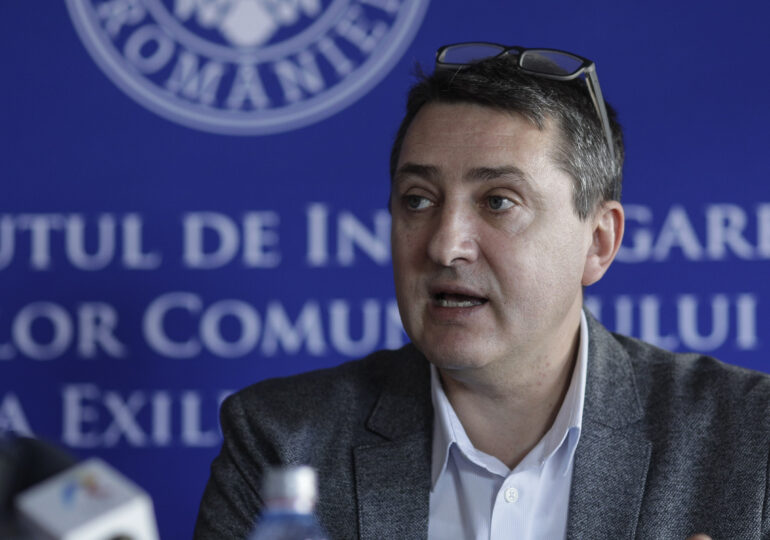
The majority of active and important politicians in Romania, according to the researcher, were trained in the final period of the communist regime, when the implosion of communist regimes occurred. Most of them are people who actually do not believe in anything. This is one of the explanations for the fragility of the country we live in today.

Relevant quotes:
- I believe it is very important to embed in the emotional memory, consciousness, and value system we operate with, a fundamental idea, namely that democracy is the only friend of the ordinary citizen.
- Intellectuals have stepped back from the forefront of politics because the entire Romanian political spectrum is anti-intellectualist… This turns the communication between politicians and intellectuals into a constant source of frustrations.
- One of the threats to society is the lack of political vision and intellectual depth in the new generations of leaders. When so-called democratic politicians fail to deliver, it is natural for many people to consider an alternative.
- The issue with Ceausescu nostalgia in Romania is not its existence, not its propagation, but its extremely broad audience…
How did you find the year 2025?
If you will, I found it to be a year that was both strange and, in a way, quite predictable. It depends on how observant you were to notice what was happening and how well your eye is trained to look from a historical perspective.
As a historian, are you pessimistic or optimistic? In general, do you look into the past using scientific tools...
I would prefer to use those scientific tools to talk a bit about the present. It seems to me that we are in a state just as vulnerable, perhaps even slightly more vulnerable, than we were last year, in 2024.
The reality is that historians are weak predictors of the future. And yes, I am an optimistic person. I have a kind of restrained optimism, but it is an optimism based on a perspective of the past. If there is a collective trait of Romanians, with all the risks involved in such a statement, it is that they tend to fall before the bullet is fired. This can be a problem in moments of tension. And yes, we certainly remain a vulnerable society, a system under severe strain, under pressure.
However, I believe that in all the events that have taken place throughout the year 2025, there are a few pieces of good news. One of them is that we are no longer all in the same camp, and this is very important. It is a sign of societal health, of intellectual health, and I think it is very important to know how many of us actually adhere to democracy and how many of us desire to live in a democracy. Such a diagnosis would allow each of us and political leaders to plan actions based on the priorities that emerge from such an image. So, from this point of view, I am neither worried nor scared.
Let's admit that, in fact, this country has achieved the progress it has made so far not under the pressure of an absolute majority, but under the pressure of a significant segment of this society, let's say up to 50-55% of the general public, which ultimately led all other segments towards modernity and prevailed, at least in certain important moments, over the resistance of various structures.
From this point of view, that's how we functioned. The fact that we were very close to collapse in 2025 is a reality, but we know that it was not the only moment in our recent history.
What surprised me? I was surprised that years of belonging to the Western world left some of us unchanged. But that's only because most of us didn't have time to observe what others were doing.
In a discussion with the chief editor, we agreed to ask you what anchors people still have in society? Our feeling as journalists is that there are many people disoriented by events, discussions, and debates in society. Even some well-intentioned and to a large extent educated individuals who simply have nothing to hold on to, nothing to refer to. How can this problem be solved and by whom?
One of the qualities of high-quality journalism that has always attracted me is that ability to ask tough questions using few words. Yes, there is a sense of insecurity in society. A form of escapism is practiced in all moments of tension, as in all moments when the world is gripped by the sense of imminent ending. But this brings us back to the first part of our discussion, namely that, collectively speaking, we are quite sensitive to the impulses we perceive from outside.
The reality is that the political radicalization in Romania in recent months, Romania in 2025, has brought back the issue of political violence.
After the first half of the '90s, when what happened happened, in the 2000s, Romania had given up this way of doing politics. But not because there was a moral, intellectual, thorough reorganization of the political environment, but because everyone was content with formalism. The sovereignist current abandoned the mask of democratic formalism and raised issues exactly as it felt. And this scared many of us.
Those who have been observing what has been happening in recent years in the Russian Federation, in Belarus, in Hungary have not been so scared, because the dynamics of the process were somewhat similar. What surprised us more was the speed with which Romania adopted all these particular reflexes more characteristic of authoritarian or autocratic regimes, such as Russia.
Why do you think intellectuals have stepped back from the forefront of political debates?
They have stepped back because the entire Romanian political spectrum is anti-intellectualist. Romanian politicians, starting from Nicolae Ceausescu, are repelled by the idea of intellectuals getting involved in politics. They do not feel comfortable in discussions with intellectuals simply because the latter, using more than 300 words, highlight with each of their statements the lexical poverty of politicians and, especially, their intellectual poverty and lack of depth. This turns the communication between politicians and intellectuals into a constant source of frustrations.
So, it is much simpler to exclude intellectuals from politics, to insist on the transactional facet of politics, because intellectuals are tiresome: they have dilemmas, they have principles, they refer to morality, and all these things impinge on the efficiency of the political exercise as it has been conceived here in recent years. Consequently, we have a historical de-intellectualization of Romanian politics, which is not a phenomenon related to democracy.
On the other hand, when you mentioned this disorientation, do you know what I think is the most important mission of intellectuals who express themselves in the public sphere? And here I am talking about a wide range of professions, from journalists to doctors. I believe it is very important to participate in embedding in the emotional memory, consciousness, and the value system with which each of us operates, a fundamental idea, namely that democracy is the only friend of the ordinary citizen.
Intellectuals must talk about democracy in intelligible terms, even for non-intellectuals, and in terms beyond any debate, even of ideas. Not in the sense of being accepted as an ultimate thesis, as an ultimate truth, but to operate with certain concepts and beliefs that we share. Because without a common conceptual framework, it is very complicated to generate common projections.
Personally, I observe that in political discourse democracy, the call for democracy, and the explanation of democracy are very rarely present in recent years. Why do you think we have reached a situation where so little is spoken about democracy?
Because there is a weak organic absorption of democratic norms and ideas across the entire Romanian political spectrum.
Against the backdrop of this crisis of ideas, of insufficient and insincere absorption of democratic ideas and values, in many political episodes of these countries, what is happening is what happened in the immediate post-World War I period: the appeal to nationalism as a force for consolidating society.
Because globalization, the acceleration of this phenomenon, as we see it happening around us, in all areas, has among its negative effects atomization.
Society loses its sense of belonging to the body. And so there are politicians who, in order to reach the forefront, to access power, appeal to this force of nationalism that they propose in irreducible contradiction with everything that modernity entails, with everything that globalization entails, with everything that democratization entails.
Therefore, there is an audience for these politicians with a predilection for the conspiratorial and obscurantist folklore that we see so well spread on social networks because this folklore is a schematic way of creating literature by following the same recipe each time. Hence its unbeatable popularity on social networks.
In this process of erosion of the concept of democracy, both at the political level and in public debate, what role does Russia play?
As I see it, there is a priority order in this explosive cocktail. Firstly, if we have to explain the causes of this degradation of democratic thinking - because that's what it is, as you defined it very well - it is the absence of political vision and intellectual scope in the new generations of politicians. When politicians, so-called democratic ones, fail to deliver, it is absolutely natural for many of us to consider an alternative to this system.
Secondly, in the particular case of Romania, but not only Romania, an important contribution is played by the excessive presence of the information and control apparatus in spheres of society where theoretically it should not be present. However, we must acknowledge one fundamental thing: the state in which we live today, by structure, by organizational philosophy, by the way it aggregates subsystems, owes an unbelievable amount to Nicolae Ceaușescu.
We are the country that not only took over en masse Nicolae Ceaușescu's entire repression apparatus but still pays pensions today to former Securitate officers, all of whom were involved, without exception, in political policing. They all did political policing.
An entire country has been built on the recycling of these mechanisms of Nicolae Ceaușescu's dictatorship. This has rooted in democratic Romania a virus that has multiplied, self-replicated, generating multiple organizational subcultures, which we find today in administration, in intelligence services, in the military. This against the backdrop of a modest professional level of these subsystems, so as not to create any confusion.
The third reason is the massive intervention of authoritarian Russian propaganda in the Romanian social and cultural equation. Russia found fertile ground here because all these structures of political policing existed, have existed, and have never really left. This is the classic pattern of action of Russia.
Russia has retained the ability to exploit the vulnerabilities of various geographical and cultural spaces. And this is what happened in Romania. Russia immediately noticed that Romania does not know how to deal with the issue of the immense Romanian diaspora that emerged after the fall of communism. It is a phenomenon with which this country, historically speaking, has not previously dealt.
Hence, the intellectual impotence of the Romanian government to address this diaspora issue, except through a national-identity key.
A large part of these communities are undergoing a radical process of marginalization, both in relation to the host societies and in relation to what is happening in Romania, hence the emergence of this immense radicalized, marginalized community, experiencing acute feelings of frustration and anger towards the country and, especially, towards those leading the country. This against the backdrop of another specific feature of Romanian political civilization, namely the constant confusion between the political leaders of this country and the country itself.
Russia has very well seized the opportunity, against the backdrop of this surviving securitarian ethos in the basement of Westernized and modernized Romania, coupled with the visceral fear of tens of thousands of reservists from various ministries with epaulets of being sent to war after receiving wonderful salaries and pensions.
This junction has been created between the frustration of Romanians in the diaspora, the legitimate frustration regarding the political, intellectual, and organizational performances of Romanian political leaders - because in a mysterious way, Romania continues to consistently elect people with poor education and nonexistent training - and what has created an environment conducive to the spread of extremely favorable Russian venom.
It didn't cost a lot of money, and it didn't require a lot of intelligence to start this cultural and civilizational reprogramming of Romanians in the diaspora, using exactly, as in the case of the Russian world, the accumulated frustration and anger in these communities that feel marginalized and estranged from the country. This would be the third important reason.
Social networks are, if you will, a technical annex, a technology that spreads the message. It depends on who uses them. From my point of view, considering social networks, including TikTok, as a threat to democracy in Romania means abandoning our ability to use them intelligently to serve democracy.