
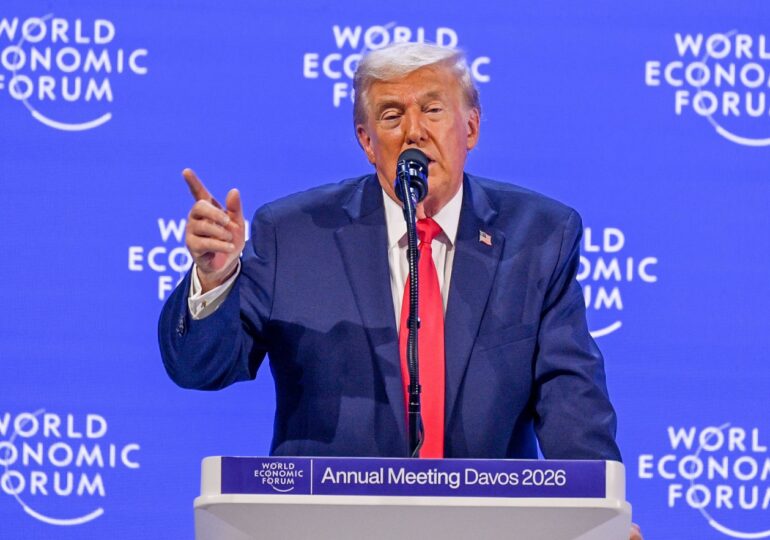
It took Donald Trump six days to build a new world.
Since threatening last Saturday with customs duties and the confiscation of Greenland, Trump’s discrediting behavior has clearly shown the West that the old norms of the world order have been set aside – „a rupture, not a transition,” in the harsh words of Canadian Prime Minister Mark Carney.
In its place: a more brutal arena, without laws, where the loudest and strongest win, and a cornerstone of the old world - the seemingly unbeatable transatlantic trust - no longer exists, as CNN comments in an extensive analysis.
Unprecedented
As early as 2019, Trump clearly expressed his desire for Denmark's icy territory, Greenland. But the intimidating threats of the past week towards a NATO ally have left Europe in a state of shock.
"One way or another, we will have Greenland," Trump promised, even if "we will do it the hard way."
In the words of French President Emmanuel Macron, "we started the week with escalation, with invasion threats and tariff threats."
What followed was simply inconceivable before Trump: allies like Polish Prime Minister Donald Tusk spoke of "appeasement" - a term laden with such a painful history in Europe - insisting that "Europe cannot afford to be weak - neither against its enemies nor against its allies."
"It is a new reality that has been created. A reality that is very often volatile," said a senior EU diplomat to journalists on Thursday, citing the "very unorthodox rhetoric of the American administration."
Trump has strained and stretched ties with Europe since January last year, often appearing to echo discussion points with Russian President Vladimir Putin and withdrawing aid to Ukraine - Europe's current front line against Moscow - imposing tariffs on close partners and launching spiteful barrages of insults online and in person.
Addressing journalists after a late-night EU leaders' meeting on Thursday, EU Council President Antonio Costa said that all agreed relationships with partners must be managed "in a cordial and respectful manner" (a stark contrast to the bold attacks from the White House during Trump's time).
The US is no longer the friend and reliable ally it once was
For some, this has been long expected, given the warning signs from the early days of the last Trump administration.
"Transatlantic relations have certainly suffered a severe blow in the past week," said EU foreign policy chief Kaja Kallas on Thursday.
For former EU Council President Charles Michel, the situation is even more evident: the transatlantic relationship "as we have known it for decades is dead", he told CNN.
After a year in which Trump showed a clear lack of respect for European allies, many have wondered how much of the old transatlantic ties remains. Trump's threats against Greenland have provided a clear answer to this question.
"If you go further in terms of Greenland, no one would believe that the US would be willing to defend Estonia," a EU diplomat told CNN.
A new path
Faced with Trump's ambitions, the choice for Europe was clear: defiance or subordination.
"Politics doesn't mean results, just humiliation," said Tusk, the President of Poland, this week, while Belgian Prime Minister Bart De Wever spoke in Davos about preferring to be a "happy vassal" rather than a "miserable slave" of the US.
Discussions with EU diplomats have highlighted how Europeans have finally united around the need for independence from the whims of the White House, especially in defense matters.
The lines crossed by Trump have been too deep, it seems. Macron criticized American tariffs imposed with ease as "fundamentally unacceptable." And in another unambiguous reply to Trump: "We prefer respect over bullies."
On Thursday, EU leaders felt relieved as they gathered to take stock of the tumultuous week of diplomacy, but they felt little that their world would return to the old normal, even if Trump's diplomatic crises had led to few clear outcomes. The White House has not yet revealed the details of the framework agreement with Denmark regarding Greenland.
Last year saw European convergence around coordinated financing for European defense, with a focus on purchasing European capital, a crucial clause for European industrial progress, long-time leaders like Macron have said.
It seems that the EU will continue on this path in 2026, boosting Europe's growing industrial base as much as capacity allows. And although a EU commissioner has broached the idea of a European army or an official EU Security Council - certainly a sign that Trump imposes taboos - there has been little interest in this level of integration.
Europe faces the same threats
Despite all of Trump's bluster, Europe faces the same threats it faced last weekend. On Monday, Russia launched one of the largest bombardments in history on Kiev.
This week, Finnish military intelligence services warned about Moscow's threats to underwater infrastructure in the Baltic Sea, a favorite target of saboteurs with ties to Russia. The risks posed by hostile actors from the Middle East and China have not disappeared either.
Consulting EU diplomats from across the bloc, none suggested that Europe should yield to the White House's desire to approach an ally's sovereign territory. However, their resistance has not been universally bold in public.
American military and economic power is an important currency in Europe, where the continent is not yet ready to avoid a sustained conflict with Russia on its own. Trump has not hidden his resentments, and some remain cautious about turning him into an enemy.
Even though Trump backed down from a potential confrontation over Greenland, after Europe used its "trade bazooka" threat to block US access to European markets, German Chancellor Friedrich Merz spoke of being "grateful" for Trump's change of heart.
The Baltic countries, usually among the most outspoken in Europe, have been remarkably quiet in the face of a sullen Trump.
"Instead of focusing on the emotional side of the dilemmas presented by the White House, we should rather focus on the military side, the technical side, identify mutual pragmatic issues, and solve them," said former Lithuanian Defense Minister Dovilė Šakalienė to CNN, adding that it would take between five and ten years for Europe to match US military power on the continent.
"Cooperation should be the key word instead of confrontation," said Lithuanian President Gitanas Nauseda to journalists. "The US is still our closest friend."