
In just one week, the world was able to witness both the best and the worst of humanity.
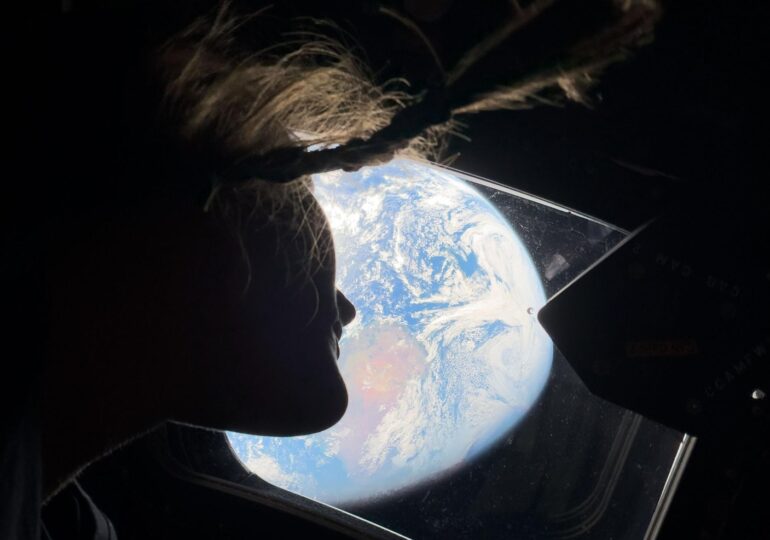
Seeing Earth from space will change you so profoundly that there is even a term for it: it’s called the overview effect.
The extreme minority who have had the privilege of this experience describe it in a similar way. You see something you were never meant to see, namely Earth just sitting there, with the entire universe surrounding it.
Looking at the blue marble, surrounded by its thin green layer of atmosphere, with auroras flickering at the edges - it is not just an impressive experience, but also a kind of reset to factory settings for your own identity. Almost everyone tears up at this sight, writes Charlie Warzel, technology journalist, in a moving essay published in The Atlantic.
"You don't see borders, you don't see religious lines, you don't see political boundaries. All you see is Earth, and you see that we are much more alike than different," recently stated NASA astronaut Christina Koch, the first woman astronaut sent close to the Moon on the Artemis II mission.
Describing the view from Apollo 8 in the late '60s, Jim Lovell stated for Chicago magazine that he could put his thumb up to the window and, at that moment, "everything I ever knew was behind that thumb. Billions of people. Oceans. Mountains. Deserts. And I started to wonder - where do I fit in what I see?"
Absolute Beauty and All Fragility in One Point
Where some see immeasurable beauty, others see fragility in this image. Marina Koren previously reported in the mentioned magazine that, seeing Earth from space, an astronaut "became absolutely convinced that we will commit suicide in 500 to 1,000 years from now." Famous actor William Shatner wrote that his brief experience gazing at Earth brought him profound sadness. "What I felt was pain, and the pain was for Earth," he told Koren in 2022.
For 40 minutes, while on the far side of the Moon, the crew of the Artemis II mission lost all contact with humanity. At one point, they were 406,099 km from Earth - the farthest distance from our planet anyone has ever reached. For seven hours, the astronauts - Koch, Reid Wiseman, Victor Glover, and Jeremy Hansen - were able to gaze at a part of the lunar surface never before seen by human eyes. According to NASA, the astronauts took approximately 10,000 photographs, which seems perfectly proportional for such an occasion.
Some of these photographs - some taken before passing by the Moon - impressed the article's author. A photograph with Earth seeming to set behind the Moon. An image, taken through a window of the Orion spacecraft, revealing Earth's smallest crescent shrinking as the capsule heads towards the Moon. According to the photo's caption, "Earth is illuminated by the darkness of space."
An Entire Civilization Threatened with Extinction by One Man
Warzel confesses that he experienced these photographs as he usually does: through the fragile screen of his phone, with wonderful images affirming life, interspersed with news about a golf tournament, oil prices, MLB's new automatic ball-strike system, and information about the US president threatening the destruction of Iran's civilization.
On a good and calm day, it's hard to know what to believe about the photographs that show, in clear terms, that everything you will and could ever know is both galactically insignificant and indescribably beautiful and precious.
The world just held its breath waiting for the deadline set by Trump for Iran to accept a deal to reopen the Strait of Hormuz. If his terms are not met, he announced one morning, "an entire civilization will die tonight and will never be brought back."
Trump's threats sparked protests and induced panic among people who interpreted the post as a suggestion of a nuclear attack. Then, an hour before the deadline, Trump announced a two-week ceasefire agreement, which Pakistan helped negotiate.
People Don't Want to Die, But Humanity Seeks Its Destruction
Trump's outburst, no matter how serious the reason, has always been impossible to analyze - he is known for backtracking, retracting, or pretending he never said what he said.
However, one way to look at our current era is to analyze it as a series of existential reminders, whether it's nuclear proliferation, climate change, or pandemics. Perhaps people don't want to die, but as a species, we seem eager to invent and perfect new ways to threaten our existence, notes the journalist.
And yet, at the same time, four human beings are hundreds of thousands of kilometers away, photographing our delicate little world. Their mission and photographs remind us of something entirely different - the desire to learn, to explore, and to come together to become something greater than the sum of our parts.
If Trump's statements about mass destruction represent humanity in its smallest, weakest, and most cowardly form, then those looking at our planet right now from a distance represent the best of what we have to offer.
How else to interpret these words from Christina Koch: "We will explore. We will build. We will construct ships. We will visit again. We will build scientific outposts. We will drive rovers. We will engage in radio astronomy. We will found companies. We will support industry. We will inspire. But, ultimately, we will always choose Earth. We will always choose each other."
While Jim Lovell looked down at Earth in 1968, an old saying came to mind: "I hope to go to Heaven when I die." Then, he realized: "In fact, I went to Heaven when I was born."
That Small Blue Dot Where (There's) Not Enough Room for All
There is something confusing, horrible, and somehow natural in the moment when all of this is happening.
That man who has the means (Trump) is threatening the destruction of a part of our planet at the same time as its beauty and fragility are fully exposed. In this tense moment, we live with our own overview effect.
Four of us look from a distance. But we also look - remaining here to ponder our own place on the pale blue dot, remembering all the ways we could die and all the reasons to live, concludes Warzel.
T.D.