

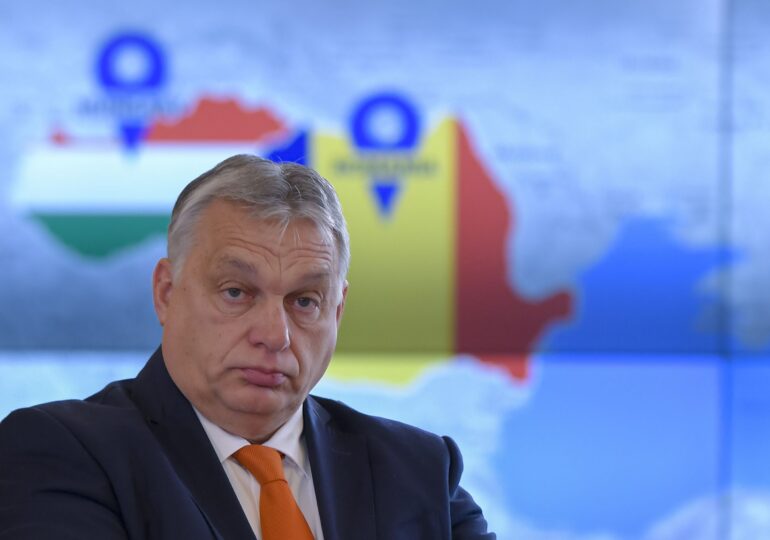
Just before the decisive elections in April, Viktor Orban is facing the most serious political challenge in the last decade. Not from liberals or pro-Europeans, but from within the conservative camp. And one of the episodes that complicated his position is the support given to George Simion in Romania, a delicate moment quickly exploited by his rival Péter Magyar to accuse him of sacrificing the interests of Hungarians outside the borders.
After more than a decade of dominating the political scene in Hungary, Viktor Orban is challenged on the ground that brought him the most victories: nationalism. Ahead of the April elections, his most serious opponent comes from within his own political tradition.
The leader of the conservative opposition, Péter Magyar, a former close associate of the ruling party, managed to turn against the prime minister even the sovereignist and eurosceptic rhetoric promoted by him for years, writes Politico.
"Not the language, but the lies"
Magyar's strategy is not to reject nationalist discourse, but to deconstruct it. He tries to convince the electorate that beyond the slogans about sovereignty and "national interest," Orban's government has delivered too few concrete results.
"We did not turn the nationalist language against him. We turn against him the lies about protecting Hungarian national interests," said Marton Hajdu, the chief of staff of the Tisza party in the European Parliament.
The message seems to resonate. According to Politico's Poll of Polls aggregator, the Tisza party is credited with 49%, while Fidesz, Orban's party, would have only 38% of the voting options at this time.
Minorities outside the borders, the new battleground
One of the most sensitive issues in Hungarian politics is that of Hungarians outside the borders. Over the years, Fidesz has granted them citizenship and voting rights, guaranteed their protection through the Constitution, and funded schools and media in the Hungarian language in neighboring states.
However, Magyar has found gaps in this strategy.
Slovakia and the Beneš Decrees
When the Slovak Prime Minister promoted a law sanctioning criticism of the Beneš Decrees - legislative acts from the period of World War II that led to the withdrawal of citizenship and properties of ethnic Hungarians and Germans from former Czechoslovakia - Orban reacted cautiously.
Magyar, on the other hand, publicly demanded the withdrawal of the measure and accused the prime minister of avoiding confrontation to not affect his political relationship with Bratislava.
Analysts speak of a "strategic compromise": Orban would have preferred to protect the alliance with Robert Fico in relations with Brussels, rather than risk a diplomatic crisis over minority issues.
The Romania Episode: the march to Oradea
Another delicate moment was in Romania, where Orban supported AUR candidate George Simion, despite his controversial background in relation to the Hungarian community.
After Hungarian voters in Romania overwhelmingly voted for Nicușor Dan, Simion's opponent, Magyar organized a symbolic march from Budapest to Oradea, a city with a large ethnic Hungarian population, accusing Orban of betraying the community's interests.
At the same time, the Opposition leader intervened in defense of the Roma minority in Hungary, following insulting statements by a Fidesz official.
Brussels, between hope and caution
In Europe, Magyar's rise is viewed with interest but also with reservations.
After years of confrontations between Budapest and Brussels on the rule of law, migration, or support for Ukraine, some European officials hoped for a clear pro-EU change. However, Magyar does not offer a radical break.
He stated that he does not believe in a "European superstate" and insists that his party is "fully pro-Hungarian." The stated objective: representing Hungary's interests "within the EU, not outside and not against it."
In the European Parliament, the seven MEPs of the Tisza party, members of the European People's Party (EPP) group, were sanctioned after abstaining from the vote of confidence for Ursula von der Leyen.
For six months, they were prohibited from speaking in plenary or holding rapporteur roles.
Magyar reacted by saying that the decision shows that "Tisza politicians have no masters." Orban harshly replied: "Empty seats, empty promises. The fate of Hungary was at stake."
Ukraine and the red line
Regarding the war in Ukraine, Magyar's position remains cautious. He acknowledges Russia as the aggressor, but - like Orban - excludes sending troops or weapons.
His party supports maintaining the border fence, rejects mandatory migrant quotas, opposes Ukraine's accelerated accession to the EU. At the same time, it promises to combat Russian propaganda and strengthen regional cooperation in the Visegrad Group format (Poland, Hungary, Czech Republic, and Slovakia).
A duel on the same vocabulary
Péter Magyar's strategy is not a classic pro-European one, but a reconfiguration of nationalism.
He tries to demonstrate that the issue is not the discourse on sovereignty but how it has been used to cover economic and institutional weaknesses.
For the first time in many years, Viktor Orban is not challenged from outside the ideological framework he has built but from within. And that makes the competition all the more dangerous for the leader from Budapest.