
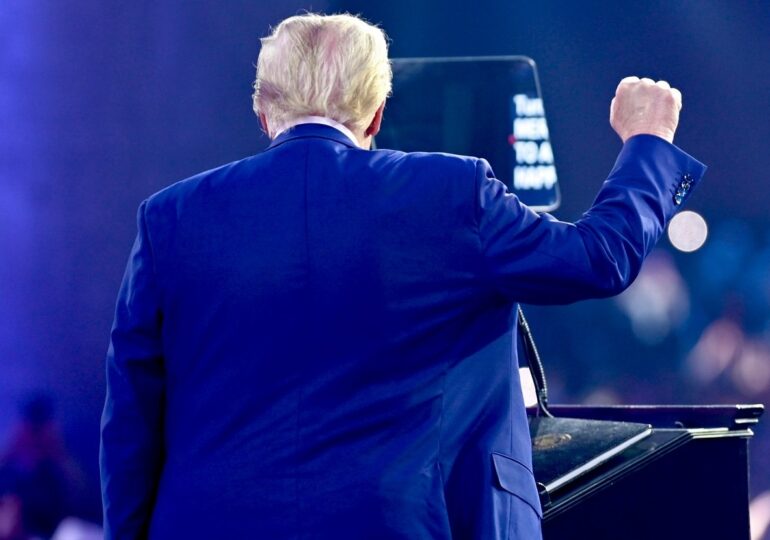
Rates are in effect, then they’re not. Military force is an option… then it’s ruled out. Chaotic behavior and unpredictability have returned to foreign policy circles. In the White House and elsewhere, these seem to be seen as a strategic asset rather than a weakness. But contrary to appearances, it doesn’t help Trump much.
Chaotic behavior in politics is not a new strategy. Violent threats, abrupt policy changes, and intentionally confusing language have long been used to unbalance adversaries and gain an advantage. In fact, the concept has its own name in international relations: it’s called the madman theory.
As highlighted by Cold War strategists Daniel Ellsberg and Thomas Schelling, this theory argues that preparing to take extreme measures can influence an opponent's calculations by amplifying fears of escalation. However, this doesn't help Trump much, as stated in an analysis published in The Conversation.
The 3 conditions for the madman's victory
The madman theory has historical roots dating back to Machiavelli's era, but it is most closely associated with Richard Nixon, who, as the future US president, used the term to explain his approach in trying to force North Vietnam's capitulation in the Vietnam War.
Historians see limited application of this theory in episodes such as Nixon placing the American military on nuclear alert in 1969, which seems to have reinforced Soviet caution, even though it did not lead to the end of the Vietnam War.
The theory was applicable in Nixon's era due to three underlying conditions that existed then.
The first was a lack of information. During the Cold War, data circulated more slowly than it does today and through narrow channels. Messages were filtered by professional diplomats, intelligence analysts, and military officers.
Ambiguity could be sustained then through unpredictable behavior. A country's leader could appear potentially unhinged to avoid being decoded, contextualized, or dissected publicly by adversaries. Signaling the "madman" depended on this controlled opacity.
The second condition was a stable adversary, with a common definition of risk. Nixon's manipulation worked, when it did, because Soviet leaders were deeply conservative risk managers operating within a rigid hierarchy. They feared potential miscalculations, believing they could lead to the collapse of the Soviet Union—or at least their removal from office.
The third condition was credibility built through restraint elsewhere. The madman image has an impact only if it is out of the ordinary. Nixon seemed dangerous to adversaries precisely because the American system appeared normally controlled. His apparently erratic behavior was exceptional in a context of bureaucratic order.
However, the world where these three conditions operated no longer exists.
Why Trump's "madness" doesn't pay off
Today's threats are transmitted on Twitter, reformulated, debunked, ridiculed, and discussed in real time. Unpredictability does not have time to develop and instill public fear. At most, it can degenerate into noise.
And states like Iran, Russia, and China operate in a world they already consider unstable and unfair. Volatility does not scare them; it is the environment they expect. In such conditions, apparent irrationality can invite investigation, risk protection, or mutual escalation.
Therefore, neurotic behavior is no longer exceptional or unexpected on today's global stage. Many madmen wouldn't succeed in their act today.
Unpredictability works only if it's strategic, not conceived on the fly. Trump has made waves, publicly contradicted himself, escalated rhetoric, and then backed down without major concessions.
The more this happens, the more predictability it creates regarding unpredictability. And once unpredictability becomes expected, it loses its coercive force.
This dynamic is evident in how Trump handled both Iran and Greenland. In the case of Tehran, pressure—including military strikes—was applied without clearly defining where escalation would end.
Regarding Greenland, threats of force against an ally only put pressure on NATO without generating compliance.
In neither case did unpredictability translate into a lasting leverage effect. Instead, it generated uncertainty about objectives and limits.
A significant problem for any leader wishing to adopt a mad strategy is that today's international order and media ecosystem are more prone to volatility. Threats no longer freeze adversaries in caution.
Friendly states protect their interests. For example, faced with US tariff threats, India strengthened its ties with China and the European Union.
Meanwhile, adversaries test boundaries. Russia, for example, treated Trump's ambiguous signaling regarding Ukraine almost as a green light to continue its campaign to conquer the Donbas region.
What future does the madman have?
There are certain circumstances in which ambiguity can serve a strategic purpose.
Uncertainty can strengthen deterrence, keeping adversaries cautious. US strategic ambiguity towards Taiwan, for example, leaves it unclear whether Washington would militarily intervene in the event of an attack by Beijing, discouraging automatic escalation.
This direction of the madman approach remains effective. But what no longer works today is volatility on clear objectives and visible limits.
The madman theory was built for a rigid world limited by rules. But it is least effective exactly where today's politics seem most chaotic. And precisely where Trump believes he has the most power.
T.D.