
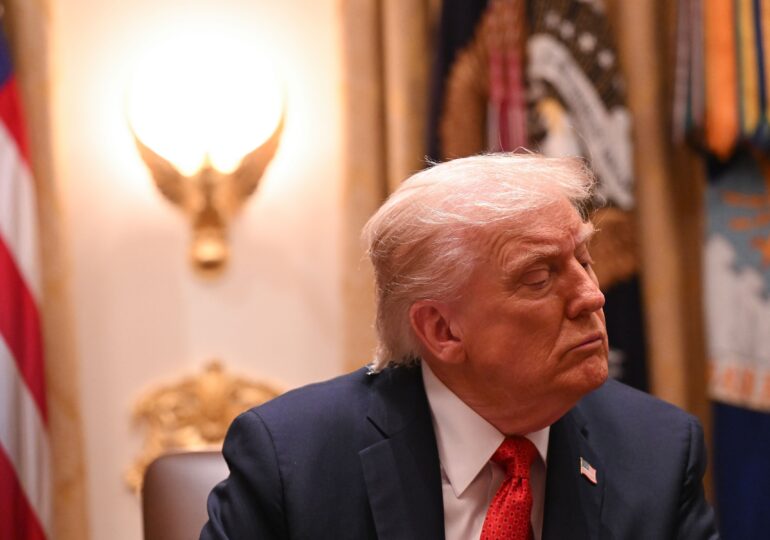
How can you keep track and then understand a president who, in just one year, has published over 6,000 messages on social media, attended over 433 public events, and held free press conferences that lasted, on average, almost two hours?
This is the question posed by Patrick Wintour, editor of The Guardian, in an analysis of the difficulty of conducting foreign policy in an era dominated by the unpredictability of Donald Trump.
The White House stenographers' office estimates that it has transcribed 2.4 million words spoken by Trump – four times the length of Tolstoy's "War and Peace" epic.
Tracking the American president is no longer just a problem for exhausted reporters, but also for Western diplomats who must search for relevant signals in a continuous noise of statements, posts, and public appearances.
Continuous Monitoring Across Different Time Zones
Western diplomats have expanded and refined their media monitoring systems to keep up with Trump's habit of making explosive political announcements or launching unexpected attacks against allies at any moment in the 24/7 news cycle.
Foreign Ministries must pay attention even to the messages posted on Truth Social, the White House chief's preferred platform.
In his first year, Trump posted here 6,606 times. Analyses show that Thursday at midnight, Tuesday at 11:00 a.m., Saturday at 5:00 p.m., and Monday at 11:00 p.m. are the times he most frequently posts – a detail that often puts diplomats in other time zones at a disadvantage.
A diplomat quoted by The Guardian says that the most commonly heard refrain on many mornings is: "What did he say this time?"
156 Posts in One Night
On the night of December 1, Trump posted no less than 156 messages. As on other similar nights, he mixed announcements impacting financial markets with personal praises and conspiracy theories, including the claim that Joe Biden was executed in 2020 and replaced with robots and clones.
For European diplomats, these nocturnal posts are often the most problematic because they reach their phones on the way to work. Last Tuesday, at 6:15 a.m., the British Foreign Ministry discovered that someone – likely Nigel Farage – had tried, through intermediaries, to persuade Trump to denounce the UK's agreement on Diego Garcia Island, a subject Downing Street already considered closed.
A diplomat stationed in the UK says that it has become a skill in itself to translate and filter often incoherent remarks to identify potential foreign policy "pearls" with real consequences.
"You can listen to the speech live at home, and he starts talking about his childhood, about a park near a psychiatric hospital, or about his mother telling him he could have become a professional baseball player. You start to disconnect – you don't want to live in this man's mind – and then you realize you missed something important," the diplomat confessed.
Many of these press conferences are dominated by empty words and self-praise, but there is always a risk that, unexpectedly, Trump will drop a "bomb": from sending an armada to Iran to imposing 100% tariffs on Canada.
Fear of Not Being Boring
Another diplomat recalls the beginning of last week's press conference, in which Trump celebrated the first year since returning to power and spoke for 80 minutes about why America is "the greatest country in the world" before answering questions.
After stating that Somalia "doesn't even look like a country" and that Democratic congresswoman Ilhan Omar is a "scammer" he can't stand, Trump began showing reporters photos of alleged criminals arrested by ICE in Minnesota, each labeled as "the worst of the worst."
What followed was a monologue that jumped from these images to "a nice place in Switzerland" where he was "sure" he was awaited "with great joy," then to Venezuela, to a gift received from opposition leader María Corina Machado – a Nobel Prize medal – and, finally, to the satisfaction of American oil companies with his policies.
"Don't get bored, right?" he asked the audience. "I hope not," he added.
Even in this digression, which betrays Trump's deep fear of appearing boring, diplomats identify relevant clues: the president would be willing to continue collaborating with the Venezuelan government, without completely ruling out Machado, whose symbolic gesture impressed him. Flattery, notes The Guardian, still works.
Fox News, a Recipe for Success
Karen Pierce, former UK Ambassador to Washington, recently explained, when asked about the secret of her good relationship with Trump's team, that she chose to appear as often as possible on Fox News, knowing that this is the channel constantly watched by the president.
Currently, some embassies have diplomats dedicated to monitoring how Fox News presents geopolitics, considering it one of Trump's main sources of information.
"We believe he doesn't read, but if a MAGA commentator says something on Fox, that's where he gets his information," explains a diplomat.
Some Western officials even believe that Trump's threat to impose tariffs on eight European states stemmed solely from his conviction that Europe had sent a reconnaissance mission to begin building Greenland's defense against an American invasion. "If he sees on TV images of a C-130 on a runway in Greenland and a MAGA commentator talks nonsense, you have problems," one of them warns.
Disinformation as a Political Arsenal
Just as he is extremely vulnerable to disinformation, Trump is also a constant source of false information. If fact-checking had become a booming industry in his first term, there is now a tacit acceptance that Trump operates with his own "facts."
However, diplomats cannot ignore them because they are part of an arsenal used to intimidate or pressure rivals.
In a broad passage from his Davos speech, Trump claimed that China sells wind turbines to Europe but excludes them from its own energy mix. "They sell to the stupid people who buy them, but they don't use them themselves," he said, in front of an audience aware that the statement was false. According to the Ember think tank, wind and solar energy accounted for 40% of China's electricity production in April 2025.
However, the statement has a clear political purpose: Trump demanded that the European Union annually purchase $250 billion worth of US oil, liquefied natural gas, and nuclear technologies by 2028.
All of this greatly complicates the work of diplomats. Paradoxically, The Guardian concludes, the further Trump strays from reality, the more valuable diplomats – trained in the art of interpretation – can become.