

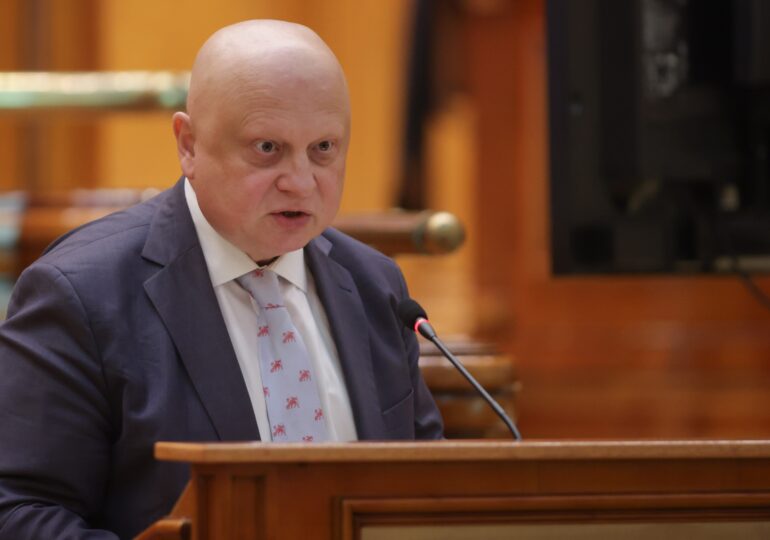
Romania is facing a series of challenges, from the consolidation of the far right to an internal crisis of representation, as well as one related to governance capacity.
Professor Radu Carp analyzed how Romania managed the year 2025 and why populist formations like AUR reached their maximum potential, situated around 40%.
This rise of political extremes is part of a European phenomenon fueled by a huge crisis of representation, generated by social networks.

Representative quotes:
- I have noticed that populist far-right, radical right are becoming increasingly powerful. Parties and candidates supported by them are formidable and can achieve between 30% and 40% in the current political context.
- The main reason for this rise is the crisis of representation. Due to social networks, voters have an increasingly acute feeling that they are not represented by politicians.
- AUR will maintain this 40% as long as it is in the Opposition and will represent the most important voice of the Opposition. The current formula of four [governing] parties is the only antidote to extremism at the moment.
- I observe another very worrying phenomenon: the normalization of AUR-type discourse in society. More and more high-quality individuals are taking up issues related to this type of discourse or even prefer to align themselves very closely with AUR's positions.
- The main challenge for 2026 is the development of the ability to anticipate certain developments and take preventive measures. We are always caught off guard. We still do not have the capacity to correlate data and issue credible warnings to decision-makers.
How did we, as a country, perform in 2025, in the context of having had a round of presidential elections annulled last year, with the negative impact that followed?
If we look back to the end of 2024, Romania's image was very unclear. There was this controversy surrounding the election results. Things were fresh, not yet explained. In 2025, I believe all the necessary clarifications were brought. We had presidential elections, which were held freely, fairly, and we have a legitimate president.
However, at the same time, we noticed that the populist far right, the radical right, is becoming increasingly powerful. We observed that George Simion, the candidate supported by these formations, made it to the second round of the presidential elections in May and performed very well in the first round. So these parties and candidates supported by these parties - AUR, SOS, and POT - are formidable candidates. They can achieve between 30% and 35%, even 40% in any circumstances and especially in the current context.
Do you think there is a trend in Europe where far-right movements are losing ground? I am thinking here of the elections in the Netherlands.
I recently went through a study conducted across the 27 European Union member states. The numbers vary greatly, but the trend from 2019 to 2024 across the entire region is an increase in support for far-right formations. It is not a steep increase, but it is a rise. That is, if these parties were accumulating around 20-25% somewhere, now they are in the range of 25-30%. Around 27.5% was the indicated score at the end of 2024.
This is a concerning thing, the fact that there is such a trend across Europe. Of course, it varies from country to country. And in the Netherlands, the extremist party managed to achieve a very good score, coming in second place. Only a very large mobilization around the liberal party, which is part of Renew Europe, managed to yield a good result. A very old party, but one that has never ranked first. I think in the Netherlands, it was realized that the far right has no solutions.
Moreover, a phenomenon has occurred that may be even more serious than the rise of the far right: the issues promoted by these parties have been integrated by established formations. This happened in the Netherlands. We observed this phenomenon. It also happened in Denmark. The Danish Social Democrats are against migration.
So, on the one hand, we have the rise of these parties, and on the other hand, established parties are contaminated with themes promoted by extremists in order to win elections and form governments.
Do you think the European voter, including the one in Romania, wants to address certain social and economic issues and thus turns to political extremes, because traditional parties have failed to do so? Or, on the contrary, if an established party addresses pressing issues for citizens such as the housing crisis, immigration, access to medical treatment - voters no longer pay attention to extremes and turn back to the center of the political spectrum?
The main reason for the rise of the far right is the crisis of representation. Why? Because currently, due to social networks, voters have an increasingly acute feeling that they are not represented by politicians.
These extremist parties create the sensation that they are better represented because they have candidates who are much more present. We have seen it here as well: Calin Georgescu was omnipresent on TikTok and gave the impression that he was actually engaging with every citizen, with each voter. It's an illusion, but it's an illusion created by social networks.
This crisis of representation is much deeper than it seems. It is common in all countries and will depend heavily on how communication develops on social networks and how a number of rules will be instituted.
These parties use microtargeting, meaning they address a message to each individual. We still don't fully understand how it works, although the European Union has imposed some rules, but many countries have not yet implemented them.
Another problem is that Europe has gone through multiple crises. It went through a financial crisis in 2008 - that was the first wave of these parties positioned at the extreme end of the political spectrum - followed by the pandemic and then the crisis generated by the war in Ukraine.
Prices have risen, social measures could not be taken to offset the increasingly high prices, and obviously, there has been a decrease in quality of life. Parties have emerged that combine both types of extremes. That is, they are extremely conservative parties but propose very socialist social measures.
And you say that this combination of messaging, with elements of far-right combined with leftist elements, this type of discourse is very much related and supported by communication capabilities through social networks?
Yes, absolutely. A Slovenian thinker, Slavoj Zizek, whom I was reading yesterday, said that in the United States, four parties have begun to emerge: the Democrats, the Republicans, the extreme Republicans who are no longer associated with the traditional Republican Party, and respectively, the extreme Democrats who are no longer associated with the Democratic Party. Even in America, the largest democracy where the bipartisan system persists, extreme currents are starting to emerge.
Let us look back a bit at Romania. In the latest polls from the latter part of this year, all in unison show AUR between 35 and 40%. How do you think AUR will evolve in the context of 2026, where economic issues will not disappear, governmental austerity measures will continue, and pressure from Russia will persist?
If we look at sociological data, we observe that the potential of AUR-type parties is at 40%. AUR together with SOS and POT. I believe that, at the moment, AUR has reached its maximum potential.
The good part is that it cannot go above 40% because it no longer has growth potential. The bad part is that it will remain at this 40% as long as it is in the Opposition and will practically represent the most important voice in the Opposition.
I believe this is not well understood by the governing parties. The fact that if one party of the four deserts, AUR will not hesitate to claim to enter the government. I don't think it is very well understood that this formula of four parties is the only antidote to extremism at the moment.
I do not see the situation in Romania suddenly becoming so favorable in 2026 that it would diminish the potential of AUR. Neither to increase, nor to decrease. Normally, if the deficit were to decrease, if people were to see that the purchasing power is starting to increase, they would not think so negatively in general. That's the big stake of 2026: How much can the economy recover in such a way that consumption restarts and there is this feeling that things are heading towards good?
Is there a possibility at this moment to see an alliance, an association between PSD and AUR in an attempt to form a new majority? I ask you this because I have seen that both Sorin Grindeanu, the president of PSD, but also other social-democratic leaders are opposing within the coalition?
Personally, I do not believe this will happen. There are other factors that determine PSD to have a certain position, for example, the party's relationship with external partners, its position in the European Parliament.
Those in charge in PSD have seen what happened to the parties that aligned with extremist groups. They have seen the precedent of Robert Fico from Slovakia, who was a party exactly like PSD in structure and thinking, and who today, although leading Slovakia, has made the country completely isolated, cut off from any European funding, with major protests. So those in PSD, at least at the top, realize this risk and I do not believe that in 2026 they will form an alliance with AUR.
But what can happen is what happened in the case of other social-democratic parties, namely that AUR's themes could be much better internalized by PSD.
The great luck or the great irony is that AUR, in fact, does not emit a coherent set of ideas. If we look at their positions, they are rather reactions regarding Romania's foreign policy. Fewer economic solutions.
I have not seen solutions from AUR that say how exactly economic growth can be generated or how the deficit can be reduced. Fortunately, for democracy in general, AUR does not have much to offer PSD in terms of ideas, ways of governing.