


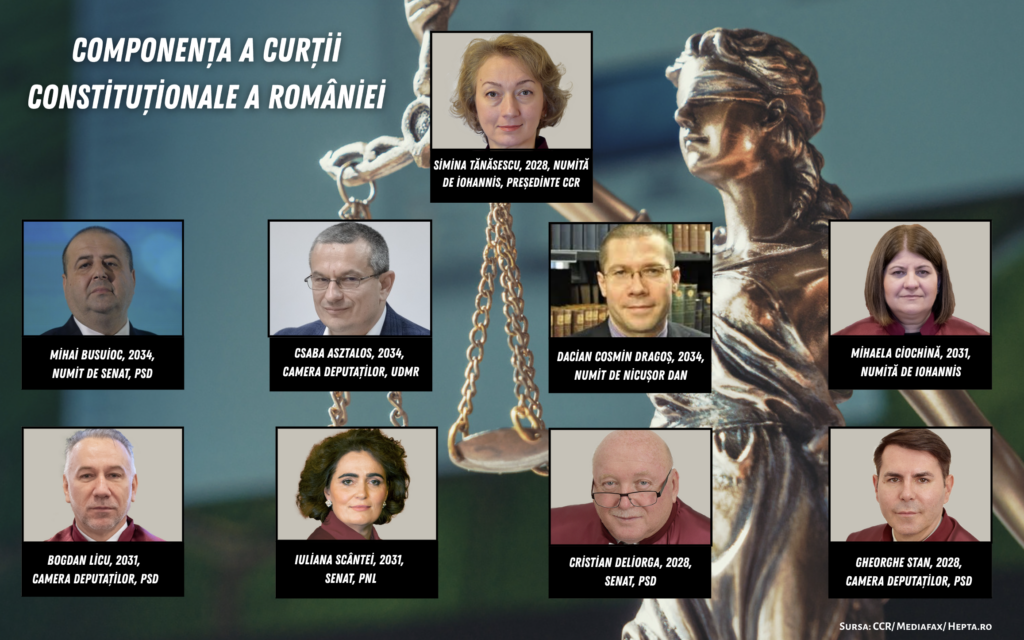
After two months and two weeks, the judges of the Constitutional Court, with a majority of 6-3, according to sources consulted for the writing of this article, have decided that the law on the reform of special pensions for magistrates, adopted by the Romanian Government by assuming responsibility before Parliament, is constitutional.
For almost 80 days, the public opinion witnessed a major confrontation between the political system and the judiciary system, regarding the influence, power, and privileges of magistrates.
The latter were led by Judge Lia Savonea, the President of the High Court of Cassation and Justice, who subordinated the Superior Council of Magistracy, the judges' section, and the Judicial Inspection.
The special pensions of magistrates have been a source of deep dissatisfaction in society because they are not calculated based on the contributory principle, like the rest, they are higher than the average salaries, and magistrates can retire before the age of 50.
The draft law proposed by the Government and adopted by Parliament reduced the pension to 70% of the net salary and increased the retirement age to 65, with a grace period of 15 years. In the next decade and a half, magistrates who meet the seniority conditions can retire based on the old law, meaning earlier.
A False Crisis
The validation of this law by the CCR decision on February 18 has sparked a real fury in the judiciary system controlled by Lia Savonea.
“This new legislative framework will have serious effects on the functioning of the judiciary system,” states an official communication sent by the CSM shortly after the CCR announcement.
“Increasing the retirement age of magistrates again and eliminating the service pension not only risks generating departures from the judiciary system but also transforms the profession of magistrate into an unattractive one for new generations of legal professionals,” the CSM communication further states.
In Romania, every year, between 8,000 and 10,000 young people graduate with a law degree, according to data published by the Ministry of Education.
The most important 6 state law faculties in the country - Bucharest, Cluj, Iași, Timișoara, Sibiu, and Craiova - graduate between 3,000 and 3,500 students each year.
The National Institute of Magistracy announces between 200 and 250 positions for competition each year. The Institute trains prosecutors and judges through a two-year training program (master's degree).
The competition averages over 8 candidates for one position, according to institute data.
There is by no means a shortage of qualified personnel in the field of law, as suggested by the CSM communication, but there is something else.
Precedent
A toxic combination of interests blocks access to the profession of judge and prosecutor, primarily to protect the privileges of those in the judiciary system and, secondly, to provide an important lever for the political system to control the legal one by maintaining a personnel crisis, which has become chronic, despite the fact that thousands of law graduates cannot find work.
“A large deficit of magistrates, a number four times higher than the European average of cases pending in court, and the inability to recruit personnel have constantly been brought to public attention, being ignored by the other branches of government, the only concern shown in this regard being the impact on the magistrate's status,” the CSM communication further states.

SOLUTION. Lawyer Florin Durgheu argues that a potential shortage of magistrates, leaving the system after the CCR decision, can be quickly resolved by hiring experienced legal experts and lawyers - Photo: Facebook/ Constantin Florin Durgheu
In a discussion with lawyer Constantin Florin Durgheu, specialized in criminal law, with nearly three decades of professional experience, he stated that a personnel crisis in the judiciary can be quickly resolved.
“It happened 20 years ago, during the first major reform of the justice system, in the context of Romania's accession to the European Union. Competitions were organized for positions of judges and prosecutors alongside courts and courts of appeal, where legal experts and lawyers with a certain seniority could participate,” declared lawyer Florin Durgheu for spotmedia.ro.
“I believe the same thing can be done now if there is a genuine desire to solve the personnel crisis issue in the judiciary system and the overload of magistrates with too many cases,” the lawyer added.
Public Pressure
The political elite's need to control the justice system has created the monster that Judge Lia Savonea is riding today, causing a real crisis of confidence in Romanian society.
PSD and PNL, the main governing parties in recent decades, concerned with limiting investigations by prosecutors and potential indictments for corruption of political leaders, have acted on three fronts:
- They bought the favor of active magistrates through huge special pensions and rapid retirement;
- They restricted the entry into the profession of young law graduates by filtering them through certain magistrates based on subjective criteria;
- They underfunded the justice system to increase the workload of prosecutors and judges with the immediate effect of prolonging the processes, so that defendants can benefit from statutes of limitations;
Judge Lia Savonea, the current CSM, and the Judicial Inspection are the effects of political action. Through the methods presented above, corruption investigations and massive diversion of public funds have been annulled.
Only the revolt of a large part of public opinion, affected by the constant increase in taxes and duties, against the privileges of magistrates has led to putting a reform of special pensions on the agenda.
Simple, Yet Very Complicated
The CCR decision on February 18 has sparked the fury of Judge Lia Savonea, who always presented herself to magistrates as the defender of their privileges. The decision will have significant effects within the judiciary system.
The Constitutional Court rejected, by a majority of votes, as unfounded, the objection of unconstitutionality raised by the High Court of Cassation and Justice... and found that... the law, as a whole, is constitutional in relation to the criticisms made.
Romanian Constitutional Court, decision February 18
Along with the reduction of special pensions, a real institutional reform is needed to remove Justice from political control to the greatest extent possible.
Also, restraint is needed from political leaders regarding interference in processes and the launch of all kinds of legislative maneuvers to protect their interests from possible actions by magistrates.
But, above all, funding for the justice system is necessary to expedite processes and reduce the professional burden on judges and prosecutors, accompanied by holding them accountable for how they practice their profession. Simple, yet very complicated.