

The United States increasingly resembles North Korea these days – with huge images of the supreme leader sternly scrutinizing citizens and his name inscribed everywhere, from public buildings and street signs to transportation hubs and self-celebratory monuments.
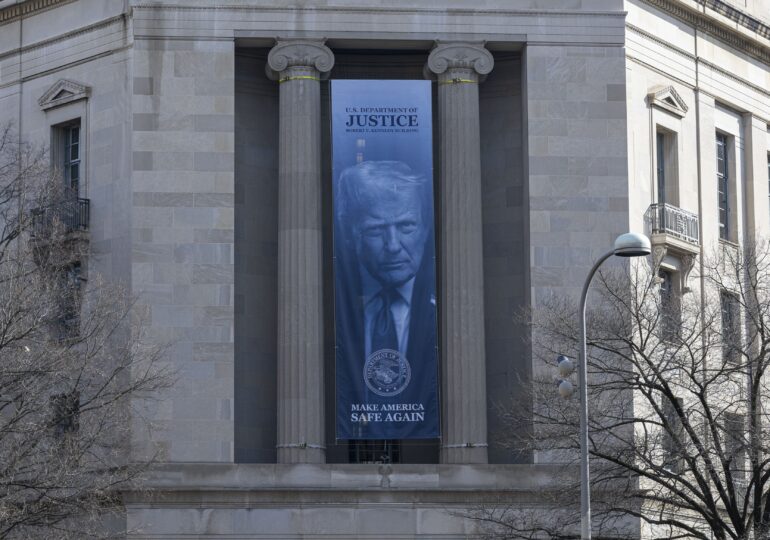
The banner on the Department of Justice building is just the latest example of how President Donald Trump has imposed his presence in the daily lives of Americans.
Last week, a massive banner featuring the face of Donald J. Trump appeared on the facade of the federal Department of Justice headquarters in Washington.
This is just the latest example of how Trump has asserted himself in almost every aspect of American life. Some critics have called the phenomenon "dictator vibes," writes The Guardian.
The banner hangs between two ionic columns that delineate a spacious area, like a balcony, above an ornate entrance to the building.
The building's angle makes this narrow facade unusually visible along Pennsylvania Avenue - the most important symbolic axis of the American capital, connecting the Capitol to the White House.
It is the route followed by inaugural parades and major marches, protests, and displays of state power.
A film director seeking to capture a dystopian vision of American authoritarian fascism would hardly find a more suitable setting to stage a speech or rally led by the great leader. The image is reminiscent of Evita's balcony - an elevated porch under a closed space, with long, vertical lines that focus the gaze on the banner and the president's face.
The proportions of the building, the color of the stone, and the refined classicism of the architecture could serve as a backdrop for the famous speech delivered in 1989 by Romanian autocrat Nicolae Ceaușescu, who shamelessly lied to his people for the last time before being booed, removed from power, and summarily executed by an ad-hoc tribunal, also writes Washington Post.
The placement and composition of the banner suggest a culture of surveillance. Positioned for maximum visibility, the Department of Justice has oriented it to convey the idea of maximum surveillance over the city and, by extension, over the people and the country as a whole.
The blue-gray color makes the president seem like a shadowy presence - or an omnipresence - in contrast to the light associated with the fundamental values of democracy: transparency, openness, and enlightenment.
This shadow's advance has occurred at a shocking pace over the past 13 months.
The president, whose business model is based on branding rather than construction or development, has placed his image not only on buildings but also on National Park Service seasonal passes and coin designs that could be issued (despite a law prohibiting this) by the U.S. Treasury.
The new banner on the Department of Justice building formalizes, at an iconographic level, what is already a reality in practice: the president has turned the institution into a tool for personal political vendettas and partisan reprisals.
As with many developments in the past year, as the country slides deeper into a new era of authoritarianism, there is also an element of dark humor that evokes a complex mix of emotions. A year ago, it all would have seemed absurd; now, processing this absurdity resembles mandatory work, meant to distract the mind and numb the conscience, adds WP.
Democracies do not celebrate their national leaders in such a blatantly hagiographic manner; however, American democracy does so now. As the mind transitions from laughter to indignation and then reluctantly recognizes a new reality, the world of shadows - of control, surveillance, and uncertainty - gains ground in the U.S.
The Impression of Dictatorship
Trump's imposing image seems impossible to avoid throughout America. And impossible to ignore. The Guardian highlights just a few of the places where the president has become omnipresent - or is trying to be - since his return to the White House last year:
Public Buildings
Places where people gather in large numbers - or at least used to - are at the top of Trump's list when it comes to making his face and name visible.
The most prominent example is the John F. Kennedy Center for the Performing Arts, inaugurated in 1971 as a "living memorial" dedicated to the assassinated president.
However, the institution was taken over by Trump associates, who quickly installed him as the head of the board. Ticket sales declined, artists withdrew, and in early February, it was announced that the hall would be closed for two years for "renovation." In December, Trump added his own name to the center - deemed illegal by critics, including some members of the Kennedy family.
The American Institute for Peace was an early casualty of Trump's second-term campaign to cut government spending deemed wasteful.
Similar to the takeover of the Kennedy Center, the old board was ousted, and the Washington headquarters became a shadow of its former self after the majority of employees were fired. In December, engravings appeared, and Trump's name was chiseled into the institute's wall.
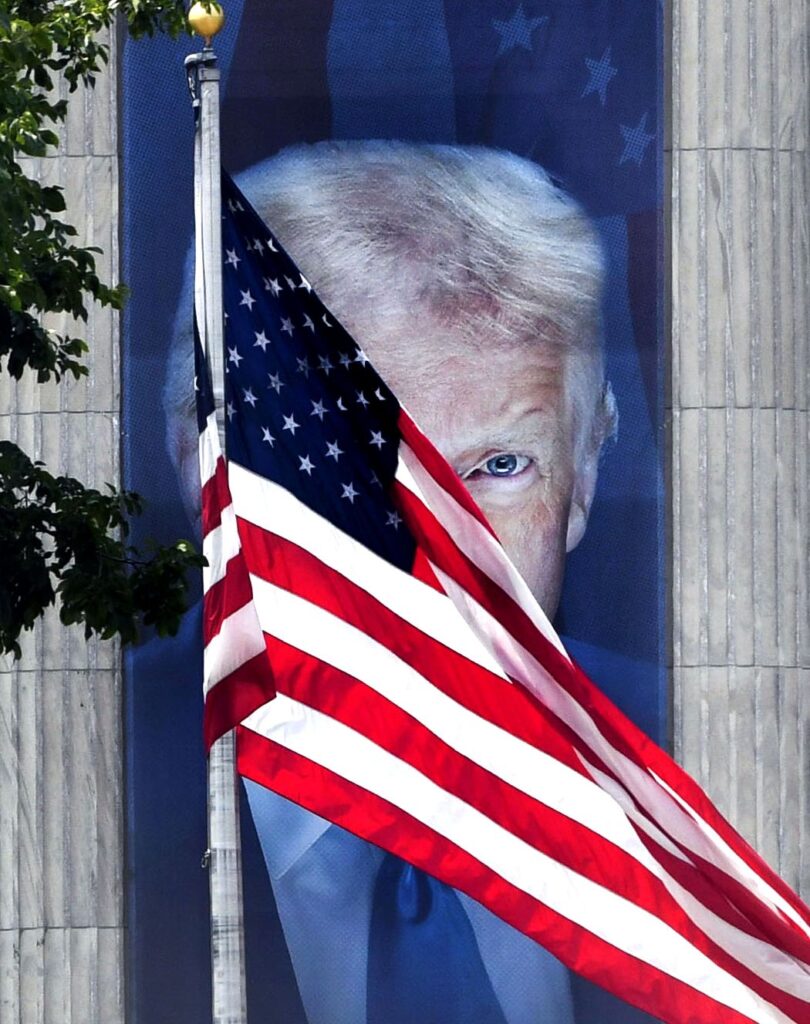
Huge banners featuring Trump's face, nearly identical to the one recently mounted at the Department of Justice, were also placed last year at the Department of Agriculture and the Department of Labor.
Public Transportation
Republican lawmakers in the Florida state legislature voted Tuesday to rename the West Palm Beach airport - where the president frequently flies between the White House and his Mar-a-Lago private club. It will be called the "President Donald J. Trump International Airport."
Just a few days earlier, the Trump Organization applied to register the trademark, opening the door to profitable commercial opportunities and licensing agreements funded by public money, although the company insisted it is not seeking to profit.
Between the airport and Mar-a-Lago, the president is transported on a recently renamed stretch of road, the President Donald J. Trump Boulevard, formerly Southern Boulevard - another gesture of loyalty from Florida's Republican-dominated legislature.
Trump is also eyeing other transportation hubs. Penn Station in New York would be a priority target. Recent reports suggest he would be willing to unlock billions of dollars for a major infrastructure project in the northeast only if Senate Minority Leader Chuck Schumer supports his efforts to rename both the station and Washington Dulles International Airport after himself.
U.S. Military
One of the president's frequent praises is that he has "rebuilt" the American military, transforming it into a leaner and more efficient war machine.
As part of this revitalization, in December, a new "golden fleet" of warships was announced, known as Trump-class destroyers, equipped with hypersonic weapons, high-power lasers, and sea-launched cruise missiles with nuclear payloads.
Stadiums
The new $3.7 billion indoor stadium of the Washington Commanders team, with 65,000 seats and scheduled to open in 2030, is expected to be named Trump Stadium - if the White House's plan is carried out. "This is what the president wants, and it will probably happen," an administration official told ESPN, claiming that Trump made the project possible because the stadium is built on land under the control of the National Park Service.
Not yet happened, but Trump's face could one day be carved on Mount Rushmore, the monument in South Dakota dedicated to the four former presidents: George Washington, Thomas Jefferson, Theodore Roosevelt, and Abraham Lincoln.
A legislative initiative proposed last year by Republican Anna Paulina Luna was not successful. However, the site has long been on Trump's radar, even before his controversial Independence Day speech and fireworks organized there in 2020.
The president's most recent monumental project is a 76-meter-high arch - the so-called "Trump Arch" - which is planned to be built on a plot of land near the Potomac River in Washington DC.
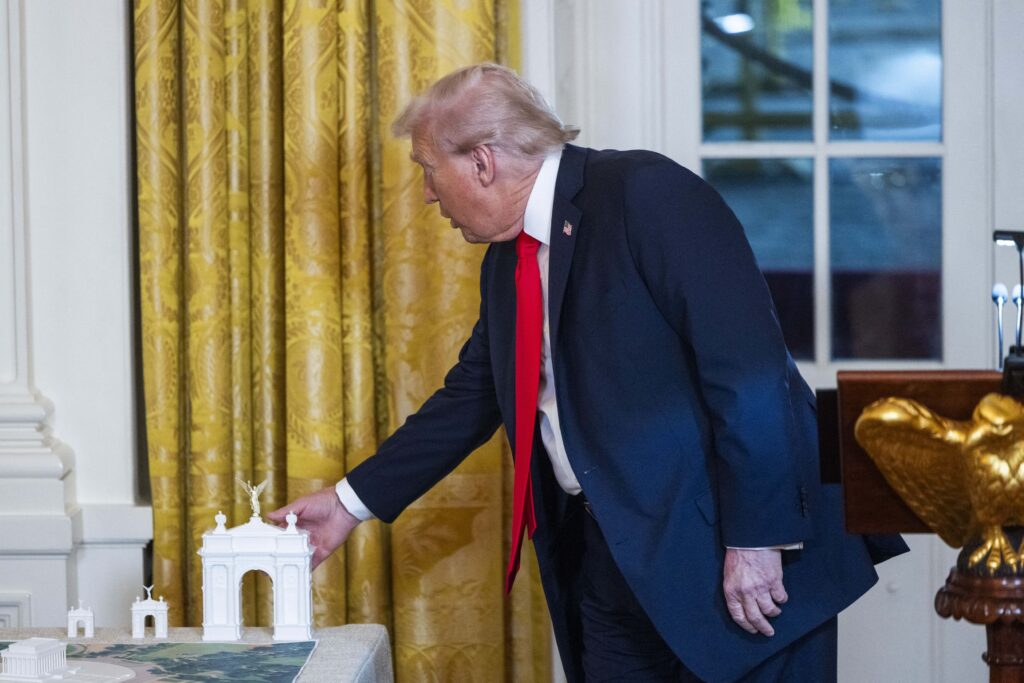
Critics say the project exudes "lifetime dictator vibes," while Trump presents it as an essential component of his domestic policy.