
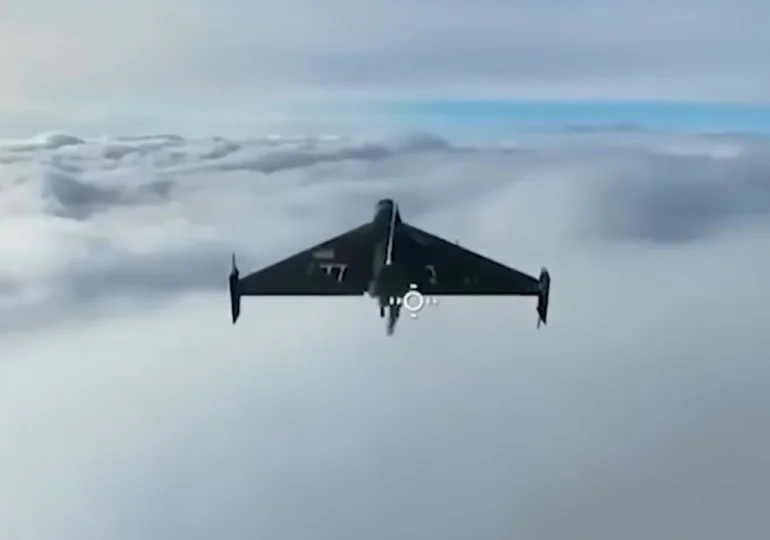
The buzzing sound like a moped of the Geran-2 drones, such as the one that hit a building in Galați Thursday night, has been terrorizing Ukrainian towns for four years. These are, in fact, the Russian version of the Iranian Shahed 136 drone, heavily used in the Gulf War.
Russia operates the drone under the name Geran-2 after importing Iranian HESA Shahed-136 drones since the end of 2022, after which they started producing tens of thousands of drones monthly, in modified versions, in the Alabuga Special Economic Zone in Tatarstan, which has been targeted several times by Ukrainian airstrikes.
Shahed 136 is the same drone that the Iranian armed forces used against Gulf countries allied with the United States. This weapon provides a competitive advantage in war for two reasons: low production cost and difficulty in shooting it down.
What is Geran-2
Shahed-136 is a drone in the "loitering" munition category, with a simple and relatively unsophisticated design: it is guided by a rudimentary computer (which may include semiconductors produced in the West), powered by a two-stroke engine, and has a 55-kilogram warhead at the tip. It is designed to be launched in groups of five from a truck-mounted rack.
For the Russian army, Geran-2 offers a cost-effective means to attack stationary targets and overwhelm Ukrainian air defense, as reported by Kyiv Post.
Unlike traditional military drones, such as the Turkish Bayraktar TB2 or the American MQ-9 Reaper models, the "Geran-2" drones do not return to base, being one-way drones, essentially turning them into cheap projectiles with a long range of action. Russia uses them almost exclusively against Ukrainian cities and civilian targets.
Their speed before impact, at approximately 185 kilometers per hour in flight - lower than that of a missile - has facilitated detection by Ukrainian forces of this type of weapon, capable of destroying four floors of a residential building in a single strike.
The Flying Moped that Kills Ukrainian Civilians
The Ukrainians have nicknamed the Geran-2 drone "moped" due to the strong buzzing produced by its engine, as noted by the cited publication. Ukrainian Telegram channels often issue warnings about "approaching mopeds." Like the British civilians during the German V-1 rocket attacks in World War II, Ukrainians have learned to recognize a faint and distant buzz as a sign of imminent danger.
In fact, in one of the video recordings that captured the incident in Galați, the buzzing of the Russian drone can be clearly heard, resembling that of a moped.
Technical specifications of the Geran-2 drone
- Length: approximately 3.5 meters;
- Wingspan: about 2.5 meters;
- Simple pusher propeller engine;
- Speed: 180–200 km/h;
- Explosive payload: about 40–50 kg, up to 90 kg in newer versions;
- Range: 1,000 - 2,500 km;
- Autonomy: up to 12 hours;
- Cost: €30,000 - €80,000 per unit, depending on version and configuration.
Source: Global Security
An Affordable and Efficient Weapon
Shahed 136 has become a crucial weapon of war for both Russia and Iran. Its very low price compared to the cost of one of the missiles used to intercept it (ranging from $1.1 to $2.3 million) facilitates large-scale production.
Since the beginning of the large-scale invasion of Ukraine in February 2022, Moscow has launched over 60,000 such missiles against Ukrainian territory, an estimate based on monitoring by two analysis centers: the Institute for the Study of War (ISW) and the Center for Strategic and International Studies (CSIS).
Most are neutralized by Ukrainian air defense systems, but some escape - sometimes due to lack of resources or targeting errors, and occasionally because their trajectory poses no risk and it is better to conserve ammunition.
Saturation of military defense shields, however, creates openings for these projectiles, which are lethal when they hit residential areas due to the mix of explosives and fuel they carry. With a height of over three meters, a useful explosive payload of about 50 kilograms, and a range of about 2,000 kilometers, these drones pose a significant challenge for interception: they fly low, slow, and on an irregular trajectory that sometimes appears chaotic.
Until now, defensive batteries were designed to intercept high-speed missiles with less erratic trajectories. "These drones are cheap," said Yasir Atalan from CSIS to El Pais.
"Defense against them with state-of-the-art means, such as fighter jets or advanced surface-to-air missiles, is economically unsustainable in the long term. The cost-benefit ratio favors the attacker if the defender relies exclusively on premium systems," added the expert.
Defense Comes at a High Cost
Kelly A. Grieco, an analyst at the Stimson Center, quantified the effectiveness of these Shahed drones in the Gulf War. In a discussion on the X network, where she analyzed the production costs of attack aircraft and their interceptors, she reached this conclusion: for every euro spent by Iran on drones, the most affected country, the United Arab Emirates, spent between 20 and 28 euros.
"The main lesson (from Ukraine) is the need for layered, low-cost air defense solutions that can absorb massive drone attacks without depleting reserves or budgets," emphasizes Atalan. "Effective counter-drone systems, electronic warfare, more accessible interceptors, and resilient infrastructure must become essential elements of territorial defense planning."
On the front lines, this translates to the need for a shield that combines more or less sophisticated radars, anti-missile batteries, trained fighter jets, as well as dynamic systems to disconnect these aircraft from the network, and ultimately, mobile artillery units. This is what the Ukrainian army has developed, and even so, it cannot counter all the drones that Moscow launches daily against its territory.
T.D.