
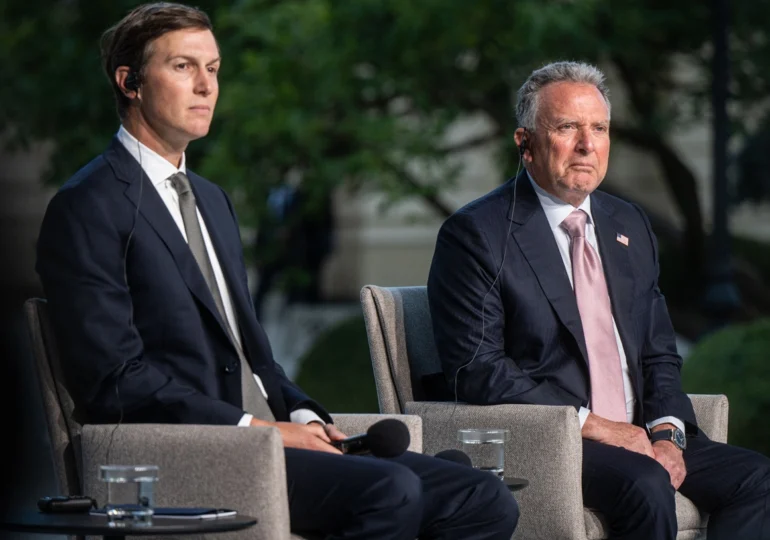
American envoys Witkoff and Kushner met with Putin and Zelensky as part of a new diplomatic initiative, but three former US ambassadors believe there is no evidence of a change in Russia’s attitude. Any potential resolution of the conflict continues to face major divergences regarding territory, security guarantees, and Moscow’s willingness to de-escalate the situation.
The meetings that American envoys Steve Witkoff and Jared Kushner had over the weekend in Moscow and Kiev did not demonstrate, at least for now, that Moscow is ready to change its position.
Witkoff and Kushner met with Russian President Vladimir Putin in Moscow before heading to Kiev for discussions with President Volodymyr Zelensky. Witkoff described the talks as constructive and mentioned that the US heard "new ideas" from Moscow, while Kushner referred to a broader "peace package."
Zelensky described the discussions with the American envoys as "very substantive" and stated that Ukraine is ready to move towards trilateral negotiations involving Kiev, Washington, and Moscow. National security advisers from the UK, France, and Germany also participated in some of the discussions in Kiev.
Three former US ambassadors to Ukraine, contacted by Radio Liberty, welcomed the relaunch of diplomatic efforts on Monday but warned that increased activity should not be mistaken for real progress:
- William Taylor, who served twice as US ambassador to Ukraine, stated that the main obstacle remains Moscow, not Kiev or Washington. He specified that he has not seen any indication suggesting that Putin has abandoned his maximalist claims.
- John Herbst, former US ambassador during the presidency of George W. Bush, described the current initiative as one of the most important American diplomatic initiatives in recent months but noted that it remains unclear if it truly presents anything new.
- Geoffrey Pyatt, who served as US ambassador to Ukraine from 2013 to 2016, welcomed this renewed engagement, emphasizing that the fundamental issue is whether Russia is willing to de-escalate the situation.
What are Russia's "new ideas"?
Witkoff's statement that Moscow presented "new ideas" is one of the most closely watched aspects of the diplomatic efforts this weekend. Neither he nor Kushner publicly explained what these ideas entail, as noted by Kyiv Post.
In William Taylor's view, the decisive test would involve concrete military measures by Russia, including a ceasefire along the current front line, cessation of long-range strikes, attacks on energy infrastructure, and arrangements concerning maritime transport.
In the absence of such measures, the new proposals could simply represent a restatement of Moscow's existing claims.
Additionally, the former ambassadors highlighted that previous indications of Russia's willingness to compromise often did not materialize into tangible results, underscoring the importance of the details of the latest discussions.
A senior US administration official told Radio Liberty that Washington remains optimistic about a new round of negotiations involving Russia and Ukraine.
The American administration will assess the envoys' meetings before deciding on next steps, and the coming weeks could be utilized to develop a more detailed roadmap. Additionally, the UN General Assembly could provide a conducive framework for continuing the discussions.
Two Thorny Issues: Territory and Security Guarantees
Any potential peace agreement should address two major unresolved issues: territory and the future security of Ukraine.
Russia continues to demand territorial concessions from Ukraine, requests that Kiev consistently rejects, while Ukraine maintains that the territories occupied by Russians remain sovereign Ukrainian land.
Taylor suggested that a possible approach could involve recognizing Russia's de facto control over approximately 19% of Ukraine's territory without legally acknowledging Russian sovereignty over those areas. Such a solution would essentially freeze the territorial dispute rather than resolve it, as noted by the Ukrainian publication.
Furthermore, there is no indication that Putin is willing to accept such a framework, William mentioned.
Herbst believes that Russia's objectives extend beyond the territorial sphere. The Kremlin also seeks to exert significant influence over Ukraine's political direction, ambitions that clash with a solution based on Ukraine's sovereignty and independence.
The two parties should also agree on security guarantees. Taylor stated that a credible arrangement could involve the presence of European troops in Ukraine, supported by the US through air capabilities, intelligence, and other resources. He also mentioned Ukraine's subsequent accession to the EU and eventually NATO as elements of its long-term security.
For Kiev, a ceasefire without a credible deterrence capability could only offer a pause before a new Russian attack. At the same time, Moscow is expected to oppose Western security commitments that could bolster Ukraine's defense capacity.
Europe's Role is Growing
The participation of security advisers from the UK, France, and Germany in the discussions in Kiev highlighted an increased role of Europe in the diplomatic process.
Witkoff stated that their presence demonstrated that close cooperation will be essential to reaching a solution. European involvement is particularly important as European countries are likely to play a major role in any security agreement for Ukraine and remain among the primary providers of financial and military support to Kiev, as noted by Taylor.
However, for now, European governments seem to be more involved in consultations rather than official negotiations. Their role could expand based on Washington's proposals and what Moscow is willing to accept.
The discussions are taking place while fighting continues, posing a significant test for the touted diplomatic progress. If Russia and Ukraine fail to show minimal restraint during the negotiations, achieving a broader ceasefire would become much more challenging, the publication writes.
There is Still No Clear Signal from Moscow
Ukraine has already expressed readiness for a new trilateral meeting with Russia and the US. Zelensky stated that Kiev will do everything possible for these discussions to take place.
However, there is still no clear public indication that Putin has agreed to meet with Zelensky and the US president.
For Taylor, this is the key indicator: Washington needs a clear "yes" from Putin confirming that Moscow is ready to engage in such negotiations.
The coming days will show whether concrete details will emerge from the meetings in Moscow and Kiev and how the three parties will react to them, Herbst stated.
Pyatt, in turn, welcomed the US's renewed diplomatic efforts but emphasized that the fundamental obstacle remains Putin's willingness to de-escalate the situation and how he understands what Ukrainians want for the future of their country.
In conclusion, if Russia does not show willingness to make even a small compromise, discussions about peace in any format are futile. And for now, Putin shows no clear sign of wanting to end the war.
T.D.