
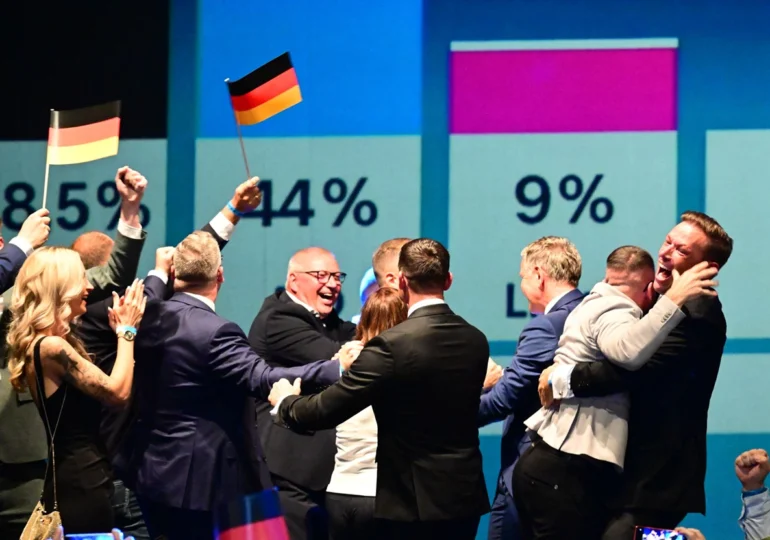
The triumph of the far-right party AfD in the regional elections in Germany has caused a shockwave that reverberated throughout Europe. The result has sparked mixed reactions across the continent: some European leaders have criticized the outcome, while it has been welcomed by certain figures on the right-wing political stage.
The result obtained by AfD in Sunday’s elections in Saxony-Anhalt has generated divergent reactions across the continent, highlighting the increasing gap between the dominant political current (the center establishment) in Europe and the rising populist right, as reported by Euronews.
The Polish Prime Minister, Donald Tusk, has harshly commented on the success of the German extremists. He wrote on the X platform that "only idiots or traitors can rejoice at the triumph of AfD," mentioning in this context members of the populist parties Konfederacja and PiS, as reported by TVP World.
The French government ministers expressed their concern on Monday regarding the impact of the victory of the far-right party "Alternative for Germany" (AfD) in the regional elections in the state of Saxony-Anhalt held on Sunday.
"It is clearly an extremely worrying signal," said the French Finance Minister, Roland Lescure, to the RTL radio station, as reported by Reuters.
Unease in Paris
"This shows that we are facing a major challenge in the face of a populist wave spreading across the world today, which we must resist," Lescure added.
On Sunday evening, the French Minister for European Affairs, Benjamin Haddad, took a similar stance. "The victory of the far-right in the regional elections in Germany marks an extremely serious moment for Europe," he wrote on the X platform.
On the other hand, the Vice Prime Minister and Minister of Foreign Affairs of Italy, Antonio Tajani, tried to temper fears. He described the result as a "worrying sign," but warned against an exaggerated reaction to a regional election.
Orbán's Joy
Viktor Orbán, who was the Prime Minister of Hungary for 16 years before losing power in April, congratulated the AfD leaders, Alice Weidel and Ulrich Siegmund, calling the result a "huge night for Germany and Europe."
"Buckle up. This is just the beginning!" he wrote on X.
The Italian Vice Prime Minister, Matteo Salvini, stated that "another Europe is possible." "Fear? Terror? Danger? No, it's called DEMOCRACY. Another Europe is possible," he wrote.
Santiago Abascal, the leader of the Spanish national-conservative party Vox, welcomed the "spectacular result" of AfD, adding that it brought "great hope for Germany and Europe," while Geert Wilders, the leader of the Party for Freedom in the Netherlands, also conveyed congratulations.
And the leader of the Spanish party Vox, Santiago Abascal, called the result "great hope for Germany and Europe," while Portuguese André Ventura welcomed the "historic" victory of AfD, attributing it to the dissatisfaction of the population with the phenomenon of immigration. Geert Wilders, the leader of the Party for Freedom in the Netherlands, also congratulated AfD on the victory.
AfD's Rise Increases Pressure in Berlin and Brussels
The "Alternative for Germany" party (AfD) placed first in the elections in Saxony-Anhalt, according to exit polls, putting a far-right party in a position to access power at the state level for the first time since World War II.
AfD obtained 43.8% of the votes, nearly double the result from 2021, and will have 39 out of the 83 seats in the new regional parliament. It is only three seats short of an absolute majority. CDU, the party of Chancellor Friedrich Merz, plummeted to 17.2% and 15 seats.
For the first time since the fall of the Third Reich in 1945, a far-right party has achieved such a clear victory in the elections of a German state.
AfD's victory adds even more pressure on the centrist coalition in Berlin, already deeply unpopular. The weakening of the government in Berlin has consequences beyond the country. Germany is the largest economy in the EU and the most important political player in the community bloc, at a time when Europe is trying to simultaneously respond to Russia's war, the trade pressures from the United States, and the increasingly strong competition from China.
The result was closely watched by the European Union. Important elections are expected in France, Italy, Spain, and Poland in the next 12 months, and Brussels fears that formations considered extremist, especially those on the right, could gain ground in several countries.
T.D.