
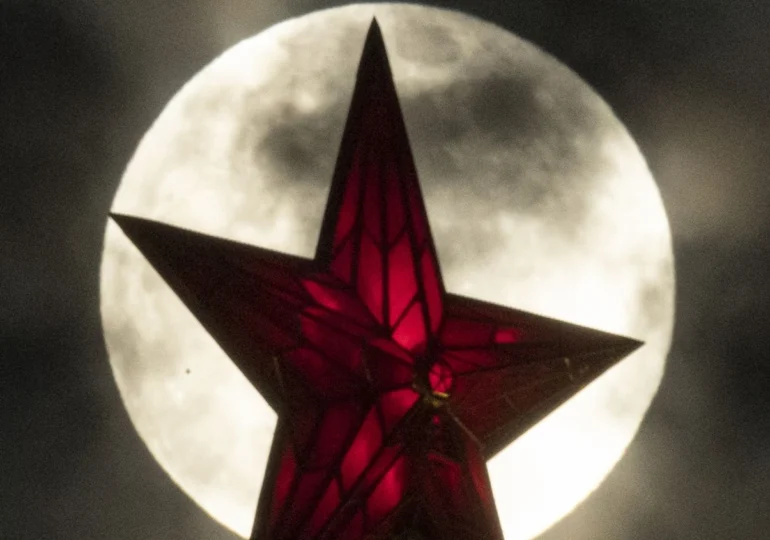
Russian ultranationalists and members of a motorcycle club close to Putin organized a ceremony near the border with Estonia to „baptize” the moon in an Orthodox ritual and „unite” it with Russia. The ritual involved the consecration of a boulder covered with drawings, which the organizers claim dates back to the Bronze Age and comes from space.
The unusual event took place on Sunday at the initiative of Alexander Prokhanov, the president of the Izborsky Club, a state-funded think tank that brings together nationalist and ultra-conservative intellectuals. Among its members is Alexander Dugin, a nationalist political philosopher nicknamed „Putin’s brain,” as reported by Kyiv Post.
Shortly after its establishment, the Izborsky Club issued a statement urging "all statesmen who value Russia's future to act as a patriotic and imperial front" and collaborate for a "return to Christian-Orthodox spirituality and the universality of traditional Russia" to make the country "invincible," as reported by the publication.
The baptism near the border with Estonia also saw the participation of the "Night Wolves," a group of motorcyclists with radical political views whom Vladimir Putin has called "friends."
These motorcyclists supported the annexation of Crimea in 2014 and fought alongside Russia-backed separatists in the Donbas region of eastern Ukraine.
Consecration ceremony of a boulder
According to the independent Russian investigative website Agentstvo, the ritual included the consecration of the Sheglet stone. This is actually a piece of granite covered with petroglyphs from the Bronze Age - a form of symbolic, primitive art usually in the form of inscribed drawings.
A soil sample taken near this boulder was placed at the base of a ceremonial cross, followed by a service and a procession. Demonstrations with a Russian lunar module and an armored military vehicle followed.
"Message from the heavens" for Russia
In a blog post, the leader of the "Night Wolves" group, Alexander Zaldastanov, wrote that the stone has a "celestial origin." Prokhanov called it a "lunar stone" and claimed that it "fell millennia before our era."
"It was a message from the heavens for this land, which later became Russia," he said in an interview with the Russian publication Komsomolskaya Pravda.
T.D.